What Are CenterPoint Energy Delivery Charges?
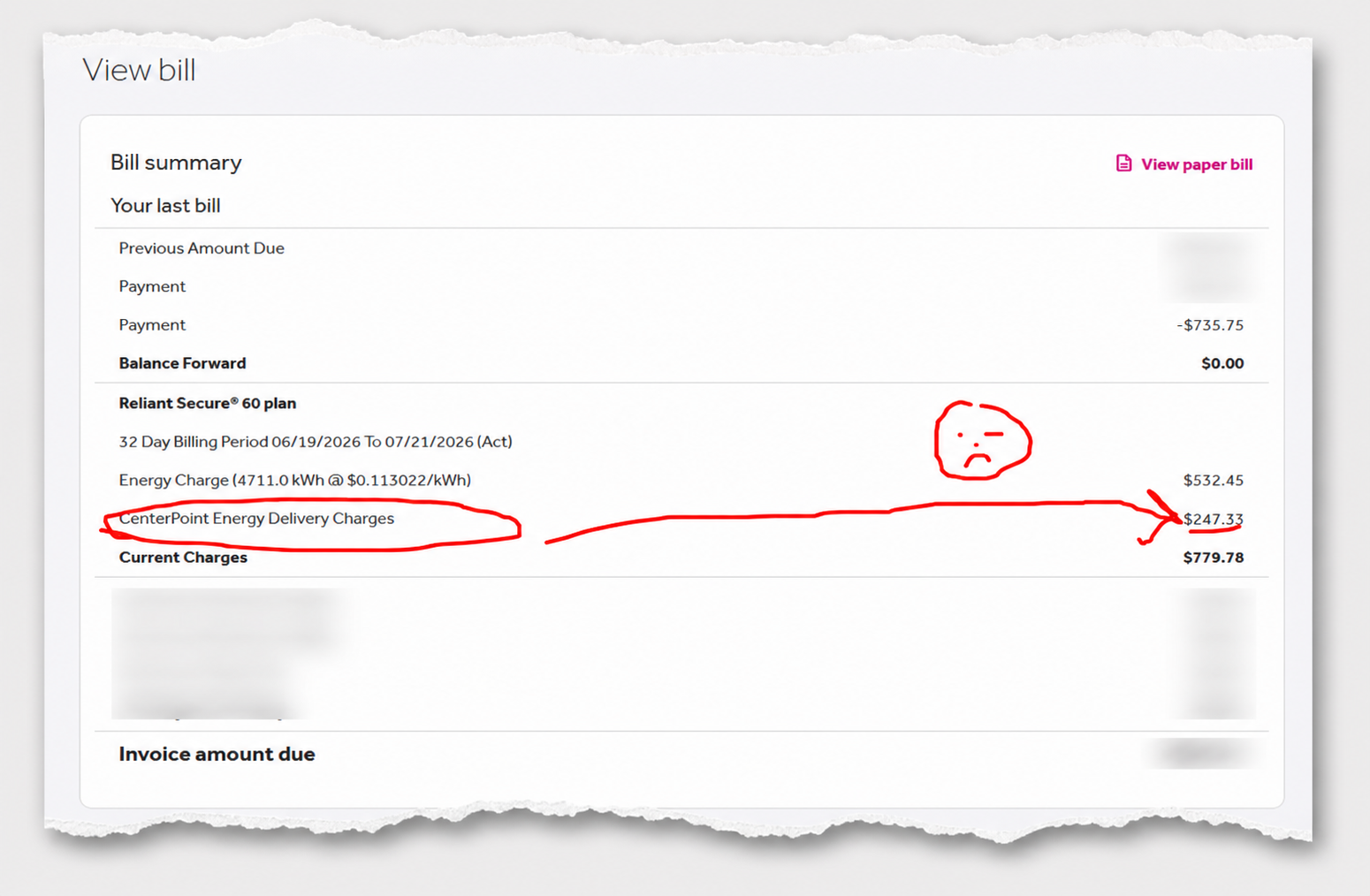
CenterPoint Energy delivery charges are regulated fees you pay for the physical transportation of electricity or natural gas from power plants and pipelines to your home. In Texas, these charges — also called TDU (Transmission and Distribution Utility) fees — are set by the Public Utility Commission of Texas and passed through on your bill without markup by your retail electricity provider. They cover the cost of maintaining the poles, wires, transformers, meters, and infrastructure that make energy delivery possible.
If you have ever opened your electric or gas bill, noticed a line item labeled “TDU Delivery Charges” or “CenterPoint Energy Delivery Charges,” and wondered what it actually means, you are far from alone. CenterPoint Energy delivery charges are one of the most commonly misunderstood components of utility bills across Texas, Indiana, Minnesota, Ohio, Mississippi, and Louisiana — every state where CenterPoint operates.
The confusion makes sense. You chose your electricity provider and signed up for a specific rate, so why is another company charging you on the same bill? The answer lies in how the energy industry is structured, particularly in deregulated markets like Texas, where the company that sells you electricity is not the same company that delivers it to your door.
This guide breaks down exactly what CenterPoint Energy delivery charges are, what they pay for, how much they cost, and whether there is anything you can do to lower them. Whether you are a Houston homeowner trying to make sense of a high electric bill or a Minnesota renter puzzled by your natural gas statement, this article covers your situation.
5 Key Terms Behind CenterPoint Energy Delivery Charges
Why CenterPoint Energy Delivery Charges Exist on Your Bill
To understand CenterPoint Energy delivery charges, you need to understand how Texas restructured its electricity market. In 2002, Texas deregulated retail electricity under Senate Bill 7. The law split the old vertically integrated utilities into two separate functions. Generating and selling electricity became a competitive business open to dozens of retail providers. But delivering electricity — maintaining the physical infrastructure of poles, wires, substations, transformers, and meters — remained a regulated monopoly.
CenterPoint Energy is that regulated monopoly for the Greater Houston metro area. The company does not sell you electricity. It delivers it. Think of it the way online shopping works: you buy a product from a retailer, but a separate shipping company physically transports it to your door. Your REP is the retailer. CenterPoint is the shipping company. And just like shipping costs, CenterPoint’s delivery charges appear on your bill alongside the energy charges from your REP.
This structure means that no matter which retail provider you choose — whether it is Reliant, TXU, Gexa, Green Mountain, or any other company — your CenterPoint Energy delivery charges remain exactly the same. Switching providers changes your energy rate, but it never changes the delivery portion of your bill. The wires, the meter, the lineworkers who restore your power after a storm — all of that stays CenterPoint regardless of who you buy electricity from.
Data Highlight: How Much of Your Bill Is Delivery?
CenterPoint Energy delivery charges typically make up 30% to 40% of a Texas residential electricity bill. For a household using 1,000 kWh per month, delivery charges total approximately $54 to $57 — before any energy charges from your REP are added. CenterPoint currently serves approximately 2.8 million electric customers across a 5,000+ square-mile territory in Greater Houston.
CenterPoint Energy Delivery Charges Breakdown: Fixed vs. Variable Fees
Your CenterPoint Energy delivery charges are split into two distinct components. Understanding each one helps you read your bill accurately and recognize what you can and cannot control.
The Fixed Monthly Charge (Customer + Metering)
The first component is a flat fee assessed every billing cycle regardless of how much electricity you use. This charge covers the cost of maintaining your account, reading your smart meter, and keeping your physical service connection active. You pay this whether you use 50 kWh in a mild month or 3,000 kWh during an August heat wave.
As of the most recent PUCT-approved rates, the fixed monthly charge for standard residential service is approximately $4.90 per month, which breaks down into a $2.11 customer charge and a $2.79 metering charge. Some sources report a slightly higher combined fixed charge depending on the specific tariff snapshot and any active riders, but the figure generally falls in the $4.90 to $5.18 range.
The Variable Per-kWh Delivery Rate
The second — and much larger — component is a per-kilowatt-hour charge applied to every unit of electricity delivered to your home. This variable rate has two sub-components that are rolled together on most bills.
The transmission charge covers the cost of moving high-voltage electricity across long-distance power lines from generating plants to local substations. The distribution charge covers the cost of stepping that voltage down and delivering it through neighborhood-level wires to your meter. Combined, the base variable delivery cost is roughly 4.77¢ to 5.15¢ per kWh before additional riders and surcharges are applied.
Pro Tip: Several additional riders — including the Distribution Cost Recovery Factor (DCRF) for new infrastructure like storm hardening and smart meters, the Transmission Cost of Service (TCOS) for transmission line investments, and an energy efficiency cost recovery factor — are layered on top of the base variable rate. When all active riders are included, the effective all-in delivery rate can reach approximately 8.8¢ to 9.2¢ per kWh, depending on the specific billing month and any in-cycle adjustments.
How CenterPoint Energy Delivery Charges Add Up: Bill Examples
Here is what CenterPoint Energy delivery charges look like at three standard usage levels, based on the PUCT rate report effective June 1, 2026.
? Data Highlight: CenterPoint vs. Other Texas TDUs
As of June 2026, CenterPoint has the lowest delivery cost among the major Texas TDUs at approximately $54.89 per month for 1,000 kWh. By comparison, Oncor (Dallas/Fort Worth) costs approximately $65.26, AEP Texas Central approximately $61.54, and TNMP approximately $80.25 at the same usage level.
When Do CenterPoint Energy Delivery Charges Change?
CenterPoint Energy delivery charges are not static. The PUCT reviews and updates TDU rates on a semi-annual schedule, with changes typically taking effect on March 1 and September 1 of each year. Understanding this schedule helps you anticipate seasonal shifts in your monthly bill — even if your energy rate from your REP is locked in under a fixed-rate contract.
This is an important distinction that trips up many Texas electricity customers. When you sign a fixed-rate electricity plan, you are locking in the energy supply charge from your REP. But the delivery charge is a regulated pass-through cost that fluctuates independently. When TDU rates change on March 1 or September 1, your total bill moves accordingly, even though your “fixed” energy rate stays exactly the same.
On your bill, this adjustment may appear as a separate line item described as “CenterPoint Energy Additional Charge” or simply as an updated per-kWh delivery rate, depending on whether your plan uses bundled or unbundled pricing.
Recent CenterPoint Rate Movements
The March 1, 2026, rate update brought welcome news for Houston-area customers. The PUCT approved a significant 16.7% reduction in CenterPoint’s variable delivery rate, lowering the per-kWh charge to just under 5 cents. This decrease directly translated to savings heading into the high-usage spring and summer seasons. However, the June 1, 2026, update reversed some of that relief with a modest increase to the per-kWh delivery charge, while the fixed monthly charge remained unchanged.
Larger rate adjustments — where CenterPoint asks the PUCT for a substantial increase to recover major infrastructure investment — happen less frequently and require formal regulatory proceedings called rate cases. CenterPoint’s most recent full rate case was Docket No. 51414, and the ongoing CenterPoint resiliency plan may trigger future adjustments as the company invests in storm hardening and grid modernization across Greater Houston.
Struggling to Keep Up With Your Utility Bills?
Explore assistance programs that can help cover electricity, gas, and water costs.
CenterPoint Energy Delivery Charges for Natural Gas Customers
CenterPoint Energy is not just an electric utility. The company is also a major natural gas provider in Minnesota, Indiana, Ohio, Mississippi, and Louisiana. If you receive natural gas service from CenterPoint, your bill contains delivery charges structured differently than the electric TDU model — but the underlying concept is the same.
How Natural Gas Delivery Charges Work
Natural gas customers pay three types of charges on their CenterPoint bill. The basic service charge is a flat monthly fee that covers account maintenance and the cost of keeping your service connection active. The delivery charge is a per-therm fee for transporting gas through CenterPoint’s distribution pipelines to your home. The cost of gas reflects the wholesale price CenterPoint pays for the natural gas itself, passed through to you at cost with no markup.
The basic service charge and delivery charge together make up approximately 50% of a typical residential natural gas bill. The cost of gas — which fluctuates monthly based on wholesale market prices — makes up the other 50%. CenterPoint does not profit from the cost of gas itself. The company earns its revenue from the delivery portion of your bill.
Minnesota Natural Gas Rates
In Minnesota, where CenterPoint serves over 920,000 natural gas customers across more than 260 communities including the Minneapolis–Saint Paul metro area, the company’s most recently approved residential rates set the basic service charge at approximately $9.50 to $11.00 per month and the delivery charge at roughly $0.245 to $0.279 per therm. In June 2025, the Minnesota Public Utilities Commission approved CenterPoint’s rate case settlement for the 2024–2025 period, and the company has been implementing interim rate adjustments while the full rate review continues.
Data Highlight: Minnesota Rate Increases
CenterPoint’s combined interim rate increases for Minnesota in 2024–2025 totaled approximately $101.9 million, or a 7.7% increase. For the average residential customer, this translated to roughly $2.58 to $5.91 per month in higher basic service and delivery charges. These interim rates are subject to refund with interest if the final approved rates come in lower.
Indiana and Ohio Natural Gas Service
Unlike the deregulated Texas market, CenterPoint operates as a fully regulated utility in Indiana and Ohio. This means the company handles both the energy supply and the delivery — you do not shop for a separate retail provider. In Indiana, CenterPoint anchors its operations around the Evansville area, while in Ohio, the company maintains natural gas distribution systems in the west-central region around Dayton. Notably, CenterPoint has been targeting a potential sale of its Ohio gas business by late 2026, so customers in that territory should watch for any changes in their service provider and billing structure.
In these regulated states, delivery charges have seen incremental rate hikes over the past year to fund mandatory safety upgrades on aging natural gas pipelines. While the charges appear on your bill similarly — as a basic service charge plus a per-unit delivery fee — you deal directly with CenterPoint for all billing questions rather than routing through a separate retail provider.
What CenterPoint Energy Delivery Charges Actually Pay For
It is reasonable to ask where your delivery dollars go. CenterPoint Energy delivery charges fund the ongoing cost of operating, maintaining, and modernizing the physical infrastructure that delivers energy to your home. The major categories of spending include the following.
Grid maintenance and repair covers the day-to-day upkeep of poles, wires, transformers, and underground cables across CenterPoint’s territory. This includes routine inspections, equipment replacements, and the lineworkers who respond to outages year-round.
Storm hardening and resiliency is a growing investment category, particularly after the criticism CenterPoint faced following Hurricane Beryl and Winter Storm Uri. CenterPoint is investing in stronger poles, upgraded conductor wire rated for higher wind loads, and strategic undergrounding of power lines in vulnerable corridors. These storm hardening costs are recovered through the DCRF rider that is added to your per-kWh delivery rate.
Smart meter technology supports the advanced metering infrastructure that allows CenterPoint to read your meter remotely, detect outages automatically, and provide real-time usage data to your retail provider. Smart meter investments are recovered through the metering component of your fixed monthly charge.
Vegetation management — commonly known as tree trimming — is essential in Greater Houston, which has one of the largest urban tree canopies in the United States. Trees growing into power lines are one of the leading causes of outages, and CenterPoint maintains an ongoing trimming cycle across its service territory. If you have experienced a CenterPoint Energy outage, it was likely tree-related contact that your delivery charges help prevent.
Transmission infrastructure covers the high-voltage lines and substations that carry electricity from generating plants to local distribution networks. These costs are recovered through the TCOS rider on your delivery charges.
Can You Lower or Avoid CenterPoint Energy Delivery Charges?
The short answer is no — you cannot avoid CenterPoint Energy delivery charges entirely. They are mandatory, regulated fees that apply to every customer in CenterPoint’s service territory, regardless of which retail provider you choose. The only way to change which TDU charges you pay is to physically move to a different service territory.
However, there are several practical strategies you can use to minimize the impact of delivery charges on your total bill.
Reduce Your Overall Usage
Since the largest portion of CenterPoint Energy delivery charges is the per-kWh variable rate, using less electricity directly lowers your delivery costs. Every kilowatt-hour you save reduces both your energy charge from your REP and your delivery charge from CenterPoint. Simple steps like sealing air leaks, upgrading to LED lighting, setting your thermostat to 78°F in summer, and replacing aging appliances with ENERGY STAR models can yield meaningful savings. As a Houston homeowner dealing with $300+ summer electric bills, cutting even 15% of your usage could save you $8 to $10 per month on the delivery portion alone.
Shop Your Energy Rate Strategically
While you cannot change the delivery charge, you can offset its impact by shopping aggressively for the lowest energy rate from your REP. Since delivery charges are identical across all providers, the energy rate is the only variable you control. When comparing plans, always use the EFL (Electricity Facts Label) to see the all-in rate at 500, 1,000, and 2,000 kWh — this includes both the energy and delivery components and gives you an accurate apples-to-apples comparison.
Pro Tip: Watch out for plans that advertise “energy only” or “excluding delivery” rates. These can make a plan appear 4–5¢ per kWh cheaper than it actually is. A rate advertised as 5¢/kWh “energy only” becomes roughly 10–14¢/kWh all-in once CenterPoint delivery charges are added. Always compare using the EFL’s total rate, not the headline number.
Time Your Contract Around Rate Updates
Since TDU delivery rates change on March 1 and September 1, signing or renewing your electricity contract shortly after a rate decrease — such as the March 2026 drop — allows you to benefit from lower delivery charges during the early months of your contract. Conversely, locking in a plan right before a known rate increase means your all-in cost rises shortly after enrollment even though your energy rate stays fixed.
Explore Utility Assistance Programs
If your total electricity bill — including CenterPoint Energy delivery charges — is more than your household can afford, multiple assistance programs exist to help. LIHEAP (the Low-Income Home Energy Assistance Program) provides direct financial assistance to income-eligible households across Texas. The Reliant Energy CARE program offers bill discounts for qualifying customers. And local nonprofits throughout Houston provide emergency utility aid through organizations like BakerRipley and Catholic Charities. You do not need to understand every line item on your bill to qualify for help — you just need to know that help paying your electric bill in Houston is available and apply.
Frequently Asked Questions About CenterPoint Energy Delivery Charges
High Utility Bills? You May Qualify for Assistance
CenterPoint Energy delivery charges are unavoidable — but help with your overall bill is within reach.