What Are CenterPoint Energy Seasonal Rates?
CenterPoint Energy seasonal rates are PUCT-approved delivery charge adjustments that lower the per-kWh TDU fee from March through August when electricity usage peaks, then return it to the standard higher rate from September through February when usage drops. On September 1, 2026, CenterPoint’s per-kWh delivery rate rose from 4.98¢ to 6.41¢, a 28.3% increase. The fixed monthly charge of $4.90 stays the same year-round.
If your September or October electric bill arrived higher than expected, the explanation sits in a single line item: CenterPoint Energy’s TDU delivery charge. Every year, the Public Utility Commission of Texas approves a seasonal rate adjustment that lowers CenterPoint Energy’s per-kWh delivery fee during the March-through-August stretch when Houston’s air conditioners run hardest. When September 1 arrives and usage starts to cool off, the rate returns to its standard level for the next six months.
This cycle repeats every year across every Texas TDU. But the September 2026 jump was sharper than most. CenterPoint’s delivery rate increased 28.3%, from 4.98¢ to 6.41¢ per kWh, while temperatures across Greater Houston stayed well above average through September and into October. Customers who expected lower fall bills instead saw delivery charges climb at the same time usage remained elevated.
At the same time, CenterPoint is deep into the largest grid resilience investment in the company’s history, installing storm-resistant poles, clearing vegetation, and undergrounding power lines across its 12-county territory. This guide breaks down how CenterPoint Energy seasonal rates and winter preparedness efforts affect your bill, what the September 2026 numbers mean, and how the grid is being hardened for winter storms.

Key Terms Behind CenterPoint Energy Seasonal Rates and Winter Preparedness
How CenterPoint Energy Seasonal Rates Work
Texas electricity delivery rates follow a predictable annual cycle. CenterPoint, like every TDU in the ERCOT market, adjusts its per-kWh delivery charge twice a year on a schedule set by the PUCT.
On March 1, the per-kWh delivery rate drops. This lower rate stays in place through August, covering the months when Houston’s electricity consumption peaks due to air conditioning. By spreading the fixed cost of grid maintenance across a higher volume of kilowatt-hours, CenterPoint keeps the per-unit delivery cost lower when your usage is highest.
On September 1, the rate returns to its standard level. Electricity usage in Greater Houston drops during fall and winter because the region relies more on natural gas than electricity for heating. With fewer total kilowatt-hours flowing through the grid, CenterPoint’s delivery costs are divided across a smaller volume, which pushes the per-unit rate higher.
Your retail electricity provider passes this adjustment through on your bill. It appears as a TDU delivery charge or a CenterPoint delivery line item. The adjustment applies identically to every customer in CenterPoint’s territory, no matter which REP you use. Switching providers does not change it. For a deeper breakdown of how these charges work, see our guide to CenterPoint Energy delivery charges.
Pro Tip: The rate change kicks in based on when CenterPoint reads your meter, not when you consumed the electricity. If your meter is read in the first week of September, some of your August usage will be billed at the higher September rate. This is normal and affects every CenterPoint customer during the seasonal transition.
September 2026 CenterPoint Energy Seasonal Rate Impact on Your Bill
The September 1, 2026, adjustment raised CenterPoint’s per-kWh delivery rate from 4.9811¢ to 6.4130¢. That represents a 28.3% increase in the variable delivery component of your bill. The fixed monthly charge held steady at $4.90.
The table below shows what the September rate change means at three standard usage levels.
? Data Highlight: CenterPoint vs. Other Texas TDUs (September 2026)
CenterPoint’s 28.3% September increase was the largest among major Texas TDUs. By comparison, AEP Texas Central’s rate decreased 5.0% and AEP Texas North decreased 4.8%. CenterPoint kept its summer rates lower than other utilities during the March-August period, and the September increase corrects for that gap. Over the full 12-month cycle, CenterPoint’s average delivery cost per kWh remains competitive with other TDUs.
Why the September 2026 Increase Hit Harder Than Usual
Two factors made this year’s adjustment more noticeable. The gap between summer and standard rates was wider than in previous years because CenterPoint’s summer rate had dropped lower (4.98¢) than its historical average. September 2026 temperatures across Greater Houston also ran above normal, which kept air conditioners running longer than a typical September. Higher usage at a higher rate produced bills that looked more like August than October.
If your September or October bill caught you off guard, the delivery charge is almost certainly the reason. Your REP’s energy rate did not change (assuming you have a fixed-rate plan). Only the CenterPoint delivery pass-through moved. This standard rate will remain in place through February 2027, when the next scheduled rate adjustment arrives on March 1.
How to Manage Your Bills During CenterPoint Energy’s Higher-Rate Season
The September-through-February rate period does not have to translate into higher total bills. Your electricity usage drops in fall and winter, so your overall bill can still come in lower than summer even with the higher per-kWh delivery charge. The key is reducing waste during the months when each kilowatt-hour costs more to deliver.
Reduce Usage During Higher-Rate Months
Set your thermostat to 68°F during winter and lower it while you sleep or leave the house. Seal air leaks around windows and doors with weatherstripping or caulking. Replace incandescent bulbs with LEDs. Run your dishwasher and laundry during off-peak hours. Every kilowatt-hour you avoid saves you both the REP energy charge and the higher CenterPoint delivery charge. For more energy-saving strategies, visit CenterPoint’s Resource Hub.
Review Your Electricity Plan
Since CenterPoint’s delivery charge is identical across all providers, your REP’s energy rate is the only variable you control. If your contract is up for renewal during the September-February period, compare plans using the Electricity Facts Label (EFL), which shows the all-in rate at 500, 1,000, and 2,000 kWh. That all-in number already includes CenterPoint’s delivery component. A plan advertised as 5¢/kWh “energy only” becomes roughly 11¢ to 12¢/kWh all-in once CenterPoint delivery charges are added.
Explore Utility Assistance Programs
If your total electricity bill is more than your household can afford, multiple programs help Houston-area families cover energy costs. LIHEAP provides direct bill payment assistance to income-eligible households. BakerRipley administers the Comprehensive Energy Assistance Program (CEAP) for Harris County. The Salvation Army’s Project SHARE helps elderly and disabled residents. You can explore all available options through Houston utility assistance programs or dial 2-1-1 for a referral.
Struggling With Higher Utility Bills This Season?
Programs exist to help Houston-area households cover electricity and gas costs.
CenterPoint Energy Winter Preparedness: How the Grid Is Getting Ready
While seasonal rates affect your wallet, winter preparedness determines whether your power stays on during the storms that hit southeast Texas between November and March. CenterPoint has been rebuilding its grid since Hurricane Beryl knocked out power for 2.3 million customers in July 2024. The work focuses on three priorities: stronger infrastructure, faster restoration, and earlier detection.
? Data Highlight: GHRI Progress as of September 30, 2026
CenterPoint has installed 83,500+ storm-resilient poles rated for 110 to 132 mph winds. Crews have cleared 14,000+ miles of higher-risk vegetation near power lines. The company has undergrounded 900+ miles of power lines and installed 850+ self-healing automation devices that detect and reroute power around faults. Nearly 3,000 crew members are working on GHRI projects across the 12-county territory. CenterPoint projects these improvements will prevent 150 million customer outage minutes in 2026.
Storm-Resilient Poles and Undergrounding
CenterPoint’s pole replacement program is the most visible component of its winter preparedness work. Older wooden poles rated for lower wind speeds are being replaced with stronger composite or steel poles rated to withstand 110 to 132 mph winds. The company’s 2026 target is 35,000 new storm-resilient poles. By end of Q1 alone, crews had installed over 10,000.
Targeted undergrounding moves power lines below ground in corridors where above-ground exposure creates the highest storm risk. Underground lines are immune to wind, falling trees, and ice accumulation. CenterPoint has undergrounded over 900 miles so far and plans to move more than 50% of its system underground through the full Systemwide Resiliency Plan.
Vegetation Management
Falling trees and limbs cause the most storm-related power outages in Greater Houston, which has one of the largest urban tree canopies in the country. CenterPoint has moved to a three-year vegetation management cycle that clears 100% of power lines of hazardous vegetation every three years. As of September 2026, crews had cleared over 14,000 miles of higher-risk vegetation near power lines. If you have experienced a CenterPoint outage, it was likely tree-related contact that this program works to prevent.
Cold Weather Infrastructure Hardening
Winter preparedness goes beyond wind and trees. CenterPoint installs heaters and protective devices on critical electric and natural gas infrastructure to prevent ice damage during freezing events. The company monitors over 100 weather stations across Greater Houston to track approaching cold fronts and trigger pre-storm protocols before conditions deteriorate.
During the January 2026 winter storm, CenterPoint activated its Emergency Operations Center days before the freeze arrived, mobilized 3,300 workers including 600 additional frontline crews, and coordinated with ERCOT and local emergency officials. The CenterPoint Energy Foundation also awarded a $1 million, five-year grant to The Salvation Army to support disaster response across the Greater Houston area.

How to Prepare Your Home for Winter Weather in Greater Houston
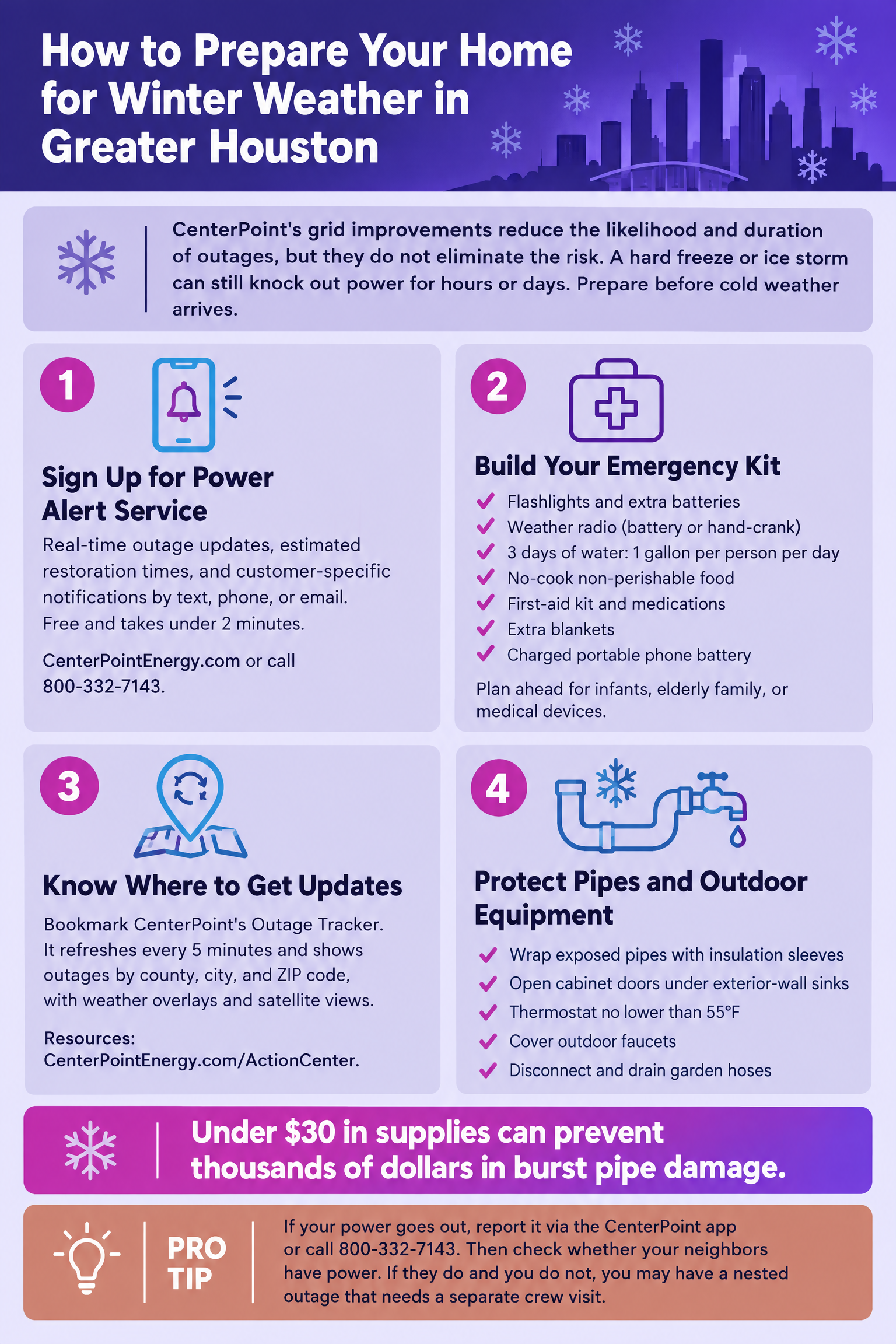
CenterPoint’s grid improvements reduce the likelihood and duration of outages, but they do not eliminate the risk. A hard freeze or ice storm can still knock out power for hours or days. Preparing your household before cold weather arrives puts you in control of the things CenterPoint’s work cannot cover.
Sign Up for CenterPoint Power Alert Service
Power Alert Service sends you real-time outage updates, estimated restoration times, and customer-specific restoration notifications by text, phone, or email. Signing up is free and takes less than two minutes. Enroll at CenterPointEnergy.com or call 800-332-7143. During an outage, the alerts replace the guesswork of refreshing social media for updates.
Build or Refresh Your Emergency Kit
Your emergency supply kit should include flashlights and extra batteries, a battery-powered or hand-crank weather radio, three days of bottled water (one gallon per person per day), non-perishable food that does not require cooking, a first-aid kit, essential medications, extra blankets, and a fully charged portable battery for your phone. As a homeowner with an infant, elderly family member, or someone with a medical device in the home, plan for their specific needs before the first freeze warning arrives.
Know Where to Get Outage and Weather Updates
Bookmark CenterPoint’s Outage Tracker, which refreshes every five minutes and shows outages by county, city, and ZIP code. The tracker includes weather overlays and satellite views to help you understand what is causing outages in your area. For winter weather preparedness resources, visit CenterPoint’s Action Center at CenterPointEnergy.com/ActionCenter.
Protect Your Pipes and Outdoor Equipment
Southeast Texas homes are not built for sustained freezing temperatures. Wrap exposed pipes with insulation sleeves. Open cabinet doors under sinks on exterior walls to let warm air circulate around pipes. Set your thermostat no lower than 55°F if you leave your home during a freeze. Cover outdoor faucets with insulated covers. Disconnect and drain garden hoses. These steps cost less than $30 and can prevent thousands of dollars in burst pipe damage.
Pro Tip: If your power goes out during a winter storm, report the outage through the CenterPoint app or by calling 800-332-7143. Then check whether the outage is isolated to your home or affects your entire street. If your neighbors have power and you do not, you may have a nested outage that requires a separate crew visit to restore.
CenterPoint Energy Seasonal Rates and Winter Preparedness Calendar
Frequently Asked Questions About CenterPoint Energy Seasonal Rates and Winter Preparedness
Higher Rates Through February. Help Is Available Now.
CenterPoint’s standard delivery rate runs through February 2027. If your bills are more than your household can handle, programs exist to help.