What Is a Nested Power Outage?
A nested power outage is a secondary, hidden outage embedded within a larger restoration area. It occurs when an initial outage from a fallen tree or damaged line is repaired and most customers regain service, but a smaller subset of homes downstream of additional, undiscovered damage remains without power. The original outage report masks the secondary one because the utility’s outage map shows the area as restored. Understanding nested power outages is the most common reason a small group of households remain dark while neighbors across the street have their lights back on. Utilities like CenterPoint Energy resolve them by sending follow-up crews to investigate sub-area damage after the main restoration is complete.
Understanding Nested Power Outages After a Major Storm

Few experiences are as frustrating as watching the streetlights come back on across the road while your house, and maybe a handful of others on your block, stays dark. The natural conclusion is that the utility has forgotten about you. The actual explanation is almost always different: you’re caught in a nested power outage. Understanding nested power outages is the single most useful piece of knowledge a household can have when working with a utility through a major restoration event.
Houston’s CenterPoint Energy has popularized the term during major storm responses, including the historic 2024 derecho and Hurricane Beryl events that caused widespread, multi-week outages across the Greater Houston area. As a homeowner caught in the middle of one, this guide walks through exactly what’s happening on the grid, why your situation is different from your neighbor’s, and what utilities are doing in 2026 to make nested outages rarer.
Key Concepts for Understanding Nested Power Outages
The original outage caused by a transmission-line failure, fallen tree on a feeder line, or substation issue. Affects the largest customer count and is what shows up on outage maps first.
A smaller, hidden outage embedded within the larger affected area. Caused by separate damage downstream of the primary outage that goes undetected until the primary repair is complete.
Medium-voltage distribution lines that carry power from substations to neighborhoods. A single feeder line outage can affect hundreds to thousands of customers.
Pole-top or pad-mounted transformers serve as few as one home or as many as a dozen. Transformer-level damage is the most common cause of true single-block nested outages.
The line running from the pole or transformer to your individual home. Damage at this level affects only your house and is the smallest possible nested outage.
Supervisory Control and Data Acquisition and Advanced Metering Infrastructure. These smart grid technologies help utilities identify nested outages earlier through real-time grid telemetry.
How Nested Power Outages Actually Happen: A Layered Breakdown
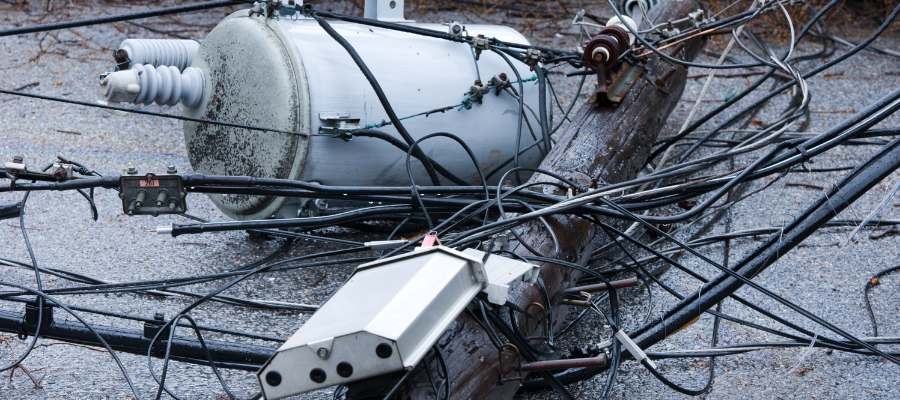
The power distribution network is organized as a hierarchy, and nested outages occur because damage can happen at multiple levels of that hierarchy simultaneously. Electricity is delivered through substations, then through feeder lines, then through transformers, and finally through individual service drops to your home. When a major storm hits, all four levels often sustain damage at the same time.
Stage 1: The primary outage
A tree falls on a high-voltage transmission line or a feeder line near a substation. This single event takes out power for thousands of customers across multiple neighborhoods. The utility’s outage management system registers the event, dispatches crews, and posts an estimated restoration time on the public outage map. Crews focus on this primary repair first because it restores power to the most people.
Stage 2: Restoration with hidden damage
Once the primary feeder is repaired, power flows back through the system. The outage map updates to show the area as restored. Most homes light up. But somewhere downstream of the primary repair, a separate piece of damage exists, a fallen branch on a single block’s wires, a damaged transformer on one street corner, or a service-drop tear at one specific house. The utility’s central monitoring system doesn’t immediately see these because they were masked by the larger outage.
Stage 3: Customer reports surface the nested outages
This is when affected customers call in, report through the utility’s app, or check the outage map and see their address listed as “no outage reported” even though their lights are off. Utilities then dispatch follow-up smaller crews, often called restoration patrol or troubleshooter crews, to track down and repair each nested issue. This phase can extend the total restoration timeline for affected homes by hours to days, even when the rest of the area was restored within the original estimate.
Stage 4: Final repair and verification
For each nested outage, crews must visually inspect, isolate the damaged component, replace or repair it, and re-energize the line. Each nested case requires its own truck, its own crew, its own permit if street access is needed, and its own quality verification. This step-by-step approach is slower per customer than the primary restoration, but it’s the only way to safely identify and fix damage that the initial sweep missed.
CenterPoint Energy serves approximately 2.8 million electric customers across the 12-county Greater Houston area. A typical major-storm restoration touches several hundred thousand homes, and a small percentage of those become nested outages requiring follow-up patrols.
Why Houston Sees More Nested Power Outages Than Most Cities

Several structural factors make the Greater Houston area more susceptible to nested outages than many other major U.S. metros. Understanding nested power outages in Houston specifically means understanding these conditions.
Dense tree canopy
Houston has one of the largest urban tree canopies in the United States. While that’s a quality-of-life win, it means every major storm produces hundreds to thousands of tree-on-line events spread across the service area. Each fallen branch is a potential nested outage waiting to be discovered.
Above-ground distribution
Like most Texas metros, Houston’s distribution network is heavily above-ground, exposing transformers, service drops, and feeder lines directly to wind, ice, and falling debris. Underground systems are more resilient to weather but vastly more expensive to install, so the legacy infrastructure dominates.
Frequent severe weather
Houston is a hurricane-belt city that also experiences regular derecho events, tropical storms, ice events, and the occasional winter freeze. The cumulative effect across years compounds. Every event leaves more weakened poles, brittle trees, and stressed equipment that becomes the seed of future nested outages.
The 2024 derecho and Hurricane Beryl context
The May 2024 derecho and July 2024 Hurricane Beryl produced some of CenterPoint’s most challenging restoration events on record, with peak outages of 2.2 million customers during Beryl. Both events generated extensive nested outage casework, prompting CenterPoint to commit to significant grid hardening investments in 2025-2026, including more underground lines, smart switches, and AI-driven outage detection.
CenterPoint Energy’s Approach to Resolving Nested Power Outages
CenterPoint Energy has invested heavily in restoration protocols specifically designed to reduce nested outage duration. Their published approach includes regular updates on restoration efforts and estimated timelines, areas being prioritized, and potential roadblocks. The company has also publicly committed to leveraging technology and data analytics to streamline its response, analyzing the power grid and its interconnectedness to better understand the extent of nested outages and prioritize accordingly.
The restoration sequence
CenterPoint’s standard restoration sequence prioritizes the largest customer-count outages first. That’s the right call for total social impact, but it’s also why nested outages stretch out: the same crews can’t be everywhere simultaneously, and the smallest cases necessarily wait for the largest ones to be cleared. Critical facilities like hospitals, water treatment plants, and emergency services are restored before residential nested cases.
The outage tracker
CenterPoint’s cloud-based Outage Tracker shows outage events by county, city, and zip code. As a customer, you can enroll in Power Alert Service to receive customer-specific updates via phone, text, or email. If your home is in a nested outage, the alert system pings you directly with estimated restoration times rather than relying on the broader public map.
Mutual aid crews
During major events, CenterPoint pulls in mutual aid crews from utilities across the country. During Winter Storm Enzo in January 2025, the company secured 1,200 mutual aid workers from Virginia, North Carolina, and Florida. These extra hands matter most during the long tail of nested outage cleanup after primary repairs are done.
Author’s Pro TipReport your specific address, not just “still no power.” When you’re caught in a nested outage, the utility’s automated systems may not flag your home individually because the original outage was closed in their system. Call CenterPoint at 800-332-7143 or report through the CenterPoint app with your specific service address and the exact symptoms (whole-house dark vs. half-house dark, lights flickering, etc.). Mention “I’m in a nested outage” by name. This often triggers a troubleshooter dispatch rather than waiting for the next system-wide patrol. Take photos of any visible damage like fallen wires or downed transformers near your property and include them with the report.
— Editorial Team, UtilityAssistanceOnline
Hit With High Bills From a Storm Recovery?
Texas CEAP, Reliant Energy payment extensions, and CenterPoint hardship programs can cover bills spiked by extreme weather events. Find your local assistance options.
Understanding Nested Power Outages in the Age of AI Grid Management

The path to a future with fewer nested outages runs through artificial intelligence and smart grid technology. Two utilities, in particular, have set the bar for the industry on AI-driven outage detection and prevention.
EPB Chattanooga: The smart grid pioneer
The Electric Power Board of Chattanooga, Tennessee, built the largest and fastest “Fiber to the Home” network in North America, then used that fiber to develop one of the most automated electric distribution networks in the country. EPB has deployed automated feeder switches and sensor equipment on 171 distribution circuits in the service territory, plus automation of motor-operated switches on 61 sub-transmission circuits. The result: SAIDI and SAIFI reliability metrics that have improved year over year since the smart grid rollout in 2009. Outages that would have been “nested” in a traditional network are detected at the moment of failure rather than waiting for customer calls.
PG&E: AI-driven outage prediction
Pacific Gas and Electric (PG&E) in California has built an AI-powered analytics platform that helps identify areas with a higher risk of outages before storms even arrive. According to PG&E, the company has operationalized 1,600 weather stations across its service area, 1,400 of which are equipped with AI or advanced machine learning capabilities. PG&E’s in-house meteorologists combine this technology with traditional forecasting tools to develop enhanced outage prediction models, then pre-position crews and troubleshooters in areas where they may need to respond.
What this means for Houston in 2026
CenterPoint has committed to similar AI-driven grid hardening following the 2024 derecho and Hurricane Beryl. While the company is still earlier in its smart grid build than EPB or PG&E, the trajectory is clear: more sensors, more predictive analytics, more automated switching, and ultimately fewer customer-reported nested outages. For Houston households, the practical effect will likely be measurable within the next several major storm seasons.
After Understanding Nested Power Outages, Here’s How to Recover Financially
Extended outages cause direct financial damage even beyond the inconvenience. Spoiled food, hotel stays, missed work, and shock-spike utility bills when service is restored all add up. Several resources can offset that financial hit for Houston-area households.
FEMA disaster relief
If you’ve suffered property damage during a federally declared disaster, apply for FEMA Individual Assistance as soon as possible at disasterassistance.gov or by calling 800-621-3362. FEMA grants can cover temporary housing, home repairs, and other disaster-related expenses not covered by insurance. Federal disaster declarations have followed multiple Houston-area events, including Hurricane Beryl.
Reliant Energy payment extensions
For customers of Reliant Energy struggling with electric bills after a major outage event, Reliant offers payment assistance programs including payment extensions and deferred payment plans. The same programs typically apply during high-bill summer months when air conditioning use spikes following restoration.
Texas LIHEAP (CEAP)
The Texas Comprehensive Energy Assistance Program (CEAP) delivers federal LIHEAP funds to qualified Houston-area households. Apply through Harris County Community Services Department or BakerRipley, depending on which agency serves your zip code. For broader context, see our companion guides on the Texas weatherization assistance program, mastering your utility bills, how weatherization works, and the broader national weatherization assistance program landscape.
Frequently Asked Questions: Understanding Nested Power Outages
Why are my neighbors’ lights on but mine aren’t?
You’re likely in a nested power outage. The primary outage affecting your broader area has been restored, but separate downstream damage near your home, often at the transformer or service-drop level, is still preventing power from reaching your house specifically. Call your utility, report your specific address, and request a troubleshooter dispatch.
How long do nested power outages typically last?
Most nested outages are resolved within a few hours to a few days after the primary outage is closed. The exact timing depends on the type of damage. A simple service-drop tear may be fixed in an hour, while a damaged transformer may take a full day to replace. Major storms can extend nested outage timelines because troubleshooter crews are competing for the same resources across thousands of cases.
Should I report my nested outage even if my area shows as “restored”?
Yes, absolutely. The utility’s automated outage tracking depends on customer reports to detect nested cases that fall through the cracks. Reporting through the utility’s app, web portal, or phone line is the single fastest way to get a troubleshooter dispatched to your home. Include your specific address and any visible damage.
Can I get reimbursed for spoiled food from a nested outage?
In most Texas cases, utilities are not legally required to reimburse spoiled food from weather-related outages. However, your homeowners or renters insurance policy may cover food loss under certain conditions, typically after a deductible. Check your specific policy and document spoiled items with photos. During federally declared disasters, FEMA may also provide some related assistance.
How can I prepare for future nested outages?
Enroll in CenterPoint’s Power Alert Service for customer-specific updates, keep a backup power source for essential devices and medications, maintain a 3-day emergency kit, and document your home’s normal post-storm electrical condition (which appliances work, which don’t) before a major event so you can communicate clearly with troubleshooter crews. Tree trimming around your service drop is also one of the highest-impact preventive measures.
Are nested outages becoming less common over time?
Yes, in the long run. Smart grid investments, AI-driven outage detection, and more sensors on distribution networks are gradually reducing both the number and duration of nested outages. Utilities like EPB Chattanooga and PG&E are 5 to 10 years ahead of the curve, but CenterPoint and other major utilities are now investing heavily following the 2024 storms. Expect measurable improvements through 2026 and beyond.
Recover Faster From Power Outages and Bill Spikes
- Texas CEAP utility bill assistance
- CenterPoint & Reliant payment options
- Free weatherization for income-qualified homes
- Free 2-minute eligibility check