Can Solar Flares Cause Power Outages?
Solar flares themselves do not directly cause power outages, but the coronal mass ejections (CMEs) often paired with them absolutely can. When CMEs collide with Earth’s magnetic field, they generate geomagnetically induced currents (GICs) that can overload transformers, trip protective relays, and cascade into widespread blackouts. The most famous example is the 1989 Quebec blackout, which left 6 million people without power for 9 hours. With Solar Cycle 25 having peaked in October 2024 and elevated activity continuing into 2026, the risk remains real, but modern grid hardening, transformer redesign, and space weather forecasting have dramatically reduced it.
Why “Can Solar Flares Cause Power Outages” Matters in 2026
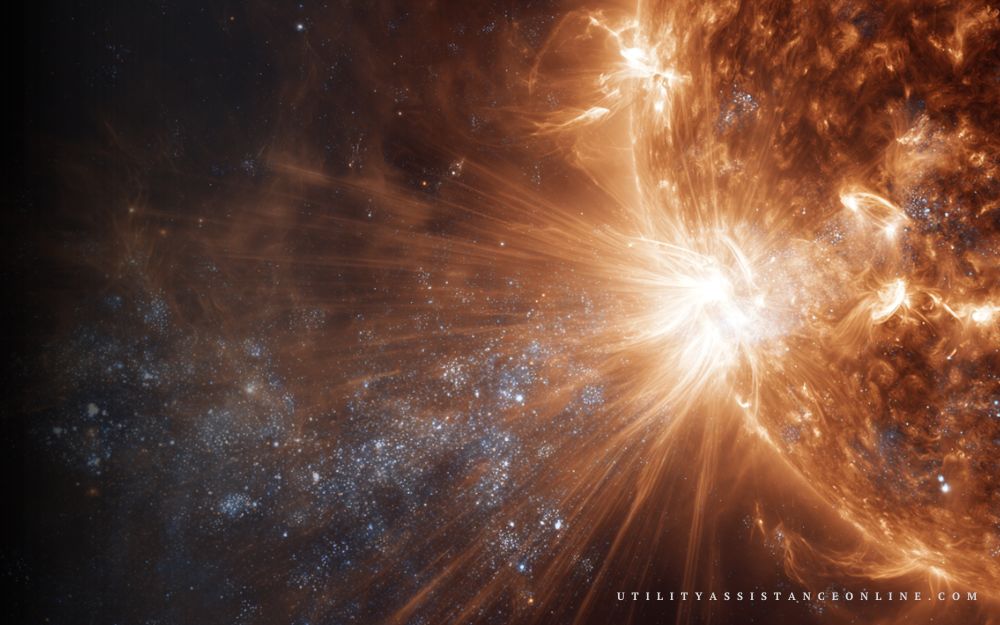
Every few years, headlines warn of a massive solar storm that could wipe out the internet or plunge continents into darkness. The claims are often exaggerated, but they are not entirely fiction. Solar activity, especially large flares and coronal mass ejections, can indeed disrupt power systems and satellites if conditions align. The short answer to “can solar flares cause power outages” is: not directly, but the geomagnetic storms they unleash absolutely can.
As a homeowner or renter concerned about grid reliability, understanding how space weather affects the power grid is more relevant now than at any time in the last two decades. NASA and NOAA confirmed in October 2024 that the Sun reached the maximum phase of Solar Cycle 25, with sunspot activity continuing at elevated levels into 2026. In May 2024, a barrage of large solar flares and CMEs produced the strongest geomagnetic storm at Earth in two decades. This guide explains the science, the real-world risks, and what utilities and governments are doing to protect modern infrastructure.
Key Concepts Behind “Can Solar Flares Cause Power Outages”
Intense bursts of electromagnetic radiation from the Sun’s surface that reach Earth in approximately eight minutes. Classified A through X, with X being the strongest.
Massive clouds of charged plasma and magnetic fields ejected from the Sun’s outer atmosphere, capable of reaching Earth in one to three days.
Electric currents generated by geomagnetic storms that flow through power lines, pipelines, and transformers, potentially causing grid failures.
The current 11-year solar cycle, which peaked in October 2024, with elevated activity continuing through 2026.
NOAA’s Space Weather Prediction Center issues watches, warnings, and alerts on a G1 to G5 scale similar to severe weather bulletins.
The 1859 Carrington Event remains the most powerful solar storm on record, sparking telegraph fires worldwide. It is the benchmark for “worst-case” superstorms.
How Solar Flares and CMEs Actually Cause Power Outages: The Science Explained
Solar flares are explosions of electromagnetic radiation caused by the sudden release of magnetic energy stored in the Sun’s atmosphere. They emit radiation across the entire spectrum from radio waves to X-rays and gamma rays, reaching Earth in approximately eight minutes. NASA classifies solar flares on an A, B, C, M, and X scale, with X-class flares being the most powerful. On October 3, 2024, Solar Cycle 25 released its strongest flare to date, an X9.0.
Coronal mass ejections are enormous clouds of charged particles and magnetic fields hurled from the Sun’s corona. Unlike flares, CMEs travel more slowly, taking one to three days to reach Earth, but they carry immense kinetic and magnetic energy capable of disrupting Earth’s magnetosphere when they arrive. When asking “can solar flares cause power outages,” the actual chain of events runs like this:
- CME impact: A coronal mass ejection strikes Earth’s magnetic field, causing a major geomagnetic disturbance that compresses the magnetosphere.
- Ground currents: The disturbance generates electric currents that flow through the ground and into long-distance transmission lines.
- Transformer overload: High-voltage power lines act like antennas, channeling GICs into transformers that overheat, saturate, or fail.
- Cascading blackout: Protection relays trip, disconnecting grid sections and potentially triggering widespread cascading power failures.
GICs can reach thousands of amperes during intense storms, far exceeding what grid infrastructure is designed to handle. Effects are most pronounced at higher latitudes and in regions with resistive bedrock where ground currents concentrate more intensely.

On March 13, 1989, a massive geomagnetic storm collapsed Quebec’s power grid within 90 seconds, leaving 6 million people without electricity for 9 hours. It remains the most well-documented example of how a solar event can directly take down a regional grid.
Historical Proof: Can Solar Flares Cause Power Outages? Yes, and Here’s When
The 1989 Quebec Blackout
On March 13, 1989, a massive geomagnetic storm struck North America. Within 90 seconds, Quebec’s power grid collapsed, leaving 6 million people without electricity for 9 hours. The cause was GICs that overwhelmed and tripped Hydro-Quebec’s protective relays, causing a cascading failure that shut down the entire network. The same storm damaged a transformer in New Jersey and disrupted radio communications and satellite operations across the continent. NASA called it a wake-up call for modern technology, and it remains one of the most studied examples of how space weather can directly impact critical infrastructure on Earth.
The 1859 Carrington Event
The Carrington Event of 1859 remains the most powerful solar storm ever recorded. Telegraph systems across North America and Europe sparked and caught fire, and some operators reported being able to send messages with their batteries disconnected, powered entirely by the storm’s induced currents. Auroras lit the night sky as far south as the Caribbean and Colombia, so bright that gold miners in the Rocky Mountains mistook them for dawn and began preparing breakfast. If a Carrington-level event struck today, a 2013 Lloyd’s of London study estimated potential U.S. damages between $600 billion and $2.6 trillion.
The May 2024 G5 Storm
In May 2024, NASA’s Solar Dynamics Observatory observed 82 notable solar flares between May 3 and May 9, with 9 categorized as X-class. The resulting geomagnetic storm reached G5 (Extreme) intensity, the first since 2003. It was the strongest geomagnetic storm at Earth in two decades, producing spectacular aurora displays visible as far south as Puerto Rico. Yet modern grid resilience kept widespread blackouts at bay. The contrast with 1989 demonstrates how much grid hardening has improved in 35 years.
NOAA’s G1-G5 Storm Scale: When Solar Flares Cause Power Outages
NOAA tracks over 100 geomagnetic disturbances per year, but only a handful reach strong or severe classifications. The May 2024 event was the first G5 storm in 21 years, underscoring how rare top-tier events actually are.
Author’s Pro TipEven if a solar superstorm never hits, the same preparedness steps protect you from ice storms, hurricanes, and heat waves. Invest in whole-home surge protectors, keep battery backups for essential devices and medications, and familiarize yourself with your local weatherization assistance programs that can make your home more resilient year-round. Households that prepare for one type of grid disruption are dramatically better positioned for any of them.
— Editorial Team, UtilityAssistanceOnline
Worried About Power Grid Vulnerability?
Whether the threat is a solar storm, winter weather, or aging infrastructure, the steps you can take to protect your household are the same. Find energy assistance and weatherization programs in your state.
How the Grid Is Being Hardened So Solar Flares Cause Fewer Power Outages

Utilities, governments, and scientists are far better prepared than they were in 1989. Decades of research and investment have produced multiple layers of defense against geomagnetic storm impacts. As a homeowner concerned about grid vulnerability, here is what is actually being done.
Space weather monitoring and early warnings
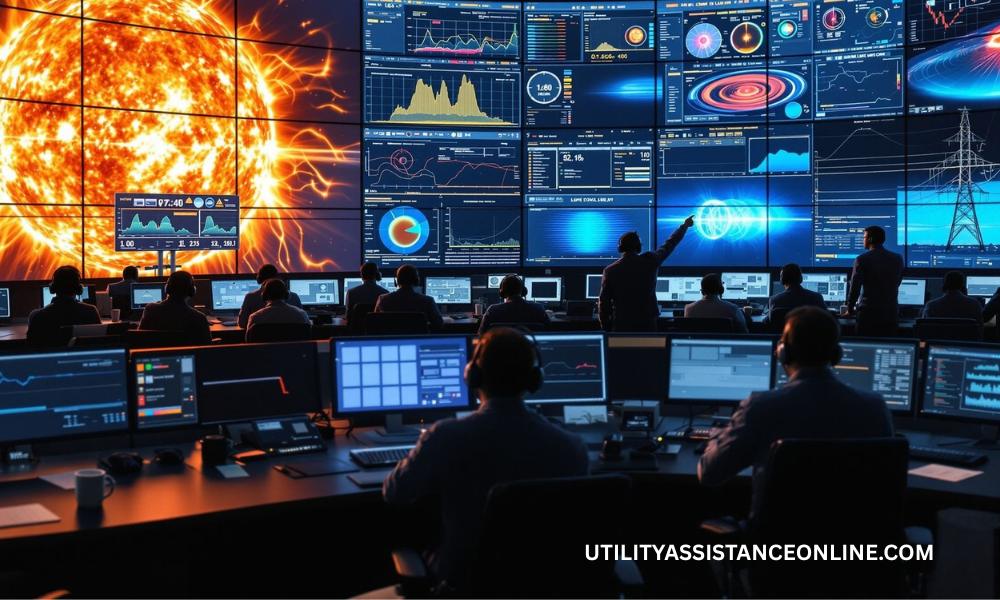
Satellites like NOAA’s Deep Space Climate Observatory (DSCOVR), positioned at the L1 Lagrange point approximately one million miles from Earth, provide real-time solar wind data that gives grid operators 15 to 60 minutes of advance warning before a CME impact. NASA’s Parker Solar Probe and the Solar Dynamics Observatory provide additional upstream monitoring. This window, while brief, is enough time for utilities to implement protective measures.
Grid grounding and automated response systems
Modern utilities now deploy sophisticated grounding systems and automated controls designed to redirect geomagnetically induced currents safely away from vulnerable equipment, preventing transformer overloads before they cascade into wider failures. Many North American grid operators have written GIC response protocols into their standard operating procedures.
Improved transformer design
Research from the Electric Power Research Institute (EPRI) and the U.S. Department of Energy has driven the development of transformers that resist magnetic saturation and incorporate neutral blocking devices to limit the flow of harmful DC-like currents during geomagnetic events. These next-generation transformers are gradually being deployed across the most vulnerable segments of the national grid, prioritizing the Eastern and Midwestern United States where geological conditions amplify ground-level currents.
Forecasting and operational resilience
When severe space weather is forecast, utilities can take precautionary actions such as reducing loads, rerouting power flows, delaying scheduled maintenance, and pre-positioning repair crews to keep systems stable during geomagnetic storms. These operational protocols have matured significantly since the 1989 Quebec event and are now standard practice across North American grid operators.
Can Solar Flares Cause Power Outages at Your House? Practical Preparedness Steps

You cannot stop a coronal mass ejection, but you can take practical steps to protect your home and family from the power disruptions that solar storms and many other natural events can cause. As a homeowner, prioritize:
- Follow real-time alerts from NOAA’s Space Weather Prediction Center at swpc.noaa.gov, which issues watches and warnings similar to severe weather bulletins.
- Install whole-home surge protectors on your electrical panel and use surge-protected outlets for sensitive electronics like computers, TVs, and medical equipment.
- Maintain backup power through battery systems, solar-charged power stations, or a properly installed generator. Even a small uninterruptible power supply (UPS) can keep essential devices running through short outages.
- Stock an emergency kit with flashlights, batteries, a hand-cranked or battery-powered NOAA Weather Radio, non-perishable food, drinking water, and any prescription medications.
- Pursue home weatherization upgrades through your state’s weatherization assistance programs to reduce your overall dependence on grid power and improve resilience.
- Know your utility’s restoration plan by enrolling in outage alerts and reviewing your utility bill provider’s emergency procedures ahead of time.
For broader home resilience, see our companion guides on how weatherization works and 5 ways to make an old home energy efficient.
Frequently Asked Questions: Can Solar Flares Cause Power Outages?
Can solar flares directly damage home electronics?
No, not directly. Solar flares release radiation, but Earth’s atmosphere blocks most of it. The indirect threat comes from geomagnetically induced currents that can overload power systems. Voltage spikes caused by GIC-related transformer issues could damage sensitive electronics connected to the grid, which is why whole-home surge protectors provide an important layer of defense.
How long could a solar flare-related blackout last?
It depends on the storm’s intensity and local infrastructure resilience. Minor disruptions may last hours, while severe events could take days or weeks to fully restore if high-voltage transformers are damaged or destroyed. Custom extra-high-voltage transformers can take 12 to 18 months to manufacture and install, which is why prevention and hardening are critical.
How do scientists predict solar flares and geomagnetic storms?
NASA and NOAA use a network of solar observatories and space-based satellites, including the Solar Dynamics Observatory and DSCOVR, to monitor magnetic field changes, sunspot activity, and solar wind conditions. These data points serve as early indicators of potential flares or Earth-directed CMEs, typically providing 15 to 60 minutes of lead time before impact.
Has Solar Cycle 25 already peaked?
Yes. NASA and NOAA officially announced on October 15, 2024, that the Sun had reached the maximum phase of Solar Cycle 25. According to subsequent analysis, the smoothed sunspot number peaked in October 2024 at approximately 161. Elevated solar activity continues through 2026, however, and another secondary maximum remains possible.
What should I do if a severe geomagnetic storm is forecast?
Charge all essential devices, ensure backup power sources are ready, unplug sensitive electronics, fill bathtubs and containers with water in case water pumps lose power, and monitor NOAA’s Space Weather Prediction Center for real-time updates. Having an emergency kit with flashlights, batteries, and a battery-powered NOAA Weather Radio is also recommended.
Can solar storms affect my cell phone service?
Solar storms primarily affect high-frequency radio communications and GPS accuracy rather than cellular networks directly. However, if a severe storm causes widespread power grid failures, cell towers could lose power and go offline. Most major carriers maintain backup generators, but extended outages could eventually exhaust those reserves.
Don’t Wait for the Next Storm to Prepare
- Explore weatherization and energy assistance programs
- Learn how to protect your home from outages
- Access energy efficiency upgrades and rebates
- Free 2-minute eligibility check
Find Energy Assistance Near You