Home Blog Page 5

AIO Food and Energy Assistance Snags $10,000 Boost—How This Award is Changing Lives

0

When a community organization receives a boost through community financial assistance, it’s more than a transaction—it’s a ripple of hope that transforms lives. AIO Food and Energy Assistance recently received a $10,000 award—a sum that’s not just about funding but about stories of lives changed, mouths fed, and homes warmed. This support represents more than numbers—it’s the heart of a community lifting itself. Imagine families resting easy, knowing that warmth and nourishment are within reach. Let’s explore how this organization is turning generosity into lasting impact.

The Impact of Financial Support on Community Initiatives

Community volunteers delivering groceries and heating supplies to a family as part of AIO Food and Energy Assistance’s outreach program.

AIO Food and Energy Assistance, a cornerstone of local resilience, works to reduce food insecurity and provide reliable energy support to those struggling to make ends meet. Through community financial assistance, the organization strengthens its capacity to serve more families and meet urgent needs head-on.

  • Expanded Food Programs: The additional funding helps AIO widen its reach, ensuring more families have consistent access to nutritious food. Each expansion reduces the number of individuals going to bed hungry—a major win in the fight against food insecurity.
  • Enhanced Energy Assistance: The financial boost allows AIO to help more households manage heating and energy bills during cold months. Beyond warmth, this means protection for the health and dignity of vulnerable residents.
  • Community Outreach Initiatives: With more resources, AIO can raise awareness about its programs, ensuring that people who need help most actually find it. Outreach becomes a bridge between need and support.

“Financial contributions empower us to touch more lives in meaningful ways,” says AIO’s director of operations. “Every dollar transforms into hope and warmth.”

Trust and Transparency in Delivering Assistance

Transparency and accountability are essential to any community financial assistance effort. AIO ensures every dollar is used effectively to serve those in greatest need, reinforcing public confidence and long-term donor relationships.

  • Clear Impact Reporting: Regular updates show exactly how funds are used, providing transparency that strengthens trust between the organization and its supporters.
  • Partnerships with Local Entities: Collaborations with local businesses, health organizations, and civic groups extend program reach and maximize impact.
  • Feedback and Continuous Improvement: AIO actively listens to the community, adapting programs to meet changing needs—ensuring support always aligns with real challenges.

This strong commitment to accountability ensures that AIO remains a trusted steward of community funds and a model for sustainable assistance.

Statistical Insights into Program Success

AIO’s success isn’t just visible—it’s measurable. Through data-driven strategies, the organization demonstrates how effective community financial assistance can be in driving meaningful change.

Program Aspect Impact Statistics
Meals Distributed 50,000 annually
Families Assisted 3,500 per year
Energy Bills Covered 2,000 homes supported
Community Workshops 250 conducted annually

These figures go beyond metrics—they represent full bellies, warm homes, and renewed hope for thousands of people who rely on AIO’s ongoing commitment to community care.

Nonprofit staff analyzing data on meals delivered and energy assistance provided as part of AIO’s transparency and accountability efforts.

The Role of Community Support in Sustained Impact

The heart of any community financial assistance effort lies within the people who support it. Volunteers, advocates, and local leaders work alongside AIO to strengthen its mission and widen its impact.

  • Volunteer Engagement: Volunteers form the backbone of AIO’s daily operations. Their time and compassion ensure that essential resources reach those who need them most.
  • Local Advocacy: Community leaders play a vital role by influencing policies that make programs like AIO’s more accessible and far-reaching.
  • Cultural Competency: By understanding the cultural fabric of the community, AIO tailors services that truly resonate with diverse groups—strengthening trust and connection.

“It’s a symbiotic relationship where community support fuels our efforts, while we, in turn, nurture this community,” shares a senior AIO program manager.

Taking Action: Individual and Collective Steps

Every person can play a role in advancing community financial assistance efforts that improve lives. Whether you’re a concerned citizen, a local business, or a civic group, your involvement makes a measurable difference.

  1. Donate: Financial contributions expand AIO’s reach and capacity to serve. Every dollar fuels tangible change in the community.
  2. Volunteer: Giving your time builds empathy and offers direct insight into both challenges and triumphs within the community.
  3. Advocate: Spread the word about AIO’s programs and encourage others to get involved. Collective advocacy drives awareness and action.

Each act of generosity—whether time, money, or advocacy—helps transform short-term relief into long-term empowerment.

Conclusion

The $10,000 award to AIO Food and Energy Assistance is more than a financial milestone—it’s a testament to the power of community financial assistance. This support fuels initiatives that provide warmth, nourishment, and hope to families who need it most. By addressing essential needs and building sustainable systems of care, AIO strengthens not only individual lives but the community as a whole. Understanding the role of financial aid in creating resilience reminds us all that when we invest in people, we invest in a stronger, more compassionate future for everyone.

 

Can Solar Flares Cause Power Outages? The Science, the Risk, and How the Grid Is Defending Itself in 2026

0
Quick Answer

Can Solar Flares Cause Power Outages?

Solar flares themselves do not directly cause power outages, but the coronal mass ejections (CMEs) often paired with them absolutely can. When CMEs collide with Earth’s magnetic field, they generate geomagnetically induced currents (GICs) that can overload transformers, trip protective relays, and cascade into widespread blackouts. The most famous example is the 1989 Quebec blackout, which left 6 million people without power for 9 hours. With Solar Cycle 25 having peaked in October 2024 and elevated activity continuing into 2026, the risk remains real, but modern grid hardening, transformer redesign, and space weather forecasting have dramatically reduced it.

Prepare Your Home for Power Disruptions


Why “Can Solar Flares Cause Power Outages” Matters in 2026

Solar flare in space causing potential power outage on Earth
A massive solar flare erupts from the Sun, the kind of event that triggers space weather alerts on Earth.

Every few years, headlines warn of a massive solar storm that could wipe out the internet or plunge continents into darkness. The claims are often exaggerated, but they are not entirely fiction. Solar activity, especially large flares and coronal mass ejections, can indeed disrupt power systems and satellites if conditions align. The short answer to “can solar flares cause power outages” is: not directly, but the geomagnetic storms they unleash absolutely can.

As a homeowner or renter concerned about grid reliability, understanding how space weather affects the power grid is more relevant now than at any time in the last two decades. NASA and NOAA confirmed in October 2024 that the Sun reached the maximum phase of Solar Cycle 25, with sunspot activity continuing at elevated levels into 2026. In May 2024, a barrage of large solar flares and CMEs produced the strongest geomagnetic storm at Earth in two decades. This guide explains the science, the real-world risks, and what utilities and governments are doing to protect modern infrastructure.


Key Concepts Behind “Can Solar Flares Cause Power Outages”

Solar Flares

Intense bursts of electromagnetic radiation from the Sun’s surface that reach Earth in approximately eight minutes. Classified A through X, with X being the strongest.

Coronal Mass Ejections (CMEs)

Massive clouds of charged plasma and magnetic fields ejected from the Sun’s outer atmosphere, capable of reaching Earth in one to three days.

Geomagnetically Induced Currents

Electric currents generated by geomagnetic storms that flow through power lines, pipelines, and transformers, potentially causing grid failures.

Solar Cycle 25

The current 11-year solar cycle, which peaked in October 2024, with elevated activity continuing through 2026.

NOAA SWPC

NOAA’s Space Weather Prediction Center issues watches, warnings, and alerts on a G1 to G5 scale similar to severe weather bulletins.

Carrington Event

The 1859 Carrington Event remains the most powerful solar storm on record, sparking telegraph fires worldwide. It is the benchmark for “worst-case” superstorms.


How Solar Flares and CMEs Actually Cause Power Outages: The Science Explained

Solar flares are explosions of electromagnetic radiation caused by the sudden release of magnetic energy stored in the Sun’s atmosphere. They emit radiation across the entire spectrum from radio waves to X-rays and gamma rays, reaching Earth in approximately eight minutes. NASA classifies solar flares on an A, B, C, M, and X scale, with X-class flares being the most powerful. On October 3, 2024, Solar Cycle 25 released its strongest flare to date, an X9.0.

Coronal mass ejections are enormous clouds of charged particles and magnetic fields hurled from the Sun’s corona. Unlike flares, CMEs travel more slowly, taking one to three days to reach Earth, but they carry immense kinetic and magnetic energy capable of disrupting Earth’s magnetosphere when they arrive. When asking “can solar flares cause power outages,” the actual chain of events runs like this:

  1. CME impact: A coronal mass ejection strikes Earth’s magnetic field, causing a major geomagnetic disturbance that compresses the magnetosphere.
  2. Ground currents: The disturbance generates electric currents that flow through the ground and into long-distance transmission lines.
  3. Transformer overload: High-voltage power lines act like antennas, channeling GICs into transformers that overheat, saturate, or fail.
  4. Cascading blackout: Protection relays trip, disconnecting grid sections and potentially triggering widespread cascading power failures.

GICs can reach thousands of amperes during intense storms, far exceeding what grid infrastructure is designed to handle. Effects are most pronounced at higher latitudes and in regions with resistive bedrock where ground currents concentrate more intensely.

Geomagnetic storm impacting Earth's magnetic field causing power outages
Charged solar particles colliding with Earth’s magnetosphere during a geomagnetic storm.


6M
People Affected by 1989 Quebec Blackout

On March 13, 1989, a massive geomagnetic storm collapsed Quebec’s power grid within 90 seconds, leaving 6 million people without electricity for 9 hours. It remains the most well-documented example of how a solar event can directly take down a regional grid.


Historical Proof: Can Solar Flares Cause Power Outages? Yes, and Here’s When

The 1989 Quebec Blackout

On March 13, 1989, a massive geomagnetic storm struck North America. Within 90 seconds, Quebec’s power grid collapsed, leaving 6 million people without electricity for 9 hours. The cause was GICs that overwhelmed and tripped Hydro-Quebec’s protective relays, causing a cascading failure that shut down the entire network. The same storm damaged a transformer in New Jersey and disrupted radio communications and satellite operations across the continent. NASA called it a wake-up call for modern technology, and it remains one of the most studied examples of how space weather can directly impact critical infrastructure on Earth.

The 1859 Carrington Event

The Carrington Event of 1859 remains the most powerful solar storm ever recorded. Telegraph systems across North America and Europe sparked and caught fire, and some operators reported being able to send messages with their batteries disconnected, powered entirely by the storm’s induced currents. Auroras lit the night sky as far south as the Caribbean and Colombia, so bright that gold miners in the Rocky Mountains mistook them for dawn and began preparing breakfast. If a Carrington-level event struck today, a 2013 Lloyd’s of London study estimated potential U.S. damages between $600 billion and $2.6 trillion.

The May 2024 G5 Storm

In May 2024, NASA’s Solar Dynamics Observatory observed 82 notable solar flares between May 3 and May 9, with 9 categorized as X-class. The resulting geomagnetic storm reached G5 (Extreme) intensity, the first since 2003. It was the strongest geomagnetic storm at Earth in two decades, producing spectacular aurora displays visible as far south as Puerto Rico. Yet modern grid resilience kept widespread blackouts at bay. The contrast with 1989 demonstrates how much grid hardening has improved in 35 years.


NOAA’s G1-G5 Storm Scale: When Solar Flares Cause Power Outages

Storm Class Impact Level Potential Effects on Power & Communications
G1 (Minor) Low Small power fluctuations, auroras visible near the poles
G2 (Moderate) Low-Moderate Voltage alarms in high-latitude power systems, possible transformer damage in extended events
G3 (Strong) Moderate Voltage corrections needed, satellite drag increases, intermittent GPS and radio issues
G4 (Severe) High Widespread voltage control problems, possible grid protection misoperations
G5 (Extreme) Severe Transformer damage, widespread radio blackouts, satellite failures, potential cascading grid collapse

NOAA tracks over 100 geomagnetic disturbances per year, but only a handful reach strong or severe classifications. The May 2024 event was the first G5 storm in 21 years, underscoring how rare top-tier events actually are.


Author’s Pro Tip

Even if a solar superstorm never hits, the same preparedness steps protect you from ice storms, hurricanes, and heat waves. Invest in whole-home surge protectors, keep battery backups for essential devices and medications, and familiarize yourself with your local weatherization assistance programs that can make your home more resilient year-round. Households that prepare for one type of grid disruption are dramatically better positioned for any of them.

— Editorial Team, UtilityAssistanceOnline


Worried About Power Grid Vulnerability?

Whether the threat is a solar storm, winter weather, or aging infrastructure, the steps you can take to protect your household are the same. Find energy assistance and weatherization programs in your state.

Explore Energy Assistance Programs


How the Grid Is Being Hardened So Solar Flares Cause Fewer Power Outages

Person jogging during solar flare power outage
Modern grid hardening makes catastrophic blackouts less likely than they were in 1989.

Utilities, governments, and scientists are far better prepared than they were in 1989. Decades of research and investment have produced multiple layers of defense against geomagnetic storm impacts. As a homeowner concerned about grid vulnerability, here is what is actually being done.

Space weather monitoring and early warnings

Grid operators monitoring solar storm data to prevent power outages
Grid operators monitoring real-time space weather data to protect power infrastructure.

Satellites like NOAA’s Deep Space Climate Observatory (DSCOVR), positioned at the L1 Lagrange point approximately one million miles from Earth, provide real-time solar wind data that gives grid operators 15 to 60 minutes of advance warning before a CME impact. NASA’s Parker Solar Probe and the Solar Dynamics Observatory provide additional upstream monitoring. This window, while brief, is enough time for utilities to implement protective measures.

Grid grounding and automated response systems

Modern utilities now deploy sophisticated grounding systems and automated controls designed to redirect geomagnetically induced currents safely away from vulnerable equipment, preventing transformer overloads before they cascade into wider failures. Many North American grid operators have written GIC response protocols into their standard operating procedures.

Improved transformer design

Research from the Electric Power Research Institute (EPRI) and the U.S. Department of Energy has driven the development of transformers that resist magnetic saturation and incorporate neutral blocking devices to limit the flow of harmful DC-like currents during geomagnetic events. These next-generation transformers are gradually being deployed across the most vulnerable segments of the national grid, prioritizing the Eastern and Midwestern United States where geological conditions amplify ground-level currents.

Forecasting and operational resilience

When severe space weather is forecast, utilities can take precautionary actions such as reducing loads, rerouting power flows, delaying scheduled maintenance, and pre-positioning repair crews to keep systems stable during geomagnetic storms. These operational protocols have matured significantly since the 1989 Quebec event and are now standard practice across North American grid operators.


Can Solar Flares Cause Power Outages at Your House? Practical Preparedness Steps

Home preparing for solar flare power outage
Practical home preparedness is the most effective protection against any grid disruption.

You cannot stop a coronal mass ejection, but you can take practical steps to protect your home and family from the power disruptions that solar storms and many other natural events can cause. As a homeowner, prioritize:

  • Follow real-time alerts from NOAA’s Space Weather Prediction Center at swpc.noaa.gov, which issues watches and warnings similar to severe weather bulletins.
  • Install whole-home surge protectors on your electrical panel and use surge-protected outlets for sensitive electronics like computers, TVs, and medical equipment.
  • Maintain backup power through battery systems, solar-charged power stations, or a properly installed generator. Even a small uninterruptible power supply (UPS) can keep essential devices running through short outages.
  • Stock an emergency kit with flashlights, batteries, a hand-cranked or battery-powered NOAA Weather Radio, non-perishable food, drinking water, and any prescription medications.
  • Pursue home weatherization upgrades through your state’s weatherization assistance programs to reduce your overall dependence on grid power and improve resilience.
  • Know your utility’s restoration plan by enrolling in outage alerts and reviewing your utility bill provider’s emergency procedures ahead of time.

For broader home resilience, see our companion guides on how weatherization works and 5 ways to make an old home energy efficient.


Frequently Asked Questions: Can Solar Flares Cause Power Outages?

Can solar flares directly damage home electronics?

No, not directly. Solar flares release radiation, but Earth’s atmosphere blocks most of it. The indirect threat comes from geomagnetically induced currents that can overload power systems. Voltage spikes caused by GIC-related transformer issues could damage sensitive electronics connected to the grid, which is why whole-home surge protectors provide an important layer of defense.

How long could a solar flare-related blackout last?

It depends on the storm’s intensity and local infrastructure resilience. Minor disruptions may last hours, while severe events could take days or weeks to fully restore if high-voltage transformers are damaged or destroyed. Custom extra-high-voltage transformers can take 12 to 18 months to manufacture and install, which is why prevention and hardening are critical.

How do scientists predict solar flares and geomagnetic storms?

NASA and NOAA use a network of solar observatories and space-based satellites, including the Solar Dynamics Observatory and DSCOVR, to monitor magnetic field changes, sunspot activity, and solar wind conditions. These data points serve as early indicators of potential flares or Earth-directed CMEs, typically providing 15 to 60 minutes of lead time before impact.

Has Solar Cycle 25 already peaked?

Yes. NASA and NOAA officially announced on October 15, 2024, that the Sun had reached the maximum phase of Solar Cycle 25. According to subsequent analysis, the smoothed sunspot number peaked in October 2024 at approximately 161. Elevated solar activity continues through 2026, however, and another secondary maximum remains possible.

What should I do if a severe geomagnetic storm is forecast?

Charge all essential devices, ensure backup power sources are ready, unplug sensitive electronics, fill bathtubs and containers with water in case water pumps lose power, and monitor NOAA’s Space Weather Prediction Center for real-time updates. Having an emergency kit with flashlights, batteries, and a battery-powered NOAA Weather Radio is also recommended.

Can solar storms affect my cell phone service?

Solar storms primarily affect high-frequency radio communications and GPS accuracy rather than cellular networks directly. However, if a severe storm causes widespread power grid failures, cell towers could lose power and go offline. Most major carriers maintain backup generators, but extended outages could eventually exhaust those reserves.


Don’t Wait for the Next Storm to Prepare

  • Explore weatherization and energy assistance programs
  • Learn how to protect your home from outages
  • Access energy efficiency upgrades and rebates
  • Free 2-minute eligibility check

Find Energy Assistance Near You

Trusted by U.S. households nationwide

Propane Air Conditioners: The Future of Efficient Off-Grid Cooling

0
Short answer: Propane air conditioners use clean-burning propane instead of electricity to power an absorption refrigeration process—making them ideal for off-grid, rural, or emergency cooling where power is limited or unreliable. As energy costs rise and sustainability takes center stage, more homeowners and off-grid enthusiasts are rethinking how they cool their spaces. One surprising contender is propane. Far from being just a heating fuel, propane is now powering a new generation of air conditioners that promise energy independence, lower emissions, and consistent performance—even miles from the nearest power line.Whether you’re cooling a remote cabin, an RV, or a home that needs resilience during blackouts, propane-based air conditioning bridges the gap between comfort and sustainability. Let’s explore how it works, what it costs, and why it might just be the future of off-grid cooling.

What Is a Propane Air Conditioner?

How Propane Powers Air Conditioning

Cutaway diagram illustrating how propane powers air conditioning through absorption cooling with labeled burner, condenser, and evaporator components

Unlike standard electric systems that use compressors, propane air conditioners rely on absorption refrigeration. Here, a small propane burner generates heat, triggering a chemical reaction that draws heat out of the indoor air. In other words, propane replaces electricity as the main energy driver for cooling.

Here’s how it works, step by step:

The burner heats a refrigerant-absorbent mixture—usually ammonia and water. The refrigerant then vaporizes, releases heat outdoors through a condenser, and finally cools indoor air as it passes through the evaporator. The result? Cool, comfortable air without a heavy electrical load.

Core components include:

  • Burner: Generates heat using propane combustion.
  • Condenser and evaporator: Manage indoor and outdoor heat exchange.
  • Absorption unit: Uses chemical absorption instead of mechanical compression.

This setup eliminates dependence on high-voltage electricity, making propane systems ideal for cabins, rural properties, or any area prone to outages.

Types of Propane Air Conditioning Systems

Propane air conditioners come in several formats, depending on your setup and energy goals:

  • Central Propane AC Systems: Whole-home solutions that can integrate with ductwork and even double as heating systems when paired with propane furnaces.
  • Portable Propane Units: Compact and mobile for short-term or small-space cooling.
  • RV and Camper Systems: Built for mobile living, offering quiet, efficient cooling without draining onboard power.
  • Hybrid Propane-Electric Models: Combine both energy sources and automatically switch for peak efficiency.

Benefits of Using Propane for Cooling

Energy Efficiency and Cost Savings

Propane air conditioners reduce dependence on the electrical grid, especially during peak summer demand. According to the Propane Education & Research Council (PERC), propane HVAC systems can lower energy costs by up to 30% in off-grid or hybrid setups.

Energy Source Average Cost per kWh Equivalent CO? Emissions (per MMBtu)
Grid Electricity (U.S. average) $0.14 117 lbs
Propane $0.09 139 lbs (but less overall energy used)

Since propane systems generate cooling through combustion heat, they sidestep the costly electricity spikes that come with grid usage during summer months.

Off-Grid and Emergency Reliability

One of the biggest draws of propane cooling is its reliability. A propane air conditioner can keep running even when the power goes out. This makes it invaluable for remote cabins, farms, RVs, or anyone preparing for grid instability.

When paired with solar panels or battery storage, a propane AC can form part of a nearly self-sufficient energy system—offering true energy independence.

Environmental Impact

Propane is a clean-burning fuel recognized by the U.S. Environmental Protection Agency (EPA) as an approved alternative energy source. It emits up to 12% less CO2 than electricity from coal-fired plants and produces virtually no particulates or sulfur dioxide.

In simple terms: propane cooling reduces emissions, lessens fossil fuel dependence, and helps support a low-carbon transition—all without sacrificing comfort.

Costs, Installation, and Maintenance

Initial Setup and Equipment Costs

Installation costs vary depending on system size and complexity:

  • Residential systems: $2,500–$6,000 for equipment, plus $1,000–$3,000 for installation.
  • RV or portable units: $1,200–$3,000, often plug-and-play for propane tanks.

Though upfront costs are higher than standard electric systems, reduced electric bills and lower maintenance typically offset the difference within a few years.

Maintenance Requirements

Propane systems are low-maintenance but should be inspected regularly to stay efficient and safe.

  • Clean burners and coils annually.
  • Check for propane leaks and corrosion.
  • Schedule professional servicing every 2–3 years.

With proper care, most propane air conditioners last 15–20 years—making them a smart, durable investment.

Fuel Consumption and Operating Costs

A 12,000 BTU propane AC uses roughly 0.25–0.35 gallons of propane per hour, meaning a 100-pound tank provides about 30–40 hours of continuous cooling. That’s efficient compared to gas or diesel generators, and much cleaner.

Key Insights and Research

According to studies by the U.S. Department of Energy (DOE) and PERC, propane absorption systems reach efficiency levels of 0.6–0.8 COP—excellent for thermal-based cooling.

Energy savings potential includes:

  • Up to 50% less energy use in hybrid or off-grid setups
  • 12% lower CO2 emissions compared to coal-sourced electricity
  • Improved reliability for rural and independent living

“Propane-based cooling technologies are bridging the gap between off-grid independence and sustainability.”
— Propane Education & Research Council

“For rural homeowners, propane air conditioners offer unmatched reliability and fuel flexibility.”
— Energy.gov HVAC Insights, 2024

Real-World Examples

Off-Grid Cabin Cooling in Colorado

A remote Colorado cabin equipped with a 12,000 BTU propane AC and a cut generator used by 60%, fuel costs by 35%, and stayed consistently cool—all without connecting to the grid.

Homeowner inspecting a propane-powered air conditioner connected to a propane tank beside an RV and cabin in a rural setting.

RV Travelers’ Experience

Many full-time RVers prefer propane cooling for its quiet performance and ability to extend battery life. Less generator time means more peaceful nights—and more miles between fill-ups.

Frequently Asked Questions

Q1: What is a propane air conditioner?
It’s a cooling system powered by propane instead of electricity, using heat-driven absorption instead of a compressor.

Q2: Can propane air conditioners cool large homes?
They’re best for small to medium spaces, though larger systems exist for commercial use.

Q3: Are propane air conditioners safe?
Yes. Propane is non-toxic and clean-burning. Modern systems include built-in leak detection and safety shutoffs.

Q4: How long does a propane tank last?
A 100-pound tank typically powers a small unit for 30–40 hours of continuous cooling.

Q5: Can I convert my electric AC to propane?
No. Propane systems use a completely different absorption process, so they can’t be retrofitted from electric units.

Alternatives to Propane Air Conditioners

If propane doesn’t fit your setup, consider:

  • Solar-powered air conditioners for full renewable cooling.
  • Dual-fuel HVAC systems that combine propane and electricity.
  • High-efficiency inverter-based electric units for flexible, low-energy operation.

Conclusion

Propane air conditioners are redefining what off-grid comfort looks like. They deliver reliable, eco-friendly cooling without tying you to the power grid—and that’s something both homeowners and adventurers can appreciate.

By investing in propane cooling, you’re not just saving on energy—you’re building a more resilient, self-reliant lifestyle.

Next Steps

If you’re considering switching to propane air conditioning:

  • Evaluate your cooling needs and home size.
  • Consult a certified HVAC technician for installation.
  • Compare local propane suppliers for the best rates.
  • Schedule regular maintenance for optimal performance.
  • Consider adding solar panels or battery storage for maximum energy independence.

In a world shifting toward cleaner, smarter energy, propane air conditioners stand out as a bridge between today’s comfort and tomorrow’s sustainability.

Houston Heat, High Bills: Your Guide to Emergency Utility Aid

0

Introduction

Houston summers are brutal. With temperatures regularly soaring above 100°F in some summers and heatwaves becoming more frequent, energy bills often spiral out of control—especially for vulnerable residents. For seniors on fixed incomes, single parents, or families struggling paycheck to paycheck, a $400 electricity bill isn’t just a financial inconvenience—it’s a crisis.

This guide is your lifeline.

Whether you’re seeking emergency utility assistance in Houston for the first time or helping someone else, we’ll break down the who, what, and how—from key programs like CEAP and BakerRipley to insider tips for faster approval.

Houston nightlight


Why Houston’s Heat is a Utility Crisis in the Making

The Impact of Extreme Heat on Energy Use

Houston’s climate isn’t just hot—it’s getting hotter. The city experiences average summer highs above 94°F, and climate data shows an upward trend in both average temperatures and extreme heat days.

This rise in heat has a direct impact on household energy use. Air conditioning becomes essential, not optional. And with Texas’s power grid managed by ERCOT, the spike in demand during peak heat periods has triggered warnings about potential blackouts.

These outages aren’t just inconvenient—they’re dangerous, particularly for people with chronic health issues or mobility challenges.

Vulnerable Populations at Risk

Some Houstonians are hit harder than others. Low-income families often live in older homes that lack proper insulation. Seniors or disabled residents who can’t leave their homes rely heavily on consistent cooling. And in urban heat islands—neighborhoods with dense concrete and few trees—temperatures are even higher.

Without help, these groups face serious risks: heatstroke, energy disconnections, and mounting debt.


What is Emergency Utility Assistance?

Definition and Purpose

Emergency utility assistance is short-term financial aid for residents who can’t afford essential services like electricity, gas, or water. It’s designed to prevent disconnection, protect health, and offer a safety net during tough times—like summer heatwaves or sudden job loss.

This support often comes from a mix of government agencies, nonprofit organizations, and even utility companies themselves.

Types of Aid Available

Assistance might look like:

  • Help paying overdue or current utility bills
  • Reconnection support if you’ve been shut off
  • Energy efficiency upgrades (like better insulation or AC repairs)
  • One-time or recurring aid, depending on the program

Key Programs Offering Emergency Utility Aid in Houston

CEAP – Comprehensive Energy Assistance Program

The CEAP or Comprehensive Energy Assistance Program is run by the Texas Department of Housing and Community Affairs (TDHCA) and helps low-income households pay electric bills. In Houston, BakerRipley is the primary application gateway.

Eligibility: Based on income (usually below 150% of federal poverty guidelines)
What it covers: Past-due bills, current balances, deposits
Application: Submit online or via partner agencies

? Pro tip: Apply early! Processing can take up to 30 days—longer during summer.

To learn more about how Houston residents can help paying electric bill in Houston, you can visit that internal resource for eligibility and application steps.

City of Houston Water Fund & Utility Assistance

Houston Public Works helps residents struggling with water bills through its Water Fund. If your water is off or at risk of disconnection, this program can help.

Eligibility: Must live in city limits and show financial hardship
What it covers: Past-due balances, reconnections
How to apply: Online or by calling the number on your water bill

Harris County Social Services

The Harris County Community Services Department offers help for utilities, rent, and other basics.

Required: Valid ID, income proof, proof of Harris County residency
Priority: Shutoff notices move your case to the front of the line

Nonprofits and Community Organizations

Local nonprofits can sometimes act faster than government programs.

BakerRipley: Runs CEAP and energy-saving home programs.
Catholic Charities: Offers one-time help for seniors and families.
United Way of Greater Houston: Use their 2-1-1 Helpline to get routed to the right aid instantly.

Bonus: One application might unlock help from multiple partners.


How to Apply for Emergency Utility Aid

Step-by-Step Application Guide

Step 1: Gather documents
Government ID, proof of income (pay stubs, SSI, SNAP), utility bills, proof of address

Step 2: Choose your program
Find out if you qualify for CEAP, city aid, or a nonprofit’s support.

Step 3: Apply online or in person
Most apps are online, but some may need a visit to verify identity.

Step 4: Follow up
Track your application status using case numbers or confirmation emails.

Tips to Speed Up Approval

Want faster help?

  • Double-check your paperwork—missing info causes big delays
  • Ask for assistance from local nonprofits if you’re unsure how to apply
  • Keep your phone and email handy for follow-up questions

Key Insights and Research on Heat & Utility Burdens

Source Key Finding
Texas Tribune (2023) Over 20% of Houston households face energy insecurity.
EIA (U.S. Energy Info Administration) Low-income homes in hot climates spend up to 30% of income on energy.
CDC Extreme heat increases ER visits and heat-related deaths.

Bottom line: Utility aid isn’t just about money—it’s about health, safety, and survival.


Expert Quotes to Add Authority

“When you’re choosing between groceries or keeping the AC running, it’s no longer just a utility issue—it’s a public health crisis.”
Dr. Elena Marks, Health Policy Expert, Rice University

“Utility assistance isn’t a handout—it’s a lifeline for families in crisis.”
Jose Villalobos, Outreach Director at BakerRipley


Case Studies: Real Houstonians Getting Help

Maria’s Story – Single Mother with Three Kids

Maria, who lives in Southwest Houston, was stunned by a $400 energy bill during a heatwave. She applied for CEAP through BakerRipley and got approved in two weeks. Today, her home is more energy efficient, and her bills are manageable.

Woman in her Houston apartment reading her energy bill

James and Linda – Retired Couple in East End

With disconnection looming, this couple dialed 2-1-1. The United Way helpline connected them to a nonprofit, and their bill was covered within seven days. Now, they receive monthly aid to stay cool safely.


FAQs About Utility Aid in Houston

Question What It Solves
What is emergency utility assistance in Houston? It’s financial aid for energy or water bills due to hardship.
Who qualifies for utility assistance in Houston? Anyone with low or fixed income, proper documentation, and demonstrated need.
Can I get help if my power is already disconnected? Yes, many programs prioritize reconnection for shut-off households.
How long does it take to get aid? Anywhere from 1 to 4 weeks, depending on the program and urgency.
What if I rent and the utility isn’t in my name? Some programs accept lease agreements or notarized letters as proof.
Can undocumented residents apply? Yes, some nonprofits and city programs don’t require citizenship or SSNs.

Conclusion

As Houston faces longer, hotter summers, the need for emergency utility assistance is more urgent than ever. But help is available. From CEAP and city programs to nonprofits like BakerRipley, support exists if you know where to look.

Use this guide as your roadmap. Act early, apply smart, and spread the word. Because staying cool in a Texas summer shouldn’t be a luxury—it should be a right.


Next Steps: What You Can Do Today

1. Call 2-1-1 to speak with a local utility navigator.
2. Visit BakerRipley to start your CEAP or energy upgrade application.
3. Gather documents like ID, bills, and proof of income—now, before it’s urgent.
4. Share this guide with friends or family who may be struggling.
5. Apply to multiple programs if you qualify—you’re not limited to just one.

Reliant Energy Late Fee: What Houston Residents Should Know

0

What is the Reliant Energy late fee?
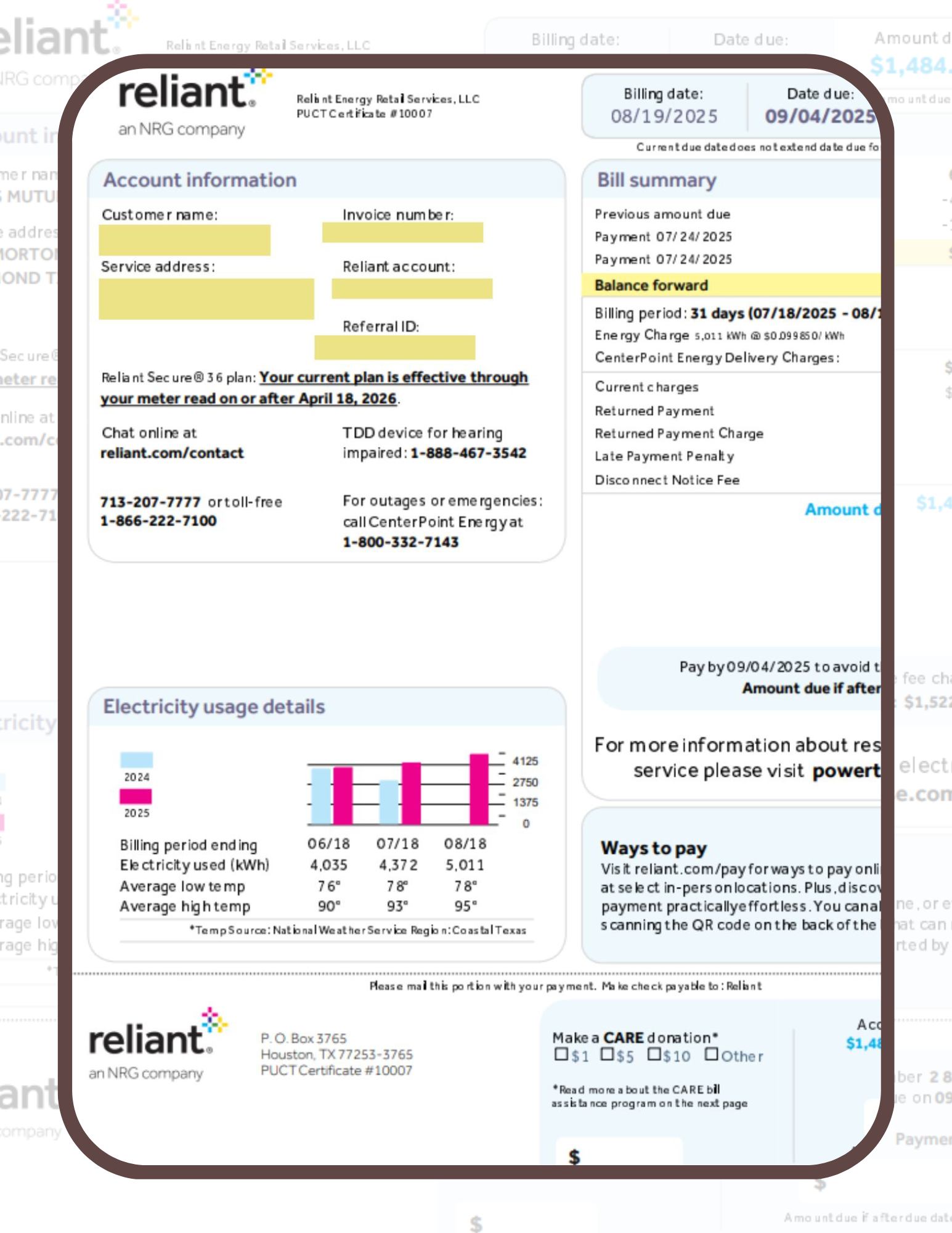
Reliant Energy charges a standard late fee of 5% of your past-due balance if a payment is not received by the due date. This applies to most Houston residents and is standard across many Texas electricity providers. Additional fees may apply for disconnection notices or returned payments.
Find Utility Assistance Programs

If you live in Houston, TX, and use Reliant Energy for your electricity, it’s important to understand how its late fee policies work. A missed payment here or there might seem harmless, but those extra charges can add up fast—and sometimes, it’s just a matter of knowing what to expect and how to avoid them by seeking utility assistance.

Understanding Your Reliant Energy Late Fee

Reliant, like most electricity providers in Texas, charges a late fee when a payment isn’t received on time. While a percentage might not sound like a lot on its own, if you’re behind on a high bill—especially during peak summer months in Houston—it can become a real financial headache.

5%

The standard penalty fee applied to past-due balances.

A real Reliant Energy bill showing the fee structure

Other Reliant Energy Fees That Might Sneak In

If a payment is late—or fails entirely—there may be a few more charges headed your way. Depending on your specific plan and whether you are enrolled in AutoPay, your fee structure in Houston (e.g., ZIP 77082) might include:

Disconnection Notice Fee

A $10 to $20 charge applied simply for Reliant having to mail out a standardized disconnection notice warning.

Returned Payment Fee

Typically around $25. Applied if a check bounces or your bank rejects an Automated Clearing House (ACH) transfer.

Reconnection Fee

A $30 to $35 penalty required to restore power if Reliant Energy physically or remotely shuts off your service.

Electricity Facts Label (EFL)

The Texas regulatory document attached to your specific plan that outlines exact fee structures and energy rates.

Late Fee

The standard 5% penalty charged on your past-due balance for failing to pay the entire bill by the required due date.

AutoPay

An automated billing feature that deducts balances from your account, often preventing accidental late payment scenarios.

Need Immediate Financial Relief?

Don’t let a temporary setback lead to disconnected services. Explore alternative energy assistance programs today.

Find Utility Assistance Programs

Outdoors checking electric meter

How to Confirm Reliant Energy Late Fees on Your Own Plan

The only way to know exactly what you’ll be charged is to look at your plan’s Electricity Facts Label (EFL) and Terms of Service. Here’s how you verify what Reliant can legally charge you:

Validating Your Fees

1

Log In to Your Account

Head over to Reliant.com, sign into “My Account” and look under “Plan Details” to find your EFL and Terms of Service PDFs.

2

Use the Plan Comparison Tool

Check out Reliant’s plan comparison tool for your specific ZIP code to see how your current fee liability measures against newer plans.

3

Contact Customer Support

If you are facing an imminent fee cascade, call customer service immediately and ask if you qualify for a payment extension or hardship waiver.

Relief Options: What to Do If You Can’t Pay Your Reliant Energy Late Fee

If you’re dealing with an unexpected medical bill, a job change, or just a high summer bill, Reliant has options that can help you catch up without falling into a fee trap.

  • Reliant Payment Extension: Gives you a little more time to pay, but you must request it *before* the disconnection notice due date.
  • Deferred Payment Plan: Lets you pay off what you owe in smaller, manageable chunks spread over time.
  • Reliant CARE Program: Designed for customers in crisis, offering actual financial relief for qualifying households.

Pro-Tip: The Reliant CARE program operates through local community nonprofits. Even if you don’t qualify for federal aid like LIHEAP, it’s worth dialing 2-1-1 or visiting 211texas.org to see if you qualify for CARE grants to offset late fees and past-due balances.

Frequently Asked Questions

How do I avoid Reliant Energy late fees?
Pay your bill on time, sign up for AutoPay, or proactively ask customer service for a payment extension before the bill’s due date expires.
Does everyone in Houston pay the same late fee?
Most Houston residents will see the standard 5% late fee penalty on the past due balance, but flat-rate disconnection notice charges can vary based on your plan and billing setup.
Can Reliant waive a late fee?
While not guaranteed, Reliant customer support may waive a late fee if you have a history of on-time payments and experienced a one-time banking error or verifiable hardship. You must call them to request the waiver.
What is a deferred payment plan?
A deferred payment plan takes your outstanding balance and splits it out over several months. You usually have to make a down payment to start the plan, and you cannot switch providers while on an active deferred plan.

Don’t Wait Until Your Power is Cut

Find safe, reliable utility assistance programs spanning energy, water, and broadband today.

Find Utility Assistance Programs

The Hidden Impact of Energy Assistance Cuts on American Families

Struggling with rising energy bills?

Energy assistance programs can help protect your home, your health, and your finances. Find out what support is still available before it’s too late.

Find Help Near You?

Picture this: it’s the dead of winter, and you’re staring at a heating bill that feels like a second mortgage. Now imagine your lifeline—financial support—is suddenly gone. For millions of households, this scenario is becoming a real concern.

Understanding energy crisis
Rising energy costs are putting pressure on households nationwide.

The Current State of Energy Assistance Funding

Energy assistance programs like the Low Income Home Energy Assistance Program (LIHEAP) are essential for families living paycheck to paycheck.

  • Government Dependency: Many households rely on LIHEAP to cover heating bills
  • Rising Costs: Utility prices continue to increase nationwide
  • Economic Impact: Higher energy costs reduce spending on essentials

Find your local office through the LIHEAP directory.

Family struggling with energy costs
Families often face difficult choices between utilities and basic needs.

The Domino Effect of Funding Cuts

Cuts to energy assistance don’t just affect bills—they ripple across health, education, and community stability.

  • Health Risks: Increased respiratory illness and hypothermia risks
  • Educational Challenges: Children struggle to focus in unsafe temperatures
  • Community Strain: Increased demand on social services

Statistical Insight

Category Potential Impact (%)
Reduction in Assisted Families 20%
Increase in Energy Costs 15%
Rise in Health Issues 25%

These numbers reflect real families facing real challenges.

Insights from Experts

Experts emphasize that energy insecurity is not just financial—it’s a public health and social stability issue.

Possible Solutions and Advocacy

Improving home energy efficiency
Energy-efficient homes help reduce long-term utility expenses.

Next Steps in Addressing the Crisis

Taking action—whether through volunteering, advocacy, or spreading awareness—can help protect vulnerable households.

Don’t wait until it’s too late

Find energy assistance programs available in your area today.

Get Help Now?

Final Thoughts

Energy assistance is about more than paying bills—it’s about safety, dignity, and stability. Protecting these programs protects communities.

Your Role in Shaping the Future

Even small actions—checking on neighbors, sharing resources, or advocating for funding—can make a meaningful difference.

Take Action Today

  • Explore assistance programs
  • Reduce your energy costs
  • Support your community

Start Here?

Churches That Help With Rent and Utilities in Houston: Your 2026 Guide to Emergency Financial Aid

0
Houston family struggling with rent and utility bills seeking church assistance
Many Houston and Fort Bend families face unexpected financial hardship, but faith-based support is available.

What are churches that help with rent and utilities in Houston?

Churches that help with rent and utilities in Houston are faith-based ministries and interfaith coalitions across Harris and Fort Bend counties that provide one-time emergency grants, direct payments to landlords or utility companies, and case management for households in short-term financial crisis. Most serve anyone in the service area regardless of religion and cap aid at one payment per 12 months.

Apply for Emergency Help »

If you have ever had that sinking feeling while staring at an overdue bill or wondering how you will cover rent this month, you are not alone. Life can change fast — a job loss, medical emergency, or surprise expense can put even careful budgeters behind. The good news is that across Harris County and Fort Bend County, dozens of faith communities have built structured assistance programs to catch people before eviction or a utility shutoff. If your immediate problem is your power bill, also review the broader options in our guide to help paying your electric bill in Houston.

These ministries are not just handing out cash at the church door. Most operate on a coalition model where multiple congregations pool funding into a professionally staffed nonprofit with intake coordinators, trained volunteer interviewers, and direct-pay relationships with major landlords and utility companies. That structure is why churches that help with rent and utilities in Houston remain one of the fastest routes to emergency aid when every government application portal says “waitlist closed.” Funding sources usually include private donations, foundation grants, resale shop proceeds, federal partnerships, and denominational support — a diversified base that keeps the money flowing even when one source dries up.

Key Terms You Will Hear When Working With Churches That Help With Rent and Utilities in Houston

Benevolence Ministry

A dedicated fund or committee within a single congregation that disburses emergency aid such as rent, utilities, gasoline, or food to community members in verified crisis.

Interfaith Coalition

A coordinated network of 5 to 30+ local congregations that pool resources into a single nonprofit, such as the East Fort Bend Human Needs Ministry or Christian Community Service Center.

Direct-Pay Model

The standard practice of mailing or wiring approved aid straight to your landlord, property manager, or utility company rather than placing funds into your personal bank account.

211 Texas HELPLINE

A free 24/7 referral service run by United Way of Greater Houston that matches callers to open church, nonprofit, and government assistance funds based on ZIP code and crisis type.

Case Management

A wraparound service many larger church-run programs include, pairing your emergency grant with a coach who helps with budgeting, job search, and long-term stability planning.

12-Month Rule

The near-universal cap that limits each household to one financial assistance payment per 12-month period, enforced so limited budgets can reach as many families in crisis as possible.

What Churches That Help With Rent and Utilities in Houston Can Do For You

The churches that help with rent and utilities in Houston generally offer four categories of assistance. Knowing what each category actually covers helps you match your request to the right ministry on the first call instead of bouncing through three referrals.

  • Rent and mortgage grants: One-time direct payments to your landlord, management company, or mortgage servicer, typically capped between $300 and $1,000 depending on the ministry’s funding cycle.
  • Utility bill assistance: Direct pledges to CenterPoint, Reliant, TXU, Gexa, or your retail electric provider, and to water, gas, and wastewater utilities. Caps often run $250 to $450 per household.
  • Food pantries and gas vouchers: Free groceries, diapers, hygiene kits, and sometimes gas cards so you can get to a job interview or medical appointment.
  • Case management and workforce coaching: Budget counseling, resume help, ESL classes, and job placement through programs like CCSC’s JobNet or Second Mile’s Equip2Grow Academy.

As a single parent in Southwest Houston, you may use church assistance to cover a partial rent payment while waiting on unemployment to process. As a senior on a fixed income in Fort Bend, you may combine a small church utility grant with your monthly Social Security to avoid a summer disconnection. As a working family hit by a surprise medical bill, you may lean on a church pantry for groceries so your paycheck can cover rent in full.

Why Churches That Help With Rent and Utilities in Houston Fill a Critical Gap

Houston’s largest federal and state safety-net programs — LIHEAP, CEAP, Emergency Rental Assistance — are perpetually oversubscribed. Funding cycles fill within minutes once they open, portals close with little notice, and processing timelines can run six to eight weeks. For a family with a disconnection notice due Friday, a two-month wait is the same as no help at all. That is where churches that help with rent and utilities in Houston close the gap.

Church-run ministries often operate with weekly or bi-weekly funding refreshes, accept same-week appointments, and make direct payments to creditors within 24 to 72 hours of approval. They also fill niches that government programs do not, such as paying security deposits, covering late fees, or bridging a single missed rent payment that would otherwise trigger eviction filing. Funding is often first-come, first-served — calling early Monday morning can dramatically improve your chances.

Another underappreciated strength is the human factor. Intake volunteers at ministries like Catholic Charities’ Mamie George Community Center and the East Fort Bend Human Needs Ministry spend 20 to 40 minutes on each case and often identify two or three other aid sources you qualify for beyond what you originally called about.

“As mortgage or rents rise, as food costs go up, Medicaid and SNAP funding are getting cut, we’ve already seen clients being impacted.”

— Stacy Williams, Executive Director, East Fort Bend Human Needs Ministry

5 Faith Networks of Churches That Help With Rent and Utilities in Houston

Five large faith networks run the backbone of the churches that help with rent and utilities in Houston. Most local parish-level benevolence funds work through one of these five systems, which means calling the network headquarters first is often faster than calling individual congregations.

1. Catholic Charities of the Archdiocese of Galveston-Houston

Operates Family Assistance Programs in Fort Bend, Galveston, and Harris counties through the Mamie George Community Center (Richmond), Guadalupe Center (Harris), and Beacon of Hope centers (Galveston). Services include emergency rent and utility assistance, food distribution, senior wellness, immigration legal support, and counseling available in English and Spanish.

2. Salvation Army Greater Houston Area Command

Provides emergency rent, utility, and food assistance across all service zip codes in Harris, Fort Bend, and Montgomery counties. The Fort Bend location at 12300 Parc Crest Drive in Stafford serves residents based on need, with utility help (water, electricity, gas) available as funding permits.

3. Society of St. Vincent de Paul

Parish-based Vincentian conferences across Houston make direct payments to landlords and utility companies after a home visit or interview. Conference members are often retired parishioners who prioritize personal relationships and long-term check-ins, not just one-off grants.

4. United Methodist Good Samaritan Funds

Individual United Methodist congregations in the Houston metro maintain benevolence funds that cover rent shortfalls, medical copays, and utility emergencies. CCSC’s Southwest location is actually co-located on the Gethsemane Campus of St. Luke’s United Methodist Church.

5. Lutheran and Episcopal Outreach Ministries

Lutheran Social Services of the South and Episcopal Health Charities back a network of smaller grants, transportation help, and refugee resettlement support. These are good fallback options when larger Catholic and Methodist networks have exhausted weekly funding.

Beyond these five, the Interfaith Food Pantry network, Greek Orthodox Philoptochos Society chapters, and Jewish Family Service Houston also run parallel emergency assistance programs. A single call to 211 will usually map you to the right network first.

Data Highlight

Up to $1,000 Rent + $450 Electric

That is the maximum one-time assistance available through the East Fort Bend Human Needs Ministry per household per 12 months — one of the higher limits among local faith-based programs, with additional caps of $250 for water and $250 for gas.

Local Fort Bend County Churches That Help With Rent and Utilities in Houston

Fort Bend County has one of the strongest faith-based assistance networks in the entire Houston metro, anchored by four specific organizations with verified rent and utility programs.

Ministry Location Help Offered How to Apply
Mamie George Community Center 1111 Collins Rd, Richmond Rent, utilities, food, case management Call 281-202-6200
Second Mile Mission Center 1135 Hwy 90A, Missouri City Past-due utilities, rent, food, financial coaching Call 281-261-9199
East Fort Bend Human Needs Ministry 435 Stafford Run, Stafford Up to $1,000 rent + $450 electric + $250 water + $250 gas Call 281-261-5470 Tuesdays 10am-12pm
Christian Community Service Center (SW) 6856 Bellaire Blvd, Houston Rent and utility pledges for 29-ZIP service area Call 713-871-9741 Mon-Fri at 10am sharp

Larger non-denominational congregations in Fort Bend — including River Pointe Church in Richmond and Second Baptist Church West — operate internal benevolence ministries for verified members and local families, though specific grant amounts and eligibility vary by review. Call the church office directly to ask about their current benevolence cycle.

If your ZIP code is served by CCSC’s 29-ZIP footprint, note that their phone line opens at 10 AM Monday through Friday and appointments for the next day are usually filled by 10:30 AM. Try calling at 9:50 AM to be at the front of the queue when lines open.

Church volunteers distributing emergency assistance to Houston families
Trained volunteers at Houston-area ministries provide direct, compassionate support during financial crises.

Funding Resets Weekly. Do Not Wait Until Friday.

Most church assistance funds are first-come, first-served and reset each Monday morning. Starting your application now dramatically improves your chances of getting approved before the week’s budget runs out.

Apply for Emergency Help »

How to Qualify for Churches That Help With Rent and Utilities in Houston

Eligibility for churches that help with rent and utilities in Houston is broader and more forgiving than federal programs. Most ministries use four simple screens:

  • Service area match: You must live inside the ministry’s service ZIP code list. EFBHNM serves 10 specific Fort Bend ZIP codes, CCSC covers 29 Inner Loop and Southwest ZIPs, and Mamie George serves all of Fort Bend.
  • Documented temporary crisis: You need to show a recent trigger (job loss, medical emergency, reduced hours, death in the family) that explains why this month is different. Permanent income shortfalls are referred to long-term programs instead.
  • Some ongoing income: Most programs require partial income — unemployment benefits, disability, Social Security, part-time wages — to ensure the one-time grant actually stabilizes your situation rather than delaying inevitable eviction.
  • Twelve-month clean record: You cannot have received financial assistance from the same ministry in the previous 12 months. Lifetime caps of 3 payments per household are common.

Faith-based eligibility is rarely a factor. Almost every Houston-area ministry explicitly states they help people of all religions and backgrounds. You do not need to be a church member, attend services, or share the ministry’s denomination.

Documents You Need for Churches That Help With Rent and Utilities in Houston

Showing up prepared is the single biggest factor in getting approved quickly. Ministries reject or delay roughly a third of applications simply because applicants arrive missing a required document. Gather these before your first call.

  • Photo ID for every adult in the household (Texas driver license, Texas ID, passport).
  • Social Security cards for every household member, including children.
  • Proof of residency: a current utility bill, lease, or piece of mail with your name at the service address.
  • Proof of income for the last 30 days: pay stubs, unemployment award letter, Social Security or SSI letter, child support documentation.
  • Bill or notice you need help with: disconnect notice, eviction filing, past-due letter, or current month’s rent statement.
  • Crisis documentation: medical bill, termination letter, hospital discharge paperwork, or other proof of what changed.
? Author’s Pro-Tip: Call Tuesday Morning, Not Monday

Everyone calls church assistance lines at 9:00 AM Monday morning, flooding the system and burning through the week’s allocation within 60 to 90 minutes. A better strategy at many Fort Bend ministries (including EFBHNM, which literally opens its appointment line Tuesdays 10 AM-12 PM) is to call right when their specific intake window opens, document in hand. You will compete against a much smaller group of callers and the volunteers will have more time to fully assess your case.

Houston resident preparing documents for church financial assistance intake appointment
Having your documents organized before calling can cut application time in half.

What to Do If Churches That Help With Rent and Utilities in Houston Are Full

Church funding does run out, especially in late summer and December. If every ministry you contact is tapped out for the week, you still have real options beyond simply waiting.

  • Dial 2-1-1 immediately: The 211 Texas HELPLINE operated by United Way of Greater Houston is the fastest way to find currently open funding. Specialists have real-time visibility into which programs are accepting applications that day.
  • Apply for LIHEAP or CEAP: These federal energy assistance programs are administered locally through BakerRipley and Gulf Coast Community Services Association. Review our full guide to utility assistance programs in Houston, TX.
  • Request a utility payment extension: If the immediate threat is shutoff, a Reliant payment extension or similar deferred payment plan from TXU, Gexa, or Direct Energy can buy you two to three weeks.
  • Contact retail provider assistance programs: The Reliant Energy CARE Program and the TXU Energy Aid program each distribute millions annually through partner agencies.
  • Follow ministries on social media: Many post when new funding cycles open or when emergency donor grants unlock additional capacity mid-week.

One often-overlooked option is calling smaller suburban congregations directly. While the five major faith networks handle the bulk of assistance volume, individual parishes in Katy, Sugar Land, Pearland, Cypress, and Humble often maintain small benevolence funds that never reach 211’s database. These funds are typically administered by a pastor or deacon who can approve a $200 to $400 grant on the spot for a verified emergency. If you are a member or regular attendee of any congregation, contact that specific church office first — internal members are usually prioritized. If you are not, calling two or three neighboring churches and honestly explaining your situation often produces help the public directories miss.

Churches That Help With Rent and Utilities in Houston vs. Government Programs

Church ministries and government programs serve overlapping needs, but they work very differently. Pairing both — not picking one — is usually the right strategy for a serious rent or utility crisis.

Feature Church Ministries LIHEAP / CEAP
Typical wait time Same week to 72 hours 4 to 8 weeks
Typical grant size $100 to $1,000 $200 to $2,400+
Income limit Flexible, based on crisis 150% of federal poverty level
Documentation burden Light to moderate Heavy
Covers rent? Yes Utilities only
Case management included Often yes Rarely

The practical playbook: apply to LIHEAP or CEAP for larger structural help, while calling churches that help with rent and utilities in Houston for the bridge payment that keeps the lights on or the eviction off your record until federal money arrives.

Frequently Analyzed Topics About Churches That Help With Rent and Utilities in Houston

Do you need to be a church member to receive assistance?

No. Nearly every major Houston church ministry explicitly helps anyone in the local service area regardless of religion, denomination, attendance, or background. Catholic Charities, CCSC, Second Mile, and EFBHNM all serve Muslim, Jewish, Buddhist, Hindu, agnostic, and atheist neighbors on equal terms with Christian applicants. You will never be asked to convert, attend a service, or sign a statement of faith.

How often can I receive help from the same ministry?

Typically once every 12 months, with many ministries enforcing a lifetime cap of three financial assistance payments total. This policy exists so limited donor funding reaches as many families as possible. You can, however, receive help from multiple different ministries in the same 12-month window as long as each has its own program rules.

What bills can Houston churches actually help pay?

The most common are past-due rent, mortgage arrears, electricity, water, wastewater, and natural gas. Many ministries also cover gasoline (via vouchers), prescription medications, dental emergencies, and transportation to work or medical appointments. Phone and internet bills are rarely covered, and credit card debt is almost never covered.

How quickly will I receive the money if approved?

You will not receive money directly. Approved funds are paid straight to your landlord, property manager, or utility company, usually within 24 to 72 hours of approval. The ministry will give you a pledge letter you can show your landlord to halt eviction filings or a utility to stop a disconnection while the check or ACH transfer processes.

Will asking for church help affect my immigration status or credit score?

No. Church assistance is private charity, not a public benefit, and does not count toward public-charge determinations for immigration purposes. It does not appear on your credit report. Ministries do not report you to ICE, share your information with creditors, or forward your data to government databases.

What should I do if I am already in eviction court?

Call 2-1-1 the same day and ask for emergency rental assistance and eviction diversion resources. Catholic Charities of Galveston-Houston operates a dedicated court-ordered eviction program, and Lone Star Legal Aid provides free legal representation for low-income tenants. Bring all eviction paperwork to any church intake appointment so volunteers can prioritize your case as time-sensitive.

You Are Not Alone — Help Is Within Reach

Dozens of trusted Houston and Fort Bend faith-based ministries are standing by right now to help you avoid eviction, stop a utility shutoff, and put food on the table. Start your application today — funding is limited and resets each week.

Access emergency rent and bill support
Get help from trusted community organizations
Take control of your financial situation today

Apply for Emergency Help »

Help Paying Electric Bill in Houston: Essential Programs, Providers & Next Steps

0

Quick Answer: Houston residents struggling with electric bills can access LIHEAP/CEAP funding, utility payment plans, and nonprofit aid programs that help prevent disconnection and reduce monthly costs. Support is based on income, hardship status, and household needs.

Check Electric Bill Assistance Eligibility

Electricity costs in Houston continue to rise due to extreme weather, fluctuating energy markets, and increased household demand. For many families, keeping up with monthly bills has become a real challenge.

Fortunately, a range of programs to help pay the electric bill in Houston programs exist to support residents during financial hardship. These include federal assistance, utility provider relief plans, and nonprofit emergency funding designed to keep homes powered year-round.

Major Programs That Help Pay Electric Bills in Houston

Several established programs provide direct financial relief or bill credits for qualifying households. These programs are often income-based and prioritize vulnerable groups such as seniors, families with children, and individuals with disabilities.

  • Federal LIHEAP/CEAP energy assistance funding
  • Utility company hardship payment plans
  • Nonprofit emergency bill support
  • Community referral services through 211 Texas
Home energy assistance program support for electric bills
Energy assistance programs like LIHEAP help Houston families manage rising electricity costs.

LIHEAP and CEAP Electric Bill Assistance

The Low Income Home Energy Assistance Program (LIHEAP), administered in Texas through CEAP, is one of the most important resources for Houston residents needing help with electric bills.

These programs provide financial assistance directly toward utility balances or ongoing monthly support, depending on eligibility and funding availability.

  • One-time bill payment assistance
  • Emergency support during disconnection risk
  • Seasonal heating and cooling relief

Eligibility typically depends on household income, residency status, and energy burden level.

Utility Company Payment Plans in Houston

Most Houston-area electricity providers offer structured payment solutions for customers experiencing financial hardship. These options can prevent disconnection while giving households time to catch up on overdue balances.

  • Deferred payment plans: Spread overdue balances over several months
  • Payment arrangements: Adjust due dates or split upcoming bills
  • Hardship programs: Temporary bill reductions or credits in qualifying cases

These programs are typically available through major providers serving Texas households and can be arranged by contacting customer support directly.

Electric bill assistance requirements and documentation
Most assistance programs require proof of income, identification, and utility statements.

211 Texas and Emergency Referral Services

For immediate help, 211 Texas connects residents with active assistance programs in their area. This service is one of the fastest ways to find available funding or emergency support.

  • Utility bill payment assistance referrals
  • Emergency housing and food support
  • Medical and childcare resources

Because funding varies, calling early increases your chances of receiving help before program limits are reached.

Nonprofit Electric Bill Assistance in Houston

Several nonprofit organizations provide short-term financial relief to households facing urgent utility needs. These programs often operate on limited funding and require early application.

  • One-time emergency utility payments
  • Case-by-case financial support
  • Referral-based assistance through community partners

Nonprofits often work alongside government programs to fill gaps in funding or eligibility coverage.

Managing high electricity delivery charges and utility costs
Understanding your bill can help identify savings opportunities and assistance eligibility.

Why Electric Bill Assistance Programs Matter

Electric bill assistance programs do more than cover overdue balances—they help stabilize households during financial hardship and prevent service interruptions that can impact health and safety.

  • Prevents utility shutoffs during financial crises
  • Reduces long-term household debt burden
  • Improves access to essential services like heating and cooling
  • Supports long-term financial recovery

Steps to Get Help Paying Your Electric Bill

  1. Gather documents: ID, income proof, and a recent utility bill
  2. Contact LIHEAP/CEAP programs through local agencies
  3. Call 211 Texas for immediate referrals
  4. Ask your electric provider about payment plans
  5. Apply for nonprofit emergency assistance if needed

Conclusion: Take Action Before Disconnection

If you’re struggling with electricity costs in Houston, waiting can make the situation more difficult. Assistance programs are available, but funding is often limited and distributed quickly.

By acting early and exploring multiple resources, you can reduce your risk of disconnection and regain control of your monthly expenses.

Take the Next Step

  • Check eligibility for electric bill assistance
  • Explore LIHEAP/CEAP funding options
  • Contact utility providers for payment arrangements

Get Help With Your Electric Bill

Frequently Asked Questions

What programs help pay electric bills in Houston?

Programs like LIHEAP/CEAP, utility provider hardship plans, and nonprofit emergency assistance all help Houston residents pay electric bills. Eligibility is usually based on income and household needs.

How fast can I get electric bill assistance?

Emergency assistance can sometimes be processed within days, but most programs depend on application volume and funding availability. Applying early increases your chances significantly.

Can I get help if I have already received a shutoff notice?

Yes. Many programs prioritize households facing disconnection and offer crisis assistance to prevent service interruption.

Do utility companies in Houston offer payment plans?

Yes. Most providers offer deferred payment plans or installment arrangements to help customers manage overdue balances and avoid disconnection.

Gexa Energy Solar Buyback: Is It Worth It for Texas Homeowners?

0

Solar energy is booming in Texas—and if I could talk face-to-face with someone thinking about adding panels, I’d say: “Welcome to the sunniest savings club in America!”

Texas homeowners are snapping up rooftop systems, and many are deciding on a solar buyback plan—where your excess energy doesn’t go to waste, but instead gets sold back to the grid for bill credits.

One option catching attention is the buyback program from Gexa Energy.

But let’s cut through the fluff:

Is Gexa a smart move for solar users, and how does it stack up against plans from TXU Energy, Reliant, Green Mountain Energy, and others?

Gexa energy solar roof

What Is the Texas Solar Buyback Plan?

In Texas, homeowners in deregulated areas can choose retail electric providers (REPs) that buy back excess solar energy—typically not at full retail value. This is different from traditional net metering (which isn’t mandated here), as your provider determines the compensation structure.

Understanding Gexa Energy’s Solar Buyback Program

What Is a Solar Buyback Plan?

When your panels produce more power than you need, that extra energy gets sent to the grid—and ideally, you get credits on your bill. These programs help boost your solar return on investment by turning surplus energy into savings.

How Gexa’s Buyback Program Works

If you’re signing up for Gexa’s program, you’ll need a smart meter, TDU interconnection approval, and ownership of your system (leased arrays aren’t eligible). Once connected, Gexa tracks your exported electricity and applies credits to your bill—it’s a bill-offset mechanism, not cash payouts.

Important things to note:

  • Credits apply to energy usage only—delivery fees, taxes, and other charges aren’t covered.
  • Credits expire at the end of each billing cycle if unused.
  • The value is based on the retail rate of your selected plan.

Rate Structures & Plan Types

Gexa offers both flat-rate and time-of-use (ToU) plans:

• Flat-rate: earn a fixed credit per kWh you export.
• ToU: earn more during peak hours—great if your system mirrors peak pricing.

Plans generally run 12–24 months and may include early termination fees.
Tip: always review the Electricity Facts Label (EFL) to understand credit rates and restrictions.

Energy Credits: The Devil’s in the Details

With retail-rate credits, you get real value—but only if you use them. There’s no rollover and no cash refund. This mirrors limitations seen in other programs—here’s a useful article about home energy improvements, including solar installations that can help align production and usage.

Benefits and Drawbacks of Gexa Energy Solar Buyback

Let me walk you through what to expect:

Advantages:
• Lower electric bills when you align your usage with production
• Helps Texas shift toward cleaner energy
• Retail-rate credits generally beat wholesale
• No extra hardware required—your smart meter does the job

Limitations:
• No rollover—unused credits disappear
• No cash payout, even if your system overproduces
• Savings depend on usage alignment

Gexa vs. Other Texas Solar Buyback Programs

Provider Credit Type Credit Rollover Cash Payout Contract Length Notes
Gexa Energy Retail (varies) No No 12–24 months Strong options—but no rollover
TXU Energy Wholesale only Yes No 12–36 months Lower value but rollover flexibility
Reliant Time-based credit Sometimes No 12–24 months High peak hour credits, plan dependent
Green Mountain Energy Retail Yes (up to 12 months) No Month-to-month or 12 months Flexible rollover, higher base rates
Ambit Wholesale No No Varies Limited availability
Just Energy Retail or fixed No No 12–24 months Inconsistent, depends on region

Who’s the Best Fit?

If flexibility matters most—and you produce more energy than you use—Green Mountain Energy may be ideal thanks to retail credits and rollover. But if you’re confident in matching your usage to production, Gexa Energy offers strong value.

Is Solar Buyback Worth It in Texas?

Absolutely. With over 19,000?MW of solar installed, Texas ranks second nationally according to SEIA. Systems typically pay for themselves in 7–10 years, and Zillow Research finds that homes with solar sell for 4.1% more.

And per the Public Utility Commission of Texas, there are more than 40 electricity providers in deregulated markets offering solar-friendly plans—so you’ve got options.

Expert Perspectives

“Solar buyback plans like Gexa’s can help homeowners offset grid usage, but understanding how credits work is crucial.” – Lauren Cook, Energy Policy Analyst

“Texas homeowners need to evaluate buyback rates carefully—some plans look great but offer low compensation for excess solar.” – Mark Davis, Solar Consultant

Case Study: A Houston Homeowner’s Experience

John M., from Houston, installed a 7 kW system with Gexa. His bill fell from $160 to $15 in peak summer—but he “missed out on $30 in unused credits in July” due to no rollover. Still, he calls it a win, if you time your usage well.

Frequently Asked Questions

What is a solar buyback rate?
It’s the per kWh credit you receive for sending power to the grid.

Is solar buyback worth it in Texas?
Yes—if you choose a provider with retail?rate credits, like Gexa or Green Mountain.

Can you sell back solar power in Texas?
Yes—deregulated areas let you pick a REP that offers a buyback plan.

How much can you earn?
Many homeowners offset 50–100% of monthly charges—saving hundreds yearly.

Why is my bill still high?
Maybe your credits expire, your delivery fees remain, or your usage doesn’t match production.

What’s the TXU rate?
Wholesale—it’s lower, but TXU includes rollover.

Is it harder to sell a home with solar?
No—in fact, Zillow shows solar homes sell faster and for more, especially in conscientious markets like Texas.

Conclusion

Gexa Energy’s solar buyback program is a strong, easy entry into solar savings—with retail rate credits and no extra hassle. It ranks among the best in Texas, though you’ll need to account for monthly credit expiration.

Time to take action:

• Estimate your solar production vs. usage habits.
• Review Gexa’s current plans and EFLs.
• Compare with TXU Energy, Green Mountain Energy, and Just Energy.
• Start your interconnection with your TDU.
• Discuss savings projections with a solar expert.

What is a Home Energy Audit? Reduce Your Energy Bill With These Pro Tips

0

Hey there—I want to walk you through something that’s truly a game-changer for both your wallet and your daily comfort: a home energy audit.

This isn’t just another chore—it’s like shining a light on all the spots where your house is silently stealing from your bank account (and even your peace of mind).

From those sneaky drafts around your windows to outdated HVAC systems working overtime, this guide has got you covered. Whether you’re performing weatherization or just want to reduce your energy bills, we’ll tell you what it is, why it matters, and how to get rolling—with ease and confidence.

What Is a Home Energy Audit?

Definition and Purpose
Think of a home energy audit—sometimes called a “home energy assessment”—as a careful, systematic look at how your home uses energy. We’re talking checking insulation, sniffing out air leaks, evaluating your HVAC, lighting, appliances… the whole works. This isn’t about guessing; it’s about zeroing in on where energy (and money) is escaping.

The big goals:
• Find where heat or air is leaking
• Spot outdated, energy-hungry devices
• Recommend upgrades that actually pay for themselves
• Make your home feel cozier and safer

Once you know exactly where energy is being wasted, you’re armed to make smart decisions—saving money and improving your day-to-day comfort.

Learn how to make even an old home energy efficient

Professional vs. DIY Energy Audits

Professional audits are the deep dive: a trained auditor comes with tools like blower door tests to see how airtight your house is, thermographic cameras to locate hidden leaks, and safety checks for furnaces and gas appliances.

DIY audits can be a great starting point if you’re on a budget. You can pick up thermal leak detectors, infrared thermometers, or try smartphone apps like HomeSelfe or EnergySaver. Two caveats: you’ll miss some of the nuance, and gadgets won’t match the trained eye and experience of a pro.

How a Home Energy Audit Works

Step-by-Step Process

1. Initial Walkthrough & Interview
The auditor will ask about your energy bills, what rooms feel cold or hot, and any odd smells or moisture issues. Then, they visually examine your home’s layout, spots you spend most time in, and potential trouble areas.

2. Equipment Testing
Tools like blower doors and infrared cameras are used to find drafts, insulation issues, and hidden moisture problems.

3. Report & Recommendations
You’ll get a detailed report explaining: your current energy use, specific issues (with photos), suggested fixes (with estimated costs), and projected ROI. It becomes your personalized roadmap.

Key inspection areas:

  • Insulation & air leaks (attics, basements, crawlspaces).
  • HVAC: heating, cooling, ventilation.
  • Windows, doors & ductwork.
  • Lighting & appliances.

Benefits of Conducting a Home Energy Audit

Financial Benefits

Getting an energy audit can really change the game financially:

  • Lower utility bills: The U.S. Department of Energy estimates you can save up to 20% on heating and cooling simply by sealing leaks.
  • Rebates & tax credits: Tons of local utilities and state programs offer incentives for upgrades like insulation, smart thermostats, or ENERGY STAR® appliances.
  • Boosted home value: Buyers love energy-efficient homes—studies show you can recoup 70–100% of retrofit costs at resale.

Environmental Impact

Being green feels good—literally:

  • Smaller carbon footprint: Less energy = fewer greenhouse gases.
  • Long-term sustainability: These improvements pay off in durability and utility savings over time.
  • ENERGY STAR says energy-efficient homes can lower energy use by up to 30%.

Home Comfort & Safety

This audit isn’t only about money—it’s about comfort and peace of mind:

  • Smoother, more consistent indoor temperatures.
  • Improved air quality thanks to better insulation and ventilation.
  • Fire & carbon monoxide safety checks embedded in most professional audits.

Key Insights & Research

Insight Source Stat
Sealing air leaks can reduce HVAC costs U.S. Department of Energy Up to 20% savings
Energy-efficient upgrades cut overall use ENERGY STAR Up to 30% energy reduction
ROI on energy improvements Real estate studies Recover 70–100% in resale value

Expert Quotes

“A home energy audit is the roadmap to smart, cost-effective energy upgrades.” — Lawrence Berkeley National Laboratory

“Most homes leak as much air as a wide-open window year-round.” — Dr. John Tooley, Building Science Expert

“Every home wastes energy—audits show you exactly where.” — ENERGY STAR® Program Manager

FAQs About Home Energy Audits

What is a home energy audit?
It’s a detailed inspection that reveals where your home loses energy and makes recommendations to boost efficiency, comfort, and savings.

How much does it cost?
Typically between $100 and $500, depending on size and depth—some utilities offer free or discounted options.

Is a DIY audit effective?
It can help with obvious issues, but professionals catch the deep stuff—think thermal bridges or duct leaks.

How long does it take?
Usually 1–3 hours. Larger or multi-zone homes may take a bit longer.

Will I really save money?
Yes—most homes save $200–$400 yearly after making recommended improvements, plus you gain in comfort and property value.

Case Study: From Drafty to Efficient

Location: Minnesota
Problem: High heating bills, uneven room temps.

Audit findings:
• Air leaks around recessed lights
• Thin attic insulation
• Drafts at basement windows

Fixes:
• Sealed leaks with caulk and foam
• Upgraded attic insulation to R-49
• Installed double-pane windows in the basement

Results:
• Heating costs dropped 25%
• Rooms feel even and comfy
• Moisture and mold issues were halted

This proves that even smaller changes—when guided by expert insights—can lead to big wins in comfort, savings, and home health.

Conclusion

A home energy audit isn’t just a nice idea—it’s a savvy investment in comfort, savings, and sustainability. Whether you DIY or hire a certified professional, knowing how your home uses energy is the first vital step toward meaningful improvements that pay off years into the future.

Next Steps

Here’s a warm nudge to take action—today:

  • Grab your last year’s energy bills and look for spikes.
  • Schedule an audit with a local certified energy auditor.
  • Start a DIY inspection using an app like HomeSelfe.
  • Seal leaks and boost insulation in priority zones.
  • Search for rebates or incentives—local utilities and your state energy office often list these online.

You deserve a home that feels cozy, saves money, and supports the planet. Now’s the time—take that first step and see how quickly the benefits start rolling in.