What Is the Best Approach to Managing Utility Bills for Low-Income Families?
Managing Utility Bills for Low-Income Families in 2026 starts with three layered actions: apply for federal assistance through LIHEAP (which received $4.05 billion in FY 2026 funding and serves ~6 million households), reduce ongoing usage through the Weatherization Assistance Program (WAP) (which saves an average of $283 per household per year on energy costs), and adopt no-cost daily habits like unplugging electronics, turning off lights, and adjusting your thermostat by a few degrees. Households at or below 150% of the Federal Poverty Level or 60% of State Median Income typically qualify for LIHEAP. Stack these with utility-specific discount programs for maximum relief.
Why Managing Utility Bills for Low-Income Families Matters in 2026

For low-income households, utility bills are not just a line item. They are often the difference between making rent and falling into crisis. Electricity, water, natural gas, and heating fuel together can consume 20% or more of a low-income family’s monthly budget, and a single hot summer or cold winter can blow that ratio wide open. According to the National Energy Assistance Directors Association, roughly one in six American families are behind on their utility bill payments in 2026.
The good news is that the federal, state, and utility-funded safety net is robust, even if it is not always obvious how to access it. The federal Low Income Home Energy Assistance Program received $4.05 billion in funding for fiscal year 2026, and the Weatherization Assistance Program received $329 million more. As a low-income household, you have access to a combination of bill payment assistance, free home energy upgrades, and utility-specific discount rates that can collectively cut your utility burden by hundreds or thousands of dollars per year. This guide walks through every layer.
Core Programs for Managing Utility Bills for Low-Income Families
The federal Low Income Home Energy Assistance Program, administered by HHS through state block grants. Provides bill payment, crisis aid, and weatherization referrals.
The Weatherization Assistance Program, run by the U.S. Department of Energy. Provides free permanent home energy upgrades to qualifying households.
Most major utility companies (PG&E CARE, ComEd CARE, Atmos Sharing the Warmth, etc.) operate income-qualified discount programs that reduce monthly bills directly through the utility account.
The Low Income Household Water Assistance Program, where still funded, helps eligible households cover past-due water and wastewater bills. Administered by state agencies alongside LIHEAP.
2-1-1 is the United Way-operated national hotline connecting callers to local utility assistance, food, housing, and crisis resources. Free, 24/7, multilingual.
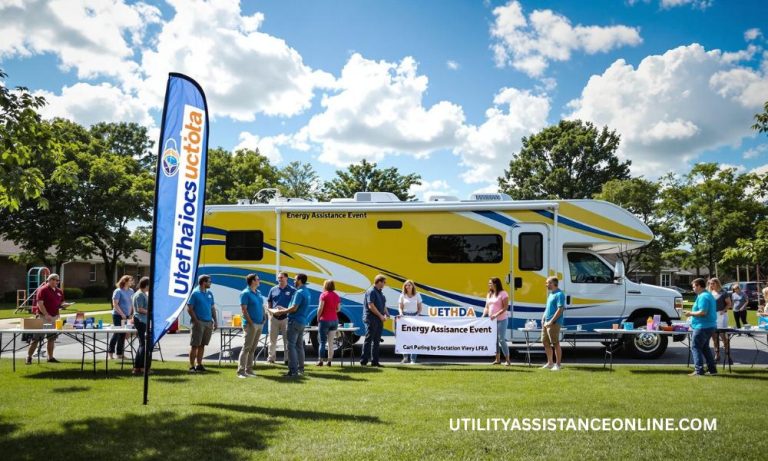
Local Community Action Agencies (CAAs) administer LIHEAP and WAP applications in most states. Find yours through Community Action Partnership.
Step 1 in Managing Utility Bills for Low-Income Families: Get an Energy Audit
Before paying off arrears or chasing assistance programs, the most impactful move is identifying where your energy is actually going. An energy audit produces a prioritized list of upgrades that save the most energy per dollar invested. For qualifying low-income households, this audit is completely free through WAP. (For a deeper primer, see our companion guide on what weatherization actually involves.)
What a professional audit covers
- Insulation evaluation: attic, wall, floor, and crawlspace insulation levels and gaps
- Blower-door test: measures whole-house air leakage in CFM50
- Infrared thermal imaging: identifies hidden cold spots, thermal bridging, and missing insulation
- HVAC efficiency check: furnace, AC, water heater age, condition, and performance
- Combustion safety testing: CO levels, draft, spillage on gas appliances
- Weatherstripping and seals: door and window gaps, weatherproofing condition
DIY home assessment if you don’t qualify for WAP
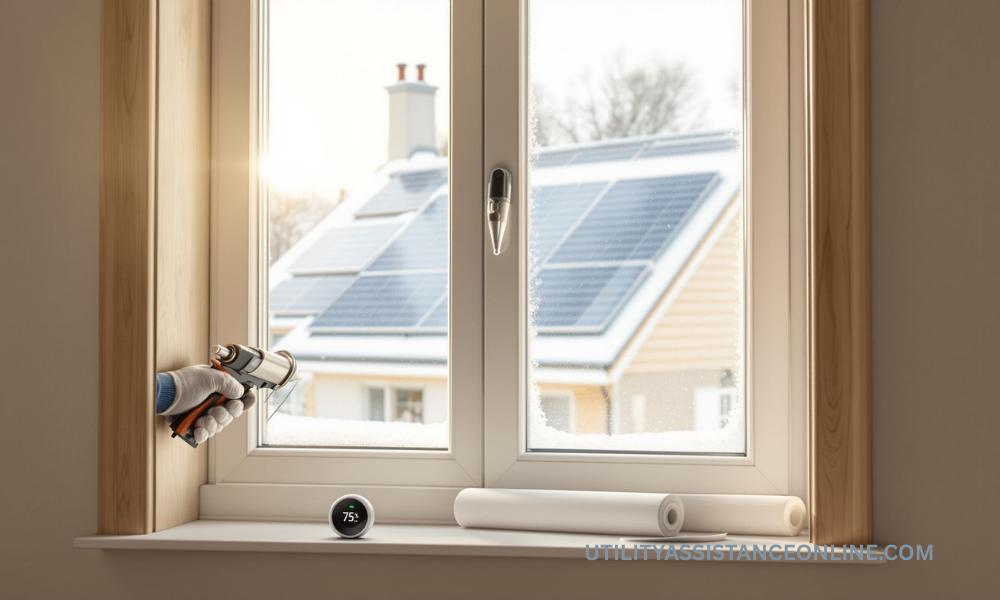
If your income exceeds WAP eligibility (200% Federal Poverty Level), you can still do a basic walkthrough yourself. Hold a lit incense stick near windows and electrical outlets to spot air leaks. Check attic insulation depth (R-49 is typical recommended for cold climates, R-30 for moderate). Note any single-pane windows, gaps under doors, or drafty floor registers. Even a low-cost DIY assessment can identify $50-$200 in annual savings.
According to U.S. Department of Energy estimates, the average WAP household saves approximately $283 per year on energy costs, with improvements lasting decades. The average WAP subsidy is $6,500 per housing unit in FY 2026.
Federal & State Programs for Managing Utility Bills for Low-Income Families
LIHEAP (Low Income Home Energy Assistance Program)
LIHEAP is the federal government’s primary energy assistance program. It provides direct bill payment assistance, crisis aid during heat waves or shutoff threats, and funding referrals to weatherization. LIHEAP received approximately $4.05 billion in federal funding for fiscal year 2026 and helps roughly 6 million households per year nationwide.
Federal eligibility is capped at the higher of 150% of the Federal Poverty Level or 60% of State Median Income, though states can set lower limits. Households receiving SNAP, SSI, or TANF are typically categorically eligible. Benefits and program dates vary widely by state, from California’s year-round heating and cooling assistance to states with discrete winter heating seasons.
Weatherization Assistance Program (WAP)
While LIHEAP helps you pay current bills, WAP takes a different approach: it permanently reduces your future bills through free home upgrades. WAP is administered by the U.S. Department of Energy through state energy offices and delivered locally by Community Action Agencies. FY 2026 funding is $329 million, with an average subsidy of $6,500 per housing unit.
WAP eligibility is set at 200% of the Federal Poverty Level, more generous than LIHEAP’s 150% threshold. SSI recipients qualify automatically in most states; some states extend categorical eligibility to SNAP and TANF as well. Priority is given to households with seniors (60+), persons with disabilities, and families with young children. Renters can apply, but landlord consent is required before work begins.
Utility company discount and hardship programs
Most major utility companies operate their own income-qualified discount programs. Examples include PG&E’s CARE (30%+ monthly discount), ComEd’s Residential Special Hardship, Atmos Energy’s Sharing the Warmth, and SDG&E’s CARE and FERA. These discounts apply automatically to your bill once you’re enrolled, often layered on top of LIHEAP and WAP. Call your utility’s customer service line and ask specifically about “low-income discount rates” or “hardship programs.”
LIHWAP (water bill assistance)
Where still funded by your state, the Low Income Household Water Assistance Program covers past-due water and wastewater bills. Households receiving LIHEAP, SNAP, SSI, or TANF are typically automatically eligible. Apply through the same Community Action Agency that processes LIHEAP.
Comparing Top Programs for Managing Utility Bills for Low-Income Families
Author’s Pro TipStack everything. The biggest mistake low-income households make is applying for one program and stopping. The actual play is to layer all available aid in this exact order: (1) Call 2-1-1 to identify your local Community Action Agency, (2) Apply for LIHEAP through your CAA for immediate bill credit, (3) Apply for WAP through the same CAA for free permanent home upgrades, (4) Call your utility company and enroll in their income-qualified discount rate (CARE, FERA, LID, or whatever your state calls it), (5) If still struggling, ask the utility for their hardship fund (Dollar Energy, Neighbor to Neighbor, Sharing the Warmth, etc.). A fully stacked stack can deliver $2,000+ in annual relief for a single qualifying household, plus an additional ~$283 per year in ongoing WAP-driven energy savings.
— Editorial Team, UtilityAssistanceOnline
Behind on Bills or Facing Disconnection?
LIHEAP Crisis assistance is funded year-round in most states for households facing shutoff. Find your local agency in under two minutes.
Daily Habits for Managing Utility Bills for Low-Income Families

Assistance programs handle the immediate crisis; daily habits compound for years. The most impactful no-cost behaviors any household can adopt today:
Eliminate phantom load
Many devices continue drawing power even when off or in standby mode. This is called “vampire power” or “phantom load.” The Department of Energy estimates this accounts for 5-10% of residential energy use. Unplug chargers, televisions, gaming consoles, microwaves, and kitchen appliances when not actively in use. A single power strip with an on/off switch can isolate entire entertainment centers and save $50-$150 per year.
Master your thermostat
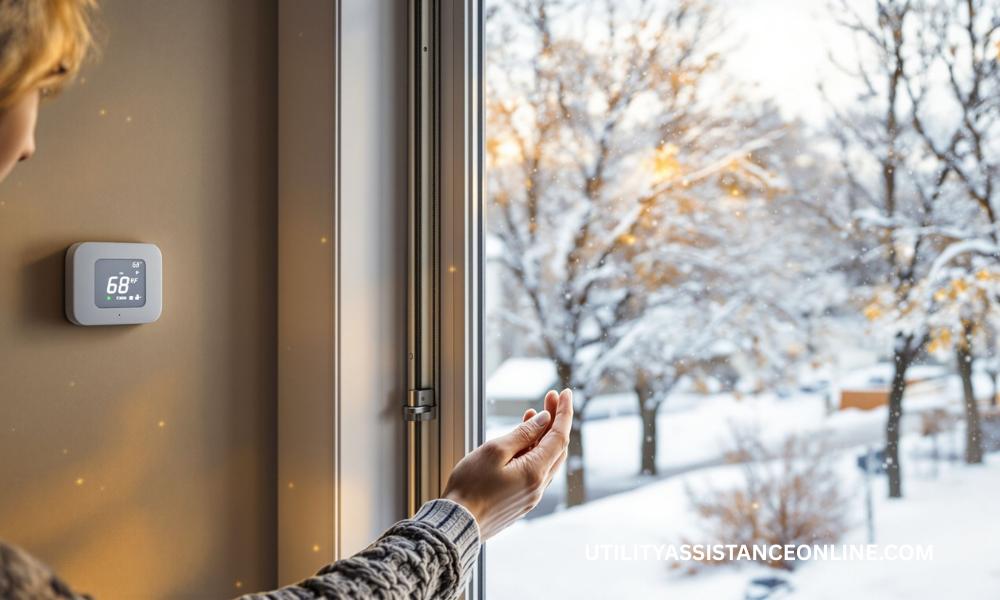
Setting your thermostat 7-10 degrees away from your comfort zone for 8 hours per day (during sleep or while away) can save up to 10% per year on heating and cooling costs, per the DOE. In summer, set the AC to 78 degrees F when home and higher when away. In winter, set heat to 68 degrees F when home and lower when away or sleeping. Ceiling fans paired with AC let you raise the thermostat 4 degrees with no comfort loss.
Switch to LED lighting
LED bulbs use approximately 75% less energy than incandescent and last 25 times longer. While LEDs cost more up front, the payback is typically under one year. If you can replace just the 5-10 most-used bulbs in your home (kitchen, living room, porch), you’ll see measurable bill reductions within the first month.
Tackle water heating
Water heating typically accounts for 14-18% of residential energy use. Lower your water heater to 120 degrees F (still safe and hot), install low-flow showerheads (under $20 each), fix leaky faucets, and wash clothes in cold water when possible. These four changes alone can cut water heating costs by 20-30%.
Audit your appliances
Refrigerators older than 15 years cost $100-$200 more per year to operate than ENERGY STAR models. Many utilities offer free or low-cost appliance recycling programs and rebates on replacements. The IRS Inflation Reduction Act energy-efficient appliance rebates are still active in 2026 for qualifying households, providing point-of-sale discounts on heat pumps, water heaters, and induction stoves. Our 5 ways to make an old home energy efficient guide covers more low-cost upgrades.
Budgeting Strategies for Managing Utility Bills for Low-Income Families
Even with assistance and efficiency improvements, predictable budgeting matters because utility bills fluctuate seasonally. Three concrete strategies make the math more manageable.
Enroll in budget billing
Most utility companies offer budget billing (also called “level pay” or “average billing”) that smooths your monthly utility cost into one consistent payment based on your 12-month rolling average. Instead of a $400 January and $90 May, you pay roughly the same amount each month all year. This makes household budgeting dramatically easier, especially for fixed-income families. For a deeper look at structuring your household budget around utilities, see our mastering your utility bills guide.
Set up payment plans before disconnection
If you fall behind, contact your utility immediately. Most utilities offer deferred payment plans that split arrears into 3-12 monthly installments alongside your current bill. Setting up a payment plan before a disconnect notice arrives gives you significantly more leverage than negotiating after the fact. Most states also have winter and summer disconnection moratoriums protecting vulnerable households during extreme weather.
Track usage monthly
Pull your utility bill each month and note the kWh, therms, or gallons used. Compare to the same month a year ago. A sudden spike often signals a malfunctioning appliance (a failing refrigerator compressor, a water heater running constantly, a hidden water leak). Catching these early can save $100s before they snowball.
Frequently Asked Questions on Managing Utility Bills for Low-Income Families
Who qualifies for help Managing Utility Bills for Low-Income Families?
Federal eligibility for LIHEAP is set at the higher of 150% of the Federal Poverty Level or 60% of State Median Income, with states allowed to set lower limits. WAP uses a more generous 200% Federal Poverty Level threshold. Households receiving SNAP, SSI, or TANF are typically automatically eligible. Both homeowners and renters can apply. Specific dollar income limits change each year based on the federal poverty guidelines.
How do I find my local LIHEAP office?
Dial 2-1-1 from any phone in the United States to reach the free, multilingual, 24/7 referral service that will route you to your local Community Action Agency. You can also visit the National Energy Assistance Referral Hotline at energyhelp.us or call 1-866-674-6327. The HHS LIHEAP Clearinghouse at liheapch.acf.gov has state-by-state contact directories.
What’s the difference between LIHEAP and WAP?
LIHEAP pays your current heating, cooling, or crisis bills with a direct credit to your utility account. WAP permanently reduces future bills through free home upgrades like insulation, air sealing, and HVAC repairs. LIHEAP has a tighter income threshold (150% FPL) but offers immediate relief. WAP has a looser threshold (200% FPL) but takes 3-9 months from application to completion. Households often qualify for and benefit from both.
Can I get help if I’m a renter?
Yes. LIHEAP serves both homeowners and renters. Renters whose utilities are billed separately receive the LIHEAP credit directly. Renters whose heat is included in rent may still qualify for a smaller LIHEAP benefit. WAP also serves renters, but landlord consent is required before work begins because weatherization upgrades attach to the property.
How much can I save with WAP?
According to U.S. Department of Energy estimates, the average WAP household saves approximately $283 per year on energy costs after weatherization. With improvements lasting 15-20+ years, the total lifetime savings often exceed $5,000 per household. The average WAP subsidy for FY 2026 is $6,500 per housing unit.
What if my utility threatens disconnection?
Contact your utility immediately and ask about emergency payment plans, hardship funds (Dollar Energy Fund, Neighbor to Neighbor, Sharing the Warmth), and disconnection moratoriums in your state. Then call your Community Action Agency and apply for LIHEAP Crisis, which most states process within days for active shutoff cases. Many states prohibit utility disconnections during extreme heat or cold weather periods. For state-by-state context, our national weatherization assistance directory covers programs across the country.
Get Help Managing Utility Bills for Low-Income Families Today
- $4.05B in 2026 LIHEAP bill payment aid
- $6,500 average WAP free home upgrade
- Utility discount & hardship programs
- Free 2-minute eligibility check