We have a curated list of the most noteworthy news from all across the globe. With any subscription plan, you get access to exclusive articles that let you stay ahead of the curve.
We have a curated list of the most noteworthy news from all across the globe. With any subscription plan, you get access to exclusive articles that let you stay ahead of the curve.
We have a curated list of the most noteworthy news from all across the globe. With any subscription plan, you get access to exclusive articles that let you stay ahead of the curve.
What is the fastest way to get utility assistance in Detroit, MI?
The fastest route to energy assistance in Detroit is applying for State Emergency Relief (SER) through the MI Bridges portal (newmibridges.michigan.gov) or calling Wayne Metro Community Action Agency at (313) 388-9799. An approved SER decision unlocks the DTE Low-Income Self-Sufficiency Plan (LSP), which sets a fixed monthly energy payment and forgives past-due balances. For water bills, apply immediately for the DWSD Lifeline Plan at (313) 386-9727 to cap your monthly water bill at $18 to $56 and erase water debt. For emergency shutoffs, dial 2-1-1.
Detroit Utility Landscape: High Heating Demands and Debt Forgiveness Programs
Detroit residents navigate brutal winter heating demands combined with some of the highest residential water burdens in the Midwest. When freezing temperatures arrive in southeast Michigan, natural gas and electricity bills through DTE Energy can quickly outpace household income. Compounding these energy costs, past-due balances on Detroit Water and Sewerage Department (DWSD) accounts frequently put homeowners and tenants at risk of service interruptions or tax liens.
Michigan operates a structured utility relief framework that coordinates state emergency grants with utility-funded debt forgiveness. Rather than providing one-time stopgap cash that leaves root debt unresolved, programs like DTE’s Low-Income Self-Sufficiency Plan (LSP) and the DWSD Lifeline Plan restructure past arrears into manageable, fixed monthly rates. Understanding how to pair state relief through MI Bridges with local intake through Wayne Metropolitan Community Action Agency gives Detroit households access to comprehensive utility protection.
Detroit Utility Assistance Programs at a Glance
MDHHS State Emergency Relief (SER) & MEAP
State-administered crisis grants up to $850 per heating season for natural gas and electric bills ($1,200 for deliverable fuels). Household income must be at or below 150% Federal Poverty Guidelines. Apply online 24/7 at newmibridges.michigan.gov.
DTE Low-Income Self-Sufficiency Plan (LSP)
Year-round program offering fixed, affordable monthly energy payments based on income. Remaining arrears are forgiven in increments over 12 to 24 months as long as monthly payments are made on time. Call Wayne Metro at (313) 388-9799.
DWSD Lifeline Plan (Water & Sewer)
Tiered water affordability program capping monthly residential water bills at $18, $43, or $56 based on income and household size. Automatically freezes collection and erases past-due debt over 36 months. Call (313) 386-9727.
Water Residential Assistance Program (WRAP)
Great Lakes Water Authority program providing up to $1,500 in direct bill credits, $25 monthly bill discounts, and up to $350 in minor household plumbing leak repairs for households at or below 200% FPL. Apply via Wayne Metro.
Michigan State Emergency Relief (SER) and MEAP in Detroit
The State Emergency Relief (SER) program, managed by the Michigan Department of Health and Human Services (MDHHS), serves as the foundational gateway for energy assistance across Wayne County. SER pays emergency energy grants directly to DTE Energy or your municipal utility to prevent shutoffs, restore disconnected service, or refill heating fuel tanks.
Income Eligibility Limits (150% FPL)
To qualify for SER energy assistance and subsequent MEAP enrollment, household gross income must fall at or below 150% of the Federal Poverty Guidelines:
Household Size
Max Monthly Gross Income
Max Annual Gross Income
1 person
$1,882
$22,590
2 people
$2,555
$30,660
3 people
$3,227
$38,730
4 people
$3,900
$46,800
5 people
$4,572
$54,870
DTE Energy Programs: LSP and Residential Income Assistance
DTE Energy provides electricity and natural gas to the vast majority of Detroit homes. The utility offers two main affordability tracks: long-term budget stabilization through LSP and direct monthly billing credits through RIA.
DTE Low-Income Self-Sufficiency Plan (LSP)
The LSP program removes the cycle of unmanageable utility debt. Once enrolled through an approved MEAP partner like Wayne Metro or The Heat and Warmth Fund (THAW), your monthly bill is calculated as a fixed, budget-friendly amount. Each time you pay this monthly amount on time, DTE pays down a portion of your historical debt balance. After 12 to 24 consecutive on-time payments, the entire past-due balance is completely forgiven.
DTE Residential Income Assistance (RIA)
If you receive Supplemental Security Income (SSI), food assistance (SNAP), or Medicaid, you can qualify for DTE’s ongoing Residential Income Assistance credit. RIA provides an ongoing credit of $8.50 per month on electric accounts and $12.50 per month on natural gas accounts. Call DTE at (800) 477-4747 to confirm this recurring discount is active on your bill.
Detroit Water Relief by the Numbers
More than 27,000 Detroit households are enrolled in the DWSD Lifeline Plan. Participating residents save an average of over $500 annually while preventing residential water shutoffs across Wayne County. For households qualifying at or below 135% FPL, total water and sewer service is fixed at just $18 per month for the first 4,500 gallons.
Detroit Water & Sewer Assistance: DWSD Lifeline and WRAP
Water debt has historically presented a severe challenge for Detroit residents. The city has developed two aggressive programs to ensure affordable, continuous clean water access.
DWSD Lifeline Plan Tiers
Tier 1 (Income ? 135% FPL): Pay $18/month for up to 4,500 gallons. Past debt is erased over 36 months of regular payments.
Tier 2 (Income 135%–150% FPL): Pay $43/month for up to 4,500 gallons with complete debt write-off over 36 months.
Tier 3 (Income 150%–200% FPL): Pay $56/month for up to 4,500 gallons with complete debt write-off over 36 months.
Water Residential Assistance Program (WRAP)
Administered by Wayne Metro on behalf of the Great Lakes Water Authority (GLWA), WRAP assists households earning up to 200% FPL. WRAP provides up to $1,500 per year in direct bill assistance, $25 monthly bill credits, and provides $350 in minor household plumbing repairs to stop silent toilet and faucet leaks that inflate monthly usage.
Comparison of Detroit Utility Assistance Options
Program
Service Covered
Income Limit
Key Benefit
State Emergency Relief (SER)
Electric & Natural Gas
? 150% FPL
Up to $850 seasonal emergency grant to halt disconnection
Fixed $18–$56/month bill cap + debt balance forgiveness
GLWA WRAP
Water & Plumbing
? 200% FPL
$1,500 bill grant + $350 plumbing leak repair audit
Editorial Team Tip: In Detroit, never apply for DTE LSP without submitting your SER application first. DTE requires an active SER approval or determination notice before enrollment in the debt-forgiveness program can proceed. Submit your SER application online through MI Bridges on a Monday morning, then immediately call Wayne Metro at (313) 388-9799 with your MI Bridges case number. For water bills, enrollment in the DWSD Lifeline Plan halts shutoffs immediately, so apply before your account reaches critical shutoff status.
Need help navigating Detroit energy, water, or crisis assistance programs?
Step-by-Step Application Roadmap for Detroit Residents
Step 1: Submit Your SER Application on MI Bridges
Go to newmibridges.michigan.gov and log into your account. Select “Apply for Benefits” and choose “State Emergency Relief.” Upload your most recent 30 days of income proof (pay stubs, award letters) and your current DTE Energy bill showing your account number and past-due balance.
Step 2: Contact Wayne Metro to Lock in DTE LSP
Once your SER application is submitted, contact Wayne Metro at (313) 388-9799. Provide your MI Bridges case number to initiate enrollment in the DTE Low-Income Self-Sufficiency Plan. Wayne Metro acts as your primary case management agency to establish your fixed monthly energy payment.
Step 3: Enroll in the DWSD Lifeline Plan for Water Relief
Call the Wayne Metro Water Assistance line at (313) 386-9727 or visit waynemetro.org/wrap. Have your DWSD account number, government-issued photo ID, and proof of household income ready. Your water bill will be locked into the appropriate $18, $43, or $56 tier.
Step 4: Request Winter Protection Plan Safeguards
If you receive a shutoff notice between November 1 and March 31, call DTE at (800) 477-4747 and state that you are applying for the Michigan Winter Protection Plan. This places an immediate hold on disconnections while your assistance applications are processed.
Beyond Bill Payment: Free Home Weatherization in Wayne County
Lowering monthly bills permanently requires addressing insulation and furnace efficiency in Detroit’s older housing stock. Through the federal Weatherization Assistance Program (WAP) administered by Wayne Metro, eligible homeowners and renters receive free wall and attic insulation, air sealing, duct repair, and heating system tune-ups. Discover more energy-saving strategies in our guide to utility assistance programs and explore weatherization assistance program options to permanently cut your utility load.
Frequently Asked Questions About Detroit Utility Help
Can DTE Energy shut off my heat in the winter in Detroit?
Under the Michigan Winter Protection Plan, regulated utilities including DTE cannot disconnect qualifying low-income households (at or below 150% FPL) or seniors aged 65 and older between November 1 and March 31. However, protection is not automatic. You must contact DTE at (800) 477-4747 and agree to a winter budget plan to prevent disconnection.
How does DWSD Lifeline debt forgiveness work?
When you enroll in the DWSD Lifeline Plan, your existing past-due water balance is frozen. For every month that you pay your new fixed monthly bill ($18, $43, or $56) on time, a portion of your past debt is written off. After 36 consecutive months of on-time payments, your entire historical water debt is completely erased.
What if I rent my home in Detroit: can I still get utility help?
Yes. Tenants who pay their own electric, gas, or water utilities are fully eligible for SER, DTE LSP, and the DWSD Lifeline Plan. If your water bill is in your landlord’s name, you can still enroll in the Lifeline Plan with a valid residential lease agreement establishing your occupancy and payment responsibility.
Take Control of Your Detroit Utility Bills Today
? Submit your State Emergency Relief (SER) application on MI Bridges
? Call Wayne Metro at (313) 388-9799 for DTE LSP debt forgiveness
? Lock in an $18–$56 monthly water bill cap with the DWSD Lifeline Plan
? Protect your home from winter disconnections under Michigan’s Winter Protection Plan
Add-on utility fees are charges landlords tack onto your monthly rent statement to cover electricity, water, gas, trash, or “utility administration” costs, separate from your base rent. When these fees are miscalculated, undisclosed, or left unpaid, many leases and state laws treat them as unpaid rent, which means an add-on utility fee dispute can turn into an eviction filing.
If you have ever opened a rent statement and found an extra $40, $75, or $120 charge labeled “utility admin fee,” “RUBS,” or “common area utility charge,” you are not imagining things, and you are not alone. Add-on utility fees have become one of the fastest-growing line items in American rental housing, and a growing body of research shows they are also becoming a quiet driver of eviction filings. As a renter already stretching a paycheck to cover housing costs, an unexpected add-on utility fee can be the difference between staying current and falling behind, and in many leases, falling behind on a fee is treated exactly like falling behind on rent.
A recent Guardian investigation into utility fees and tenant evictions put a spotlight on this exact problem, examining how opaque add-on charges are showing up in eviction court dockets around the country. This guide breaks down what these fees actually are, how they legally translate into eviction risk, what federal and state regulators are doing about them in 2026, and the concrete steps you can take to dispute a fee before it costs you your home. If you need help right away, you can also connect with free utility bill assistance programs in your area while you work through a dispute.
Understanding add-on utility fees: how landlords convert utility costs into extra rent-adjacent charges.
What Counts as an Add-On Utility Fee?
An add-on utility fee is any charge for electricity, gas, water, sewer, trash, stormwater, or “utility administration” that a landlord bills separately from base rent. Some are legitimate pass-throughs of real utility costs. Others are pure profit centers dressed up as operating costs. The National Consumer Law Center has identified roughly two dozen distinct categories of these rental “junk fees,” and utility-related charges are consistently among the most common and least understood by tenants.
Common Types of Add-On Utility Fees
As a renter, you are most likely to encounter one or more of the following on a monthly statement:
Ratio Utility Billing System (RUBS) charges, where a building’s single master utility bill is divided among units using a formula based on square footage, occupancy, or bedroom count, rather than your actual usage.
Utility administration or “convenience” fees, a flat monthly charge for the landlord’s cost of billing you, often $3 to $10 per utility per month.
Trash, valet trash, or recycling fees, billed as a separate line item even when trash collection is a standard municipal service.
Stormwater or “green” fees, which pass through a municipality’s stormwater utility charge, sometimes with a markup.
Submeter or third-party billing company fees, charged by companies like Conservice or NWP that manage utility billing on behalf of the landlord.
Data Highlight: Across ledgers examined by the Urban Institute at three large Denver-area landlords, non-rent fees, including utility charges, added between 10% and 30% to renters’ total monthly housing costs, and penalty fees on already-late accounts added another 5% to 10% on top of base rent.
As a single parent budgeting a fixed paycheck around a fixed rent number, discovering that your “rent” is actually rent plus four or five variable add-on fees can undo weeks of careful planning in a single billing cycle. That gap between what you budgeted and what you actually owe is exactly where eviction risk starts to build.
Entities You Need to Know
Add-On Utility Fee
A charge for electricity, water, gas, trash, or billing administration added to a rent statement separately from base rent.
RUBS
Ratio Utility Billing System; a formula that splits a building’s master utility bill among tenants without measuring individual usage.
LIHEAP
The Low Income Home Energy Assistance Program, a federally funded, state-administered program that helps eligible households pay home energy costs.
FTC Rental Housing Fee Rule
A Federal Trade Commission rulemaking proposal, opened for public comment in 2026, aimed at curbing unfair or deceptive rental fee practices.
Weatherization Assistance Program
A federal program that pays for free home energy-efficiency upgrades for qualifying low-income households, reducing future utility costs.
How Add-On Utility Fees Push Renters Toward Eviction
Add-on utility fees do not usually cause eviction by themselves. They cause eviction through a chain reaction that starts small and compounds fast. Understanding that chain is the first step to breaking it before it reaches a courtroom.
The “Additional Rent” Trap
Most leases define “rent” broadly enough to include any fee the landlord charges, often under a clause labeling all charges as “additional rent.” That single clause is what turns a $60 utility administration fee into something a landlord can legally pursue through the same nonpayment eviction process used for missed rent. In most states, once a fee is contractually defined as additional rent, unpaid fees appear on the same ledger, the same notice to quit, and the same eviction complaint as unpaid rent.
Why Payments Get Applied to Fees First
A second, less visible mechanism makes this worse: many landlord accounting systems apply incoming payments to fees and late charges before they apply anything to base rent. That means a tenant who pays their full rent amount, but is behind on a utility fee, can still show an “unpaid rent” balance on paper, because the payment satisfied fees first and left a rent-shaped hole behind it. Renter advocates have flagged this as a specific reason some households remain vulnerable to eviction even after receiving emergency rental assistance, since the assistance payment can be absorbed by fees rather than clearing the rent balance the landlord is suing over.
“Junk fees are fees charged on top of a tenant’s base rent in relation to the rental and occupancy of a unit.” — National Consumer Law Center
As a renter already living paycheck to paycheck, this dynamic is punishing precisely because it is invisible until you are standing in housing court. You paid what you thought was the full bill. On the landlord’s ledger, you are behind.
Data Highlight: Rents rose 26.6% nationally between March 2020 and July 2023, and more than 21 million renter households, roughly half of all U.S. renters, spent over 30% of their income on rent in 2023. Against that backdrop, an unexpected $100 in add-on utility fees is often enough to disrupt a tightly managed budget and cause a missed payment.
Behind on rent or add-on utility fees and worried about eviction? You may qualify for utility and emergency rental assistance right now.
5 Warning Signs Your Add-On Utility Fees May Be Illegal or Excessive
Not every add-on utility fee is improper, but a growing number of state investigations and lawsuits have found charges that cross the line from “annoying” to “actionable.” As a tenant, watch for these five red flags on your statement.
1. The charge exceeds the building’s actual utility bill. RUBS and similar formulas are only supposed to allocate real costs. If the sum of every tenant’s charge is higher than what the utility company actually billed the property, the landlord is marking up the bill.
2. You were never shown the billing formula. Several 2026 state laws now require landlords to disclose the exact allocation method, whether it is based on square footage, occupancy, or bedroom count, before you sign a lease.
3. Common-area or vacant-unit usage is folded into your bill. Charging tenants for hallway lighting, laundry rooms, or empty units under the guise of “your share” is one of the most frequently cited violations in recent utility-billing enforcement actions.
4. The “administration fee” changes without explanation. A flat monthly billing fee that fluctuates month to month, or jumps sharply after a lease renewal, is worth requesting documentation for.
5. Fees appear on the same notice as an eviction threat. If a pay-or-quit notice lumps utility fees in with rent without breaking out the amounts separately, you are entitled in most states to an itemized accounting before the case can proceed.
State and Federal Rules Now Regulating Add-On Utility Fees
2026 has been an unusually active year for add-on utility fee regulation. Lawmakers in multiple states responded directly to reporting and litigation over hidden rental charges, and federal regulators opened their own inquiry into the practice.
Jurisdiction
Law
What It Does
Effective
Colorado
HB26-1013
Caps RUBS charges at the utility provider’s actual bill, bars markups, and excludes common-area costs.
March 26, 2026
Maryland
SB 130
Creates a water submetering framework, caps administrative fees at $1 per unit monthly, and requires two years of historical cost disclosure.
October 1, 2026
Illinois
HB 3564
Requires all non-optional fees on the first page of the lease and caps application and late fees.
January 1, 2027
Virginia
HB 1005 / SB 294
Restricts payment-processing fees to real third-party cost and requires itemized 12-month statements before a nonpayment notice.
July 1, 2026 / 2027
Washington, D.C.
Consumer Protection Procedures Act
Requires clear, timely, and accurate disclosure of all utility billing fees before lease signing.
In effect
At the federal level, the Federal Trade Commission opened public comment in March 2026 on a proposed rule targeting unfair or deceptive rental housing fee practices, citing prior settlements of $48 million with Invitation Homes and $23 million with Greystar Real Estate Partners over hidden mandatory fees. The rule as proposed focuses on total rent disclosure and mandatory fees broadly rather than utility charges specifically, so state-level protections remain your strongest tool if you are disputing a utility add-on today.
Advocacy groups continue pushing for stronger protections. As of the most recent tracking, roughly 16 states and 8 localities had introduced or passed legislation addressing excessive rental fees, according to the Urban Institute’s research on rental junk fees.
How to Dispute an Add-On Utility Fee Before It Becomes an Eviction Notice
Disputing add-on utility fees starts with documentation, not confrontation.
If you suspect an add-on utility fee is wrong, excessive, or undisclosed, act before the balance grows and before a pay-or-quit notice arrives. As a renter, these steps put you in the strongest possible position:
Request the billing formula in writing. Ask your landlord or the third-party billing company for the exact method used to calculate your charge, and for the underlying master utility bill.
Pull your full billing history. Request at least 12 months of past statements so you can compare your charges against the property’s actual utility costs and spot inconsistencies.
Confirm what the fee actually pays for. Ask directly whether common areas, vacant units, or commercial space are factored into your residential charge.
Put every dispute in writing. Email or certified mail creates a paper trail that matters enormously if the dispute ever reaches housing court.
Keep paying the undisputed portion. Continuing to pay base rent and any fees you are not disputing protects you from a straightforward nonpayment claim while the disputed amount is worked out.
Contact your state attorney general or local tenant rights office. Many, including the D.C. Office of the Attorney General, offer free mediation between tenants and unresponsive landlords or billing companies.
Renter’s Pro Tip: Before you ever sign a new lease, ask the leasing office for the average monthly utility add-on fee paid by current tenants in a comparable unit. A landlord who cannot or will not answer that question in writing is telling you something important about how those fees are calculated.
Emergency Assistance Programs That Can Stop an Add-On Fee Eviction
If an add-on utility fee has already pushed you behind and an eviction notice is on the table, dispute rights alone will not always move fast enough. Several assistance channels can help close the gap while your dispute is resolved.
LIHEAP: Federal Home Energy Assistance
LIHEAP, the Low Income Home Energy Assistance Program, distributed its full FY 2026 allocation of roughly $4.035 billion to states as of April 2026, and can help eligible households cover energy costs, including some utility fees billed alongside rent, depending on your state’s program rules.
Data Highlight: The current federal budget proposal would eliminate LIHEAP funding entirely starting in FY 2027, the second consecutive year the program has faced a proposed elimination. Congress increased funding over the prior year’s proposal in FY 2026, but availability in future years is not guaranteed, so applying while funds remain available matters.
If funding cuts to federal energy assistance programs have you worried about whether help will still be there when you need it, the safest move is to apply as early in the program year as your state allows rather than waiting until a fee dispute turns into a shutoff or eviction threat.
Emergency Rental and Utility Grants
Beyond LIHEAP, many utility assistance programs run through community action agencies, nonprofits, and utility companies themselves offer emergency grants specifically for households facing imminent shutoff or eviction over unpaid utility charges, including add-on fees billed through the landlord. The Weatherization Assistance Program can also reduce your ongoing exposure to variable utility charges by funding free efficiency upgrades, which lowers the master bill that RUBS and similar formulas divide among tenants in the first place.
Protecting Yourself for Good: A Renter’s Add-On Utility Fee Action Plan
As a tenant, the strongest protection against add-on utility fees is treating them the same way you would treat your base rent: with a paper trail, a budget line, and a plan for what happens if a charge looks wrong. Read your lease’s fee and “additional rent” language before you sign, request 12 months of billing history for any unit you are considering, and check whether your state or city has passed one of the 2026 disclosure or fee-cap laws covered above. If you are already behind, use your strategies for managing utility bills to triage what to pay first, and apply for assistance before a fee dispute turns into a courtroom date.
Add-on utility fees are not going away, and regulators are still catching up to how widespread the practice has become. But knowing how these charges are calculated, what your state now requires landlords to disclose, and where to find emergency help gives you real leverage, whether you are fighting an incorrect charge or simply trying to keep your household stable while the rules catch up.
Facing eviction over add-on utility fees? Help is available right now.
Find local, state, and federal programs that can help cover utility bills, rental fees, and past-due balances before they cost you your home.
Frequently Asked Questions About Add-On Utility Fees and Eviction
Can a landlord evict me for not paying an add-on utility fee instead of rent?
In most states, yes, if your lease defines fees as “additional rent.” That clause lets a landlord include unpaid utility fees on the same nonpayment notice and eviction filing used for missed rent, even if your base rent itself is fully paid.
What is a Ratio Utility Billing System, and is it legal?
RUBS is a formula landlords use to divide a building’s master utility bill among tenants based on factors like square footage or occupancy, rather than actual usage. It is legal in most states, but a growing number of 2026 laws now require it to reflect the property’s real utility bill without markups.
How do I dispute an add-on utility fee I believe is incorrect?
Request the billing formula and 12 months of billing history in writing, compare the total charged to tenants against the property’s actual utility bill, and keep paying any undisputed portion of rent and fees while the dispute is pending to avoid a nonpayment claim.
Can utility assistance programs like LIHEAP help pay disputed add-on fees?
It depends on your state’s program rules and how the fee is billed. Many programs can cover energy-related charges billed alongside rent, and applying early matters, since LIHEAP funding levels are reauthorized annually and have faced repeated proposed cuts.
Are there caps on how much landlords can charge for utility fees?
A growing number of states now cap these charges. Colorado’s HB26-1013, for example, bars RUBS charges from exceeding the property’s actual utility bill, and Maryland’s SB 130 caps water administrative fees at $1 per unit per month.
What should I do if I receive an eviction notice over unpaid utility fees?
Request an itemized accounting separating fees from base rent, respond in writing within your state’s deadline, and apply immediately for emergency rental or utility assistance, since many programs can pay past-due balances directly to landlords before a court date.
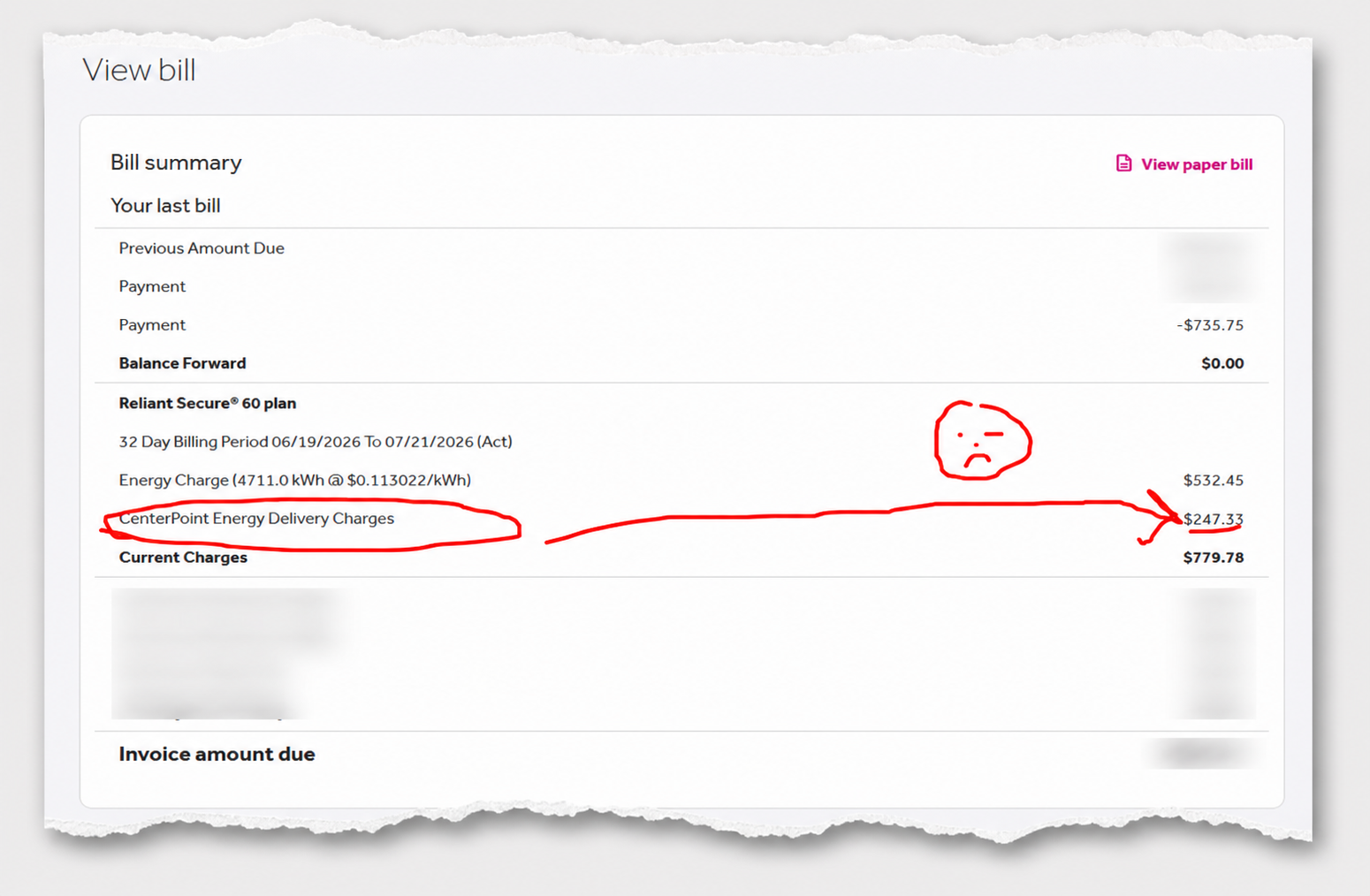
CenterPoint Energy delivery charges are regulated fees you pay for the physical transportation of electricity or natural gas from power plants and pipelines to your home. In Texas, these charges — also called TDU (Transmission and Distribution Utility) fees — are set by the Public Utility Commission of Texas and passed through on your bill without markup by your retail electricity provider. They cover the cost of maintaining the poles, wires, transformers, meters, and infrastructure that make energy delivery possible.
If you have ever opened your electric or gas bill, noticed a line item labeled “TDU Delivery Charges” or “CenterPoint Energy Delivery Charges,” and wondered what it actually means, you are far from alone. CenterPoint Energy delivery charges are one of the most commonly misunderstood components of utility bills across Texas, Indiana, Minnesota, Ohio, Mississippi, and Louisiana — every state where CenterPoint operates.
The confusion makes sense. You chose your electricity provider and signed up for a specific rate, so why is another company charging you on the same bill? The answer lies in how the energy industry is structured, particularly in deregulated markets like Texas, where the company that sells you electricity is not the same company that delivers it to your door.
This guide breaks down exactly what CenterPoint Energy delivery charges are, what they pay for, how much they cost, and whether there is anything you can do to lower them. Whether you are a Houston homeowner trying to make sense of a high electric bill or a Minnesota renter puzzled by your natural gas statement, this article covers your situation.
CenterPoint Energy delivery charges appear as separate line items on your electricity bill, distinct from the energy charges set by your retail provider.
5 Key Terms Behind CenterPoint Energy Delivery Charges
TDU (Transmission & Distribution Utility)
The regulated utility company that owns and maintains the physical grid — the poles, wires, transformers, substations, and meters — that delivers electricity to your home. In Greater Houston, that TDU is CenterPoint Energy. You cannot choose your TDU; it is determined by your physical address.
REP (Retail Electric Provider)
The competitive company you sign up with that buys electricity on the wholesale market and sells it to you. In Texas, companies like Reliant Energy, TXU Energy, and Gexa Energy are REPs. Your REP sets the energy rate and sends your bill, but it passes CenterPoint’s delivery charges through without markup.
PUCT
The Public Utility Commission of Texas — the state agency that regulates TDU delivery rates, approves rate changes, and oversees consumer protections in the deregulated electricity market. All CenterPoint Energy delivery charges must be reviewed and approved by the PUCT before they take effect.
EFL (Electricity Facts Label)
A standardized disclosure document required by the PUCT on every Texas electricity plan. The EFL shows your total rate at 500, 1,000, and 2,000 kWh usage levels — including both the energy charge and the TDU delivery charge. Always read the EFL before enrolling in any plan.
ERCOT
The Electric Reliability Council of Texas manages the flow of electric power across the Texas grid. CenterPoint operates within the ERCOT competitive retail market, which covers roughly 75% of the state’s electric load and is where deregulation allows consumers to choose their REP.
Why CenterPoint Energy Delivery Charges Exist on Your Bill
To understand CenterPoint Energy delivery charges, you need to understand how Texas restructured its electricity market. In 2002, Texas deregulated retail electricity under Senate Bill 7. The law split the old vertically integrated utilities into two separate functions. Generating and selling electricity became a competitive business open to dozens of retail providers. But delivering electricity — maintaining the physical infrastructure of poles, wires, substations, transformers, and meters — remained a regulated monopoly.
CenterPoint Energy is that regulated monopoly for the Greater Houston metro area. The company does not sell you electricity. It delivers it. Think of it the way online shopping works: you buy a product from a retailer, but a separate shipping company physically transports it to your door. Your REP is the retailer. CenterPoint is the shipping company. And just like shipping costs, CenterPoint’s delivery charges appear on your bill alongside the energy charges from your REP.
This structure means that no matter which retail provider you choose — whether it is Reliant, TXU, Gexa, Green Mountain, or any other company — your CenterPoint Energy delivery charges remain exactly the same. Switching providers changes your energy rate, but it never changes the delivery portion of your bill. The wires, the meter, the lineworkers who restore your power after a storm — all of that stays CenterPoint regardless of who you buy electricity from.
Data Highlight: How Much of Your Bill Is Delivery?
CenterPoint Energy delivery charges typically make up 30% to 40% of a Texas residential electricity bill. For a household using 1,000 kWh per month, delivery charges total approximately $54 to $57 — before any energy charges from your REP are added. CenterPoint currently serves approximately 2.8 million electric customers across a 5,000+ square-mile territory in Greater Houston.
CenterPoint Energy Delivery Charges Breakdown: Fixed vs. Variable Fees
Your CenterPoint Energy delivery charges are split into two distinct components. Understanding each one helps you read your bill accurately and recognize what you can and cannot control.
The Fixed Monthly Charge (Customer + Metering)
The first component is a flat fee assessed every billing cycle regardless of how much electricity you use. This charge covers the cost of maintaining your account, reading your smart meter, and keeping your physical service connection active. You pay this whether you use 50 kWh in a mild month or 3,000 kWh during an August heat wave.
As of the most recent PUCT-approved rates, the fixed monthly charge for standard residential service is approximately $4.90 per month, which breaks down into a $2.11 customer charge and a $2.79 metering charge. Some sources report a slightly higher combined fixed charge depending on the specific tariff snapshot and any active riders, but the figure generally falls in the $4.90 to $5.18 range.
The Variable Per-kWh Delivery Rate
The second — and much larger — component is a per-kilowatt-hour charge applied to every unit of electricity delivered to your home. This variable rate has two sub-components that are rolled together on most bills.
The transmission charge covers the cost of moving high-voltage electricity across long-distance power lines from generating plants to local substations. The distribution charge covers the cost of stepping that voltage down and delivering it through neighborhood-level wires to your meter. Combined, the base variable delivery cost is roughly 4.77¢ to 5.15¢ per kWh before additional riders and surcharges are applied.
Pro Tip: Several additional riders — including the Distribution Cost Recovery Factor (DCRF) for new infrastructure like storm hardening and smart meters, the Transmission Cost of Service (TCOS) for transmission line investments, and an energy efficiency cost recovery factor — are layered on top of the base variable rate. When all active riders are included, the effective all-in delivery rate can reach approximately 8.8¢ to 9.2¢ per kWh, depending on the specific billing month and any in-cycle adjustments.
How CenterPoint Energy Delivery Charges Add Up: Bill Examples
Here is what CenterPoint Energy delivery charges look like at three standard usage levels, based on the PUCT rate report effective June 1, 2026.
Monthly Usage
Approximate CenterPoint Delivery Charge
Share of a Typical Total Bill
500 kWh
~$30.63
~35–40%
1,000 kWh
~$56.36
~30–38%
2,000 kWh
~$107.82
~28–35%
? Data Highlight: CenterPoint vs. Other Texas TDUs
As of June 2026, CenterPoint has the lowest delivery cost among the major Texas TDUs at approximately $54.89 per month for 1,000 kWh. By comparison, Oncor (Dallas/Fort Worth) costs approximately $65.26, AEP Texas Central approximately $61.54, and TNMP approximately $80.25 at the same usage level.
When Do CenterPoint Energy Delivery Charges Change?
CenterPoint Energy delivery charges are not static. The PUCT reviews and updates TDU rates on a semi-annual schedule, with changes typically taking effect on March 1 and September 1 of each year. Understanding this schedule helps you anticipate seasonal shifts in your monthly bill — even if your energy rate from your REP is locked in under a fixed-rate contract.
This is an important distinction that trips up many Texas electricity customers. When you sign a fixed-rate electricity plan, you are locking in the energy supply charge from your REP. But the delivery charge is a regulated pass-through cost that fluctuates independently. When TDU rates change on March 1 or September 1, your total bill moves accordingly, even though your “fixed” energy rate stays exactly the same.
On your bill, this adjustment may appear as a separate line item described as “CenterPoint Energy Additional Charge” or simply as an updated per-kWh delivery rate, depending on whether your plan uses bundled or unbundled pricing.
Recent CenterPoint Rate Movements
The March 1, 2026, rate update brought welcome news for Houston-area customers. The PUCT approved a significant 16.7% reduction in CenterPoint’s variable delivery rate, lowering the per-kWh charge to just under 5 cents. This decrease directly translated to savings heading into the high-usage spring and summer seasons. However, the June 1, 2026, update reversed some of that relief with a modest increase to the per-kWh delivery charge, while the fixed monthly charge remained unchanged.
Larger rate adjustments — where CenterPoint asks the PUCT for a substantial increase to recover major infrastructure investment — happen less frequently and require formal regulatory proceedings called rate cases. CenterPoint’s most recent full rate case was Docket No. 51414, and the ongoing CenterPoint resiliency plan may trigger future adjustments as the company invests in storm hardening and grid modernization across Greater Houston.
Struggling to Keep Up With Your Utility Bills?
Explore assistance programs that can help cover electricity, gas, and water costs.
CenterPoint Energy Delivery Charges for Natural Gas Customers
CenterPoint Energy is not just an electric utility. The company is also a major natural gas provider in Minnesota, Indiana, Ohio, Mississippi, and Louisiana. If you receive natural gas service from CenterPoint, your bill contains delivery charges structured differently than the electric TDU model — but the underlying concept is the same.
How Natural Gas Delivery Charges Work
Natural gas customers pay three types of charges on their CenterPoint bill. The basic service charge is a flat monthly fee that covers account maintenance and the cost of keeping your service connection active. The delivery charge is a per-therm fee for transporting gas through CenterPoint’s distribution pipelines to your home. The cost of gas reflects the wholesale price CenterPoint pays for the natural gas itself, passed through to you at cost with no markup.
The basic service charge and delivery charge together make up approximately 50% of a typical residential natural gas bill. The cost of gas — which fluctuates monthly based on wholesale market prices — makes up the other 50%. CenterPoint does not profit from the cost of gas itself. The company earns its revenue from the delivery portion of your bill.
Minnesota Natural Gas Rates
In Minnesota, where CenterPoint serves over 920,000 natural gas customers across more than 260 communities including the Minneapolis–Saint Paul metro area, the company’s most recently approved residential rates set the basic service charge at approximately $9.50 to $11.00 per month and the delivery charge at roughly $0.245 to $0.279 per therm. In June 2025, the Minnesota Public Utilities Commission approved CenterPoint’s rate case settlement for the 2024–2025 period, and the company has been implementing interim rate adjustments while the full rate review continues.
Data Highlight: Minnesota Rate Increases
CenterPoint’s combined interim rate increases for Minnesota in 2024–2025 totaled approximately $101.9 million, or a 7.7% increase. For the average residential customer, this translated to roughly $2.58 to $5.91 per month in higher basic service and delivery charges. These interim rates are subject to refund with interest if the final approved rates come in lower.
Indiana and Ohio Natural Gas Service
Unlike the deregulated Texas market, CenterPoint operates as a fully regulated utility in Indiana and Ohio. This means the company handles both the energy supply and the delivery — you do not shop for a separate retail provider. In Indiana, CenterPoint anchors its operations around the Evansville area, while in Ohio, the company maintains natural gas distribution systems in the west-central region around Dayton. Notably, CenterPoint has been targeting a potential sale of its Ohio gas business by late 2026, so customers in that territory should watch for any changes in their service provider and billing structure.
In these regulated states, delivery charges have seen incremental rate hikes over the past year to fund mandatory safety upgrades on aging natural gas pipelines. While the charges appear on your bill similarly — as a basic service charge plus a per-unit delivery fee — you deal directly with CenterPoint for all billing questions rather than routing through a separate retail provider.
What CenterPoint Energy Delivery Charges Actually Pay For
It is reasonable to ask where your delivery dollars go. CenterPoint Energy delivery charges fund the ongoing cost of operating, maintaining, and modernizing the physical infrastructure that delivers energy to your home. The major categories of spending include the following.
Grid maintenance and repair covers the day-to-day upkeep of poles, wires, transformers, and underground cables across CenterPoint’s territory. This includes routine inspections, equipment replacements, and the lineworkers who respond to outages year-round.
Storm hardening and resiliency is a growing investment category, particularly after the criticism CenterPoint faced following Hurricane Beryl and Winter Storm Uri. CenterPoint is investing in stronger poles, upgraded conductor wire rated for higher wind loads, and strategic undergrounding of power lines in vulnerable corridors. These storm hardening costs are recovered through the DCRF rider that is added to your per-kWh delivery rate.
Smart meter technology supports the advanced metering infrastructure that allows CenterPoint to read your meter remotely, detect outages automatically, and provide real-time usage data to your retail provider. Smart meter investments are recovered through the metering component of your fixed monthly charge.
Vegetation management — commonly known as tree trimming — is essential in Greater Houston, which has one of the largest urban tree canopies in the United States. Trees growing into power lines are one of the leading causes of outages, and CenterPoint maintains an ongoing trimming cycle across its service territory. If you have experienced a CenterPoint Energy outage, it was likely tree-related contact that your delivery charges help prevent.
Transmission infrastructure covers the high-voltage lines and substations that carry electricity from generating plants to local distribution networks. These costs are recovered through the TCOS rider on your delivery charges.
Can You Lower or Avoid CenterPoint Energy Delivery Charges?
The short answer is no — you cannot avoid CenterPoint Energy delivery charges entirely. They are mandatory, regulated fees that apply to every customer in CenterPoint’s service territory, regardless of which retail provider you choose. The only way to change which TDU charges you pay is to physically move to a different service territory.
However, there are several practical strategies you can use to minimize the impact of delivery charges on your total bill.
Reduce Your Overall Usage
Since the largest portion of CenterPoint Energy delivery charges is the per-kWh variable rate, using less electricity directly lowers your delivery costs. Every kilowatt-hour you save reduces both your energy charge from your REP and your delivery charge from CenterPoint. Simple steps like sealing air leaks, upgrading to LED lighting, setting your thermostat to 78°F in summer, and replacing aging appliances with ENERGY STAR models can yield meaningful savings. As a Houston homeowner dealing with $300+ summer electric bills, cutting even 15% of your usage could save you $8 to $10 per month on the delivery portion alone.
Shop Your Energy Rate Strategically
While you cannot change the delivery charge, you can offset its impact by shopping aggressively for the lowest energy rate from your REP. Since delivery charges are identical across all providers, the energy rate is the only variable you control. When comparing plans, always use the EFL (Electricity Facts Label) to see the all-in rate at 500, 1,000, and 2,000 kWh — this includes both the energy and delivery components and gives you an accurate apples-to-apples comparison.
Pro Tip: Watch out for plans that advertise “energy only” or “excluding delivery” rates. These can make a plan appear 4–5¢ per kWh cheaper than it actually is. A rate advertised as 5¢/kWh “energy only” becomes roughly 10–14¢/kWh all-in once CenterPoint delivery charges are added. Always compare using the EFL’s total rate, not the headline number.
Time Your Contract Around Rate Updates
Since TDU delivery rates change on March 1 and September 1, signing or renewing your electricity contract shortly after a rate decrease — such as the March 2026 drop — allows you to benefit from lower delivery charges during the early months of your contract. Conversely, locking in a plan right before a known rate increase means your all-in cost rises shortly after enrollment even though your energy rate stays fixed.
Explore Utility Assistance Programs
If your total electricity bill — including CenterPoint Energy delivery charges — is more than your household can afford, multiple assistance programs exist to help. LIHEAP (the Low-Income Home Energy Assistance Program) provides direct financial assistance to income-eligible households across Texas. The Reliant Energy CARE program offers bill discounts for qualifying customers. And local nonprofits throughout Houston provide emergency utility aid through organizations like BakerRipley and Catholic Charities. You do not need to understand every line item on your bill to qualify for help — you just need to know that help paying your electric bill in Houston is available and apply.
Frequently Asked Questions About CenterPoint Energy Delivery Charges
Can I switch to a different delivery company to avoid CenterPoint charges?
No. Your TDU is determined by your physical address and is a regulated monopoly in its territory. In Greater Houston — which includes Harris, Fort Bend, Montgomery, Galveston, Brazoria, Chambers, Liberty, and Waller counties — CenterPoint Energy is the only delivery utility. The only way to change your TDU is to move to an address served by a different utility such as Oncor (Dallas–Fort Worth area) or AEP Texas (Corpus Christi/South Texas).
Does my retail electricity provider mark up CenterPoint’s delivery charges?
No. TDU delivery charges are regulated pass-through costs that your retail electric provider must pass to you at exactly the PUCT-approved rate with zero markup. Whether you are with Reliant, TXU, Gexa, Green Mountain, or any other provider, the CenterPoint delivery portion of your bill is identical. Your REP earns its revenue from the energy supply charge, not from the delivery pass-through.
Why did my CenterPoint delivery charges change if I have a fixed-rate plan?
A “fixed-rate” electricity plan locks in the energy supply charge from your retail provider, not the TDU delivery charges. Since CenterPoint’s delivery rates are adjusted by the PUCT twice a year — typically on March 1 and September 1 — your total bill will shift at those points even though your energy rate stays the same. This is normal and disclosed in the Electricity Facts Label of every plan. Look for a line item like “CenterPoint Energy Additional Charge” if the adjustment is listed separately.
What percentage of my total electric bill is CenterPoint delivery charges?
CenterPoint Energy delivery charges typically represent 30% to 40% of a Houston-area residential electricity bill, depending on your energy rate and usage level. At 1,000 kWh per month, the delivery component is approximately $54 to $57. The remaining 60% to 70% of your bill is the energy supply charge from your retail provider, plus applicable taxes and fees.
How do I find out if CenterPoint is my TDU?
The most reliable way is to check your ESI ID (Electric Service Identifier) — a unique 22-digit number assigned to your meter. Your ESI ID appears on your electricity bill and on the EFL of any plan you enroll in. If your ESI ID begins with “1008901,” CenterPoint is your TDU. You can also check by entering your ZIP code on the PUCT website or any Texas electricity comparison site, which will display the TDU serving your address.
Are CenterPoint delivery charges the same for natural gas as for electricity?
No. Electricity and natural gas delivery charges have entirely separate rate structures, are approved by different regulatory bodies, and cover different types of infrastructure. In Texas, electric delivery charges are regulated by the PUCT and measured in cents per kilowatt-hour. In Minnesota, natural gas delivery charges are regulated by the Minnesota Public Utilities Commission and measured in dollars per therm. Both types cover the cost of transporting energy to your home, but the amounts, components, and update schedules are independent.
High Utility Bills? You May Qualify for Assistance
CenterPoint Energy delivery charges are unavoidable — but help with your overall bill is within reach.
Utility assistance in Portland includes recurring bill discounts through PGE and NW Natural (15–80% off monthly bills), one-time energy grants through the Oregon Energy Assistance Program (OEAP) and LIHEAP ($250–$750, up to $1,000 in a crisis), and emergency charitable grants through the Oregon Energy Fund — all available to income-eligible Portland-area households regardless of whether they rent or own.
Portland households have access to layered utility assistance — from ongoing monthly discounts to one-time emergency grants.
Portland households facing high electric or gas bills — or a past-due balance that’s putting service at risk — have more options than most cities in the country. Programs differ significantly in how they work: PGE and NW Natural offer recurring monthly discounts baked into your bill every month; OEAP and LIHEAP provide one-time energy grants paid directly to your utility; and the Oregon Energy Fund distributes emergency charitable grants through local nonprofits when other programs have been exhausted or don’t apply. Understanding which type of help you need before you apply makes the process faster and more likely to succeed. This guide compares all the major 2026 options and explains how Portland-area households can use more than one at the same time.
If you are already behind on bills and worried about a shutoff, also read the overview of how utility assistance programs work — it explains what “bill payment” vs. “discount” programs actually do to your account and why timing matters. Oregon households facing both utility and rental cost burdens can also see what LIHEAP programs look like in comparable cold-weather markets to understand how benefit amounts are typically calculated across different state programs.
Portland Utility Assistance at a Glance
Program
Best For
Utility / Bill
Income-Based?
Assistance Type
Where to Apply
PGE Income-Qualified Bill Discount (IQBD)
Ongoing affordability
PGE electricity
Yes (60% SMI)
Recurring 15–80% monthly discount
portlandgeneral.com/iqbd or 503-228-6322
Oregon Energy Assistance Program (OEAP)
At-risk-of-disconnection PGE customers
PGE electricity
Yes (60% SMI)
One-time grant to utility account
Local Community Action Agency
LIHEAP
Heating, cooling, or crisis need
Electric, gas, oil, propane, wood
Yes (60% SMI)
Grant $250–$750 ($1,000 crisis)
Local Community Action Agency
Oregon Energy Fund
Emergency charitable gap help
Electric and gas
Yes (slightly above LIHEAP limits)
One-time charitable grant
oregonenergyfund.org — find by ZIP
NW Natural Bill Discount
Ongoing gas bill affordability
NW Natural gas
Yes (60% SMI)
Recurring 15–85% monthly discount
nwnatural.com/account/bill-discount-program or 800-422-4012
Which program should you try first?
If your bills are currently unaffordable but you are not yet behind, start with the recurring monthly discounts — PGE IQBD if you are a PGE customer, NW Natural Bill Discount if you use gas. These don’t exhaust limited grant funding and stay on your account for two years. If you already have a past-due balance or are at risk of disconnection, apply simultaneously for OEAP/LIHEAP through your local Community Action Agency — those programs make direct payments to your utility account.
Can Portland households qualify for more than one program?
Yes. PGE’s IQBD is explicitly designed to layer on top of other assistance. A PGE customer can receive the IQBD monthly discount and also receive a LIHEAP or OEAP one-time grant in the same billing period. NW Natural’s Bill Discount similarly stacks with LIHEAP and Oregon Energy Fund grants. Each program has its own eligibility review, so receiving one does not guarantee approval for another.
PGE Income-Qualified Bill Discount (IQBD)
The Portland General Electric Income-Qualified Bill Discount is a recurring monthly discount on your PGE electricity bill — not a one-time payment. It is available to residential PGE customers whose combined household income is at or below 60% of Oregon’s State Median Income (SMI). No financial documents are required to apply; PGE uses self-certification of household size and income.
What the PGE discount does
Depending on your household size and income, the monthly discount ranges from 15% to 80% off eligible charges on your PGE bill. The discount is applied to energy use charges and does not cover every line item on the bill. Once enrolled, the discount continues for two years, after which re-enrollment is required. PGE notes the program currently has over 75,000 households enrolled.
2026 eligibility and income rules
Eligibility is based on the combined gross annual income of all household members aged 18 or older. Gross income means income before taxes and deductions. The income threshold is 60% of Oregon’s State Median Income, which varies by household size and is updated annually. If you have received LIHEAP or OEAP assistance in the past, you very likely qualify for the IQBD. Confirm current income tables at portlandgeneral.com/iqbd.
How enrollment works
Apply online at portlandgeneral.com/iqbd or call 503-228-6322 (Monday–Friday, 7 a.m.–7 p.m.). No income documents are required at the time of application. Have your household size and average gross annual income ready. Assistance is also available in over 200 languages through PGE’s customer service line. The application takes only a few minutes.
What happens if your income or household changes
Contact PGE if your household size or income changes significantly. Changes that affect your tier placement should be reported. The discount is recertified at enrollment renewal (every two years), but PGE may request updates if your circumstances change.
PGE payment arrangements and other bill options
Beyond the IQBD, PGE customers can request payment extensions, enter a payment plan, or choose a flexible due date online. Customers can also access community resource referrals directly through PGE’s website if they need additional support beyond bill discounts.
Oregon LIHEAP & OEAP — 2026 Data
Oregon’s FY2026 LIHEAP funding totals approximately $40.5 million. OEAP — the state’s companion program for PGE and Pacific Power customers — holds roughly $36.4 million in FY2026. Both use the same income threshold: 60% of Oregon State Median Income. Heating and cooling grants range from $250 to $750; crisis assistance up to $1,000. Funding is not an entitlement — it is first-come, first-served. Oregon Housing and Community Services (OHCS) administers both programs through local Community Action Agencies.
Oregon Energy Assistance Program (OEAP) for Portland-Area PGE Customers
OEAP is a year-round bill payment assistance program funded by a state-mandated charge added to every PGE and Pacific Power customer’s bill. Its purpose is specifically to reduce service disconnections for income-eligible customers. Unlike LIHEAP, which is federally funded, OEAP money comes from utility customers collectively. Because it targets disconnection risk, priority assistance goes to households that are in danger of having electricity service cut off.
Who may qualify
Eligibility uses the same 60% SMI income threshold as LIHEAP. Household income and size are the primary factors. Renters can qualify if they have a direct account with PGE or if their utility costs are documented through their rental arrangement. Landlord cooperation may be needed in some cases.
What OEAP can pay
OEAP provides a one-time grant applied directly to your PGE account. The amount depends on your household’s energy costs and circumstances. It does not pay you cash; the payment goes straight to the utility to reduce your account balance.
How Portland-area applicants access funds
OEAP applications are processed by local Community Action Agencies (CAAs) — not by PGE or OHCS directly. In the Portland area, CAAs include Community Action of Washington County and a network of neighborhood organizations and nonprofits. PGE’s energy assistance page at portlandgeneral.com/energy-assistance includes a locator for agencies serving your zip code, including St. Vincent de Paul offices in various Portland neighborhoods.
Funding availability and why timing matters
OEAP is year-round but not unlimited. Funding can be exhausted during peak demand periods. Applying early — ideally before your account is delinquent — gives you more options and may make a disconnection hold easier to arrange. Once funds at your local CAA run out, you may be placed on a waiting list.
LIHEAP Energy Assistance in the Portland Area
The Low-Income Home Energy Assistance Program (LIHEAP) is federally funded through the U.S. Department of Health and Human Services (HHS) Office of Community Services and administered in Oregon by Oregon Housing and Community Services (OHCS) through local Community Action Agencies. In the Portland area, the program typically opens to the general public in December, with priority outreach to seniors, people with disabilities, and households with children under age six beginning in October and November.
Income eligibility
For FY2026 (October 1, 2025 through September 30, 2026), eligibility requires household income at or below 60% of Oregon State Median Income. For a single-person household, that is approximately $3,198 per month (gross). For a two-person household, approximately $4,183 per month. Income guidelines are verified against current HHS data — confirm exact limits with your local CAA at the time of application.
Heating and crisis assistance
LIHEAP standard heating or cooling grants range from $250 to $750, applied directly to your utility account. Separate crisis assistance of up to $1,000 is available for households facing an immediate shutoff threat or a broken heating system. These are distinct funding pools — a household can receive both standard and crisis assistance in the same program year if both situations occur. LIHEAP can also fund heating system repair or replacement for eligible households.
Where Portland-area residents apply
Applications are taken only through Community Action Agencies, not directly through OHCS or the federal government. The Oregon Energy Assistance page at oregon.gov/ohcs lists the CAA serving each county. In Multnomah County (central Portland), check with the relevant community action partner listed on the OHCS agency directory. Renters who have utility costs included in rent may still qualify — bring documentation of your energy costs and contact your local CAA for guidance on how the benefit is structured in that situation.
Oregon Energy Fund Emergency Assistance
The Oregon Energy Fund is a private 501(c)(3) nonprofit funded by donations from PGE, NW Natural, and other utility partners, as well as private donors. It distributes one-time emergency grants through a network of more than 30 partner agencies and nonprofits across Oregon — not through utility companies directly. In Portland, partners include nonprofits like Impact Northwest and other neighborhood-based organizations.
Who the fund is designed to help
Oregon Energy Fund income guidelines are slightly higher than LIHEAP/OEAP limits, which means some households who narrowly miss the LIHEAP threshold may still qualify. It is particularly useful as a bridge program when LIHEAP funding is exhausted or when a household needs emergency help between LIHEAP application cycles.
How assistance reaches a utility account
Grants are applied directly to your electric or gas account — not paid to you in cash. The partner agency processes your application and coordinates the payment with your utility. Assistance is a one-time grant, not a recurring benefit.
Partner agencies and application process
Visit oregonenergyfund.org/energy-assistance and enter your ZIP code to find the partner agency serving your Portland neighborhood. Each partner sets its own application schedule and may have limited appointment slots.
When charitable assistance is especially useful
Oregon Energy Fund help is most valuable when: LIHEAP is closed for the season or funds are exhausted; the household’s income is just above LIHEAP limits; an immediate utility crisis requires faster action than a CAA waitlist can provide; or the household needs help with a type of bill that specific government programs don’t currently cover.
“Oregon Energy Fund is a private nonprofit that helps customers struggling to pay their utility bills. It’s funded by donations from partnerships with PGE and other utility companies, as well as from private individuals. One-time grants are distributed through community nonprofit organizations.”
NW Natural Bill Assistance for Portland Gas Customers
NW Natural offers a tiered income-qualified Bill Discount Program for residential gas customers in Oregon. Like PGE’s IQBD, no proof of income documents are required to apply — self-certification is accepted.
Income-qualified and emergency assistance options
Oregon customers at or below 60% of State Median Income can receive 15% to 85% off their monthly NW Natural gas bills, depending on income tier. The discount stacks with LIHEAP and Oregon Energy Fund grants. NW Natural also works with local Community Action Agencies to help pay gas bills for income-qualifying households through the Gas Assistance Program (GAP), which collects funds from NW Natural shareholders, employees, and customers to help households experiencing difficulty.
Payment plans and account arrangements
NW Natural offers 12-month level payment plans that spread an account balance into equal monthly installments, reducing the burden of a large past-due amount. Contact NW Natural at 800-422-4012 (Monday–Friday, 7 a.m.–6 p.m.) to discuss a payment arrangement before service is disconnected.
Energy-efficiency and weatherization resources
NW Natural partners with Energy Trust of Oregon to offer weatherization services, home insulation incentives, and efficiency upgrades that reduce future gas bills. These services may be available at no or low cost to income-qualifying customers and are separate from bill discount or assistance programs. Households that have gone through the weatherization process often find their energy costs drop permanently — the weatherization assistance program guide explains how to access these services alongside utility assistance grants.
What to Do If You Have a Shutoff Notice in Portland
Shutoff Callout: Act the Same Day
If you have received a disconnection notice, contact your utility immediately. A pending assistance application does not automatically stop disconnection — you must also communicate with the utility and ask about available holds, payment arrangements, or agency pledge procedures.
Contact your utility directly — PGE at 503-228-6322 or NW Natural at 800-422-4012 — and tell them you are seeking financial assistance. Ask specifically about crisis programs, payment extensions, and whether an agency pledge letter from a CAA would pause collection activity on your account while an application is being processed. Simultaneously apply at your local Community Action Agency for LIHEAP crisis assistance (up to $1,000) and OEAP. Do not assume that an application alone stops the disconnection clock — you must actively communicate with your provider.
The Oregon Public Utility Commission (PUC) maintains consumer protection rules for utility customers. If you believe your utility has not followed proper disconnection procedures, contact the PUC consumer services team.
Documents to Gather Before Applying for Portland Utility Assistance
Having your documents organized before contacting a program reduces back-and-forth and speeds up review.
Requirements vary by program and agency, but gathering these items in advance makes every application faster:
Government-issued photo ID (required by most CAAs, optional for PGE/NW Natural self-certification)
Current utility bill or account number for PGE and/or NW Natural
Proof of gross household income for all members aged 18 and older (pay stubs, benefit award letters, Social Security documentation)
Household-member information including names, dates of birth, and Social Security numbers if applicable
Shutoff or disconnect notice, if one has been issued
Proof of current address (lease, utility bill, or official mail)
For LIHEAP: documentation of your energy costs if utilities are included in rent
The following is an illustrative example of how programs can be layered. It is not a guarantee of eligibility or approval, as each program has its own rules and funding availability.
Consider a Portland renter with a PGE electric account and an NW Natural gas account, currently $400 past due on electricity and $150 past due on gas, with a shutoff notice on the electric bill. A logical assistance sequence might look like this:
Step 1 — Recurring discount: Apply immediately for PGE’s IQBD (15–80% monthly discount, no docs required, takes effect within weeks). Apply for NW Natural’s Bill Discount simultaneously.
Step 2 — Energy grant: Contact the local Community Action Agency to apply for OEAP (priority given to disconnection-risk PGE customers) and LIHEAP crisis assistance for the shutoff threat. Both grants go directly to PGE — they do not pay cash to the customer.
Step 3 — Charitable gap assistance: If the LIHEAP/OEAP grants don’t cover the full past-due amount, apply through an Oregon Energy Fund partner agency (slightly higher income limits than LIHEAP) for a supplemental one-time grant on either the PGE or NW Natural balance.
Step 4 — Payment plan: Contact PGE and NW Natural to put the remaining balance on a payment plan, with the monthly burden now lower because of the active IQBD discount on both accounts.
This sequence is not guaranteed to eliminate all past-due balances — each program has limited funding, its own eligibility review, and its own timeline. But applying across multiple channels simultaneously is always more effective than applying to one program and waiting for an outcome before trying the next.
For more context on how utility assistance intersects with broader household financial emergencies, the utility and energy crisis resource guide covers what to do when multiple bills are at risk at the same time.
Frequently Asked Questions About Portland Utility Assistance
What is the income limit for utility assistance in Portland?
Most programs — including LIHEAP, OEAP, PGE IQBD, and NW Natural’s Bill Discount — use 60% of Oregon’s State Median Income as the eligibility threshold. The dollar amount varies by household size and is updated annually. For a single person, it is approximately $3,198/month gross income in 2026. Oregon Energy Fund uses slightly higher limits. Confirm exact current figures with your local CAA or utility before applying.
Can I get PGE utility assistance if I rent?
Yes. PGE’s IQBD requires that you be a residential PGE account holder — many renters pay their own PGE bill directly and qualify. For LIHEAP and OEAP, renters can qualify even if electricity is included in rent, but you’ll need documentation of your energy costs and may need landlord cooperation for how the benefit is applied. Contact your local CAA to discuss your specific situation.
Can I receive both OEAP and LIHEAP?
OEAP and LIHEAP use the same funding infrastructure in Oregon but can address different needs — OEAP is specifically for PGE customers at disconnection risk; LIHEAP covers multiple energy types including heat sources beyond electricity. Whether you can receive both in the same program year depends on your specific circumstances and your local CAA’s program policies. Ask your local agency directly — do not assume stacking is either always permitted or always denied.
Does Oregon Energy Fund pay the applicant directly?
No. Oregon Energy Fund grants are paid directly to the utility (PGE or NW Natural) on your behalf — not to you in cash. The partner agency coordinates the payment with the utility after your application is processed.
Can NW Natural stop a shutoff while I apply?
An application alone does not stop disconnection. Contact NW Natural at 800-422-4012 immediately and tell them you are actively applying for assistance and request an extension or arrangement. Ask whether an agency pledge letter from a Community Action Agency would pause collection. NW Natural account holds are case-specific — there is no blanket rule that applications create automatic disconnection delays.
What if I earn too much for LIHEAP?
If your income is above 60% SMI, check Oregon Energy Fund (slightly higher limits), PGE’s IQBD (same 60% SMI threshold but check the current table — it uses gross income for all household members 18+), and NW Natural’s Bill Discount. If none apply, contact PGE or NW Natural directly about payment plans, budget billing, or other account options that don’t depend on income limits.
Start With the Program Tied to Your Utility
Apply for the PGE or NW Natural monthly discount even if you are not currently behind — it lowers every future bill. Then check LIHEAP/OEAP and Oregon Energy Fund for any past-due balance. If you already have a shutoff notice, contact your provider today and tell them you are seeking financial assistance.
Apply for PGE IQBD or NW Natural discount first — no income docs needed
Contact your local Community Action Agency for LIHEAP and OEAP
Check Oregon Energy Fund by ZIP code for gap emergency help
Call your utility the same day as your assistance application — don’t wait
Last reviewed August 2026. Program rules, income thresholds, funding availability, and application procedures can change during the program year. Always verify current information directly with the administering agency, utility, or official program source before applying. Eligibility for one program does not guarantee eligibility for another, and assistance is not an entitlement — it depends on available funding.
Boston utility assistance centers on the Massachusetts Home Energy Assistance Program (HEAP), also called Fuel Assistance, which is administered locally by Action for Boston Community Development (ABCD). HEAP pays up to $850 for utility customers and up to $1,000 for deliverable-fuel households per heating season. Qualifying for HEAP also unlocks Eversource’s Discount Rate and access to HEARTWAP heating-system services. The program runs November 1 through April 30; the 2026–2027 online application opens October 1, 2026.
Boston households can access bill payment, discount rates, arrearage management, and heating-system repair through layered state, utility, and nonprofit programs.
Boston residents facing high heating bills or past-due energy balances have access to a multi-layer system of assistance: a state-administered heating grant through HEAP, a discounted utility rate through Eversource, arrearage management to clear old balances, and HEARTWAP for failing heating equipment. These programs are related but distinct — knowing which does what determines how you apply and in what order.
This guide explains each program, how ABCD administers HEAP in Greater Boston, how to access the Eversource Discount Rate, and what HEARTWAP covers. It also addresses Massachusetts utility shutoff protections, which are conditional — not automatic — and explains how Boston households can layer multiple resources to address both bill arrears and structural heating problems. For a broader overview of how these programs fit into the federal LIHEAP framework, this guide to how utility assistance programs work provides helpful context before you begin applying. Boston households dealing with both utility and housing instability may also find the weatherization assistance program guide useful — HEARTWAP and WAP both connect to the same intake as HEAP, and weatherization improvements can significantly reduce future heating costs.
Boston Utility Assistance Programs at a Glance
Program
Best For
Assistance Type
Income Threshold
Where to Apply
HEAP / Fuel Assistance
Winter heating bills
One-time seasonal grant
60% State Median Income
ABCD / mass.gov/heap
Eversource Discount Rate
Ongoing lower monthly bills
Recurring electric rate discount
HEAP/qualifying benefit receipt
eversource.com or 800-566-2080
Eversource New Start
Clearing past-due balances
12-month arrearage management
60% SMI + HEAP eligibility
Eversource / through ABCD
HEARTWAP
Broken or unsafe heating system
Repair or replacement services
Same as HEAP (60% SMI)
Automatic with HEAP application
ABCD’s role in Greater Boston: Action for Boston Community Development is the Community Action Agency serving Boston, Brookline, Newton, Malden, Medford, Everett, Melrose, Stoneham, Winchester, and Woburn. It administers all HEAP applications for this service area, processes arrearage referrals for Eversource and National Grid customers, and connects HEAP-eligible households with HEARTWAP and weatherization services.
Massachusetts HEAP: What Boston’s Fuel Assistance Program Pays
HEAP is a one-time seasonal grant paid directly to your heating provider or utility company — not to you in cash. It covers the cost of heating your primary residence. Eligible fuel types include natural gas, electricity, heating oil, propane, kerosene, coal, and wood. Renters can qualify even if heat is included in their rent, under both subsidized and private housing arrangements.
FY2026 eligibility and income guidelines
Eligibility is based on gross household income at or below 60% of Massachusetts State Median Income and household size. The income thresholds are verified before benefit payment. Eligibility is based on the last four weeks of gross income, and pandemic-related stimulus funds do not count toward income. Current FY2026 income limits include:
FY2026 HEAP Income Eligibility — Selected Household Sizes
The exact benefit amount is determined by a matrix that considers household size, gross income, fuel type, and housing situation. Homeowners or unsubsidized renters using deliverable fuels (oil, propane) generally receive the highest benefits. FY2026 standard maximum benefits are $850 for utility customers (natural gas, electricity) and $1,000 for deliverable fuel customers. Mid-season, the Healey-Driscoll Administration increased these caps to $925 for utilities and up to $1,400 for deliverable fuels to address unusually high demand. A High Energy Cost Supplement (HECS) may add additional funds for households with unusually high prior-year energy costs.
Heating fuel types covered
HEAP covers all primary residential heating sources: natural gas, electricity, heating oil, propane, kerosene, coal, and wood. The fuel type affects your benefit tier — deliverable-fuel households typically receive higher benefits than utility-billed households.
Seasonal application timing
The FY2026 season covered November 1, 2025 through April 30, 2026. Applications were accepted beginning October 1, 2025. For the 2026–2027 season: the online application opens October 1, 2026, and the program runs November 1, 2026 through April 30, 2027. Previous fuel assistance recipients receive recertification forms by mail; returning applicants can recertify by mail, online, or by calling ABCD’s automated line.
Applying Through ABCD in Boston
For Greater Boston residents, ABCD is the primary intake point for HEAP/Fuel Assistance. ABCD serves Boston, Brookline, Newton, Malden, Medford, Everett, Melrose, Stoneham, Winchester, and Woburn. Residents in other parts of Massachusetts apply through the Community Action Agency serving their city or town.
New vs. returning applicants
New applicants apply online at mass.gov/heap, by telephone at 617-357-6012, or in person by appointment at an ABCD intake site. Returning applicants who received a recertification form by mail can renew by returning the signed form with current income documentation in the postage-paid envelope or through the online portal. Boston, Brookline, and Newton applicants direct correspondence to ABCD Fuel Assistance, 178 Tremont Street, 4th Floor, Boston, MA 02111. Mystic Valley area applicants use 2 Florence Street, 4th Floor, Suite 408, Malden, MA 02148.
Documents applicants should prepare
Proof of gross income for all household members for the last four weeks (pay stubs, Social Security or benefit award letters, pension statements)
Utility bills or heating fuel account information
Lease or proof of residence
Social Security numbers or other identification for household members
For heat-included-in-rent situations: rental agreement showing monthly rent amount
Application and status process
After submitting, Boston, Brookline, and Newton applicants can check status using ABCD’s automated phone system at 617-348-6411. Mystic Valley clients call 781-322-6284 ext. 334. The state portal at mass.gov/heap also provides status updates for applications submitted online. Award letters are sent by mail once eligibility is determined.
What to do in a heating emergency
Current ABCD HEAP clients experiencing a heating emergency can contact ABCD for crisis assistance. If you are not yet a HEAP client and have no heat, contact ABCD at 617-357-6012 and explain the emergency. ABCD also serves Eversource and National Grid customers who receive Fuel Assistance with utility bill advocacy (arrearage management) — call or apply online and ask specifically about arrearage management if you have a past-due electric or gas balance.
“HEAP is a critical health and safety program. No one should hesitate to contact their local Community Action Agency and find out more. The program is accepting applications until April 30, 2026 and it has never been easier to apply.”
— Andrea Mendoza, ABCD Director of Energy Services, January 2026
Facing a Heating Shutoff or No Heat?
Contact ABCD and Eversource on the same day — applying for assistance does not automatically stop disconnection. Our guide can help you identify every current program available.
Eversource Discount Rate and Bill Assistance for Boston Customers
Eversource is the primary electric utility for most of Boston and Greater Boston. It offers a Discount Rate — a reduced electricity rate applied to your monthly bill — for eligible low-income residential customers.
Who can qualify for a discounted rate
To receive Eversource’s Discount Rate, you must be a current residential Eversource customer with the utility account in your name, and you must be eligible for HEAP (Fuel Assistance) or currently receiving one of a set of qualifying means-tested benefit programs. Qualifying benefits include SSI, MassHealth, EAEDC, TAFDC, Head Start, and certain Veterans’ Service Benefits. Eligibility for the Discount Rate is not limited to HEAP — any listed means-tested program qualifies. Separately, the Healey-Driscoll Administration established an automatic data-matching agreement in 2026 that provides Discount Rate enrollment automatically to MassHealth members and DTA clients (SNAP, TAFDC, EAEDC) without additional paperwork, with electric discounts averaging up to $1,058 per year.
Enrollment routes
Apply for the Discount Rate at eversource.com or call 800-566-2080. If you qualify through HEAP, the enrollment is often coordinated during the HEAP application process through ABCD. If you qualify through a separate means-tested benefit, apply directly to Eversource.
New Start arrearage management
If you have a past-due Eversource balance, the New Start program allows you to eliminate the outstanding balance in as little as 12 months. Requirements include: being a residential Eversource customer; having an account balance over $100 that is at least 60 days overdue; income at or below 60% SMI; eligibility for HEAP or other documented proof of income; making a good-faith payment (amount varies by customer); and making on-time monthly budget payments. Eversource makes up the difference after the 12-month period. ABCD administers arrearage management referrals for Eversource and National Grid customers in its service area — call 617-357-6012 to ask about eligibility.
Shutoff protections and when to contact Eversource
Eversource shutoff protections are conditional, not automatic. Massachusetts’s Winter Moratorium (October 27, 2025 through April 1, 2026 for the current season) protects qualifying low-income utility customers from heat-related termination — but only if you have submitted a Financial Hardship Form to your utility company. Each utility company has its own version of this form. Contact Eversource at 800-592-2000 as soon as you receive a shutoff notice and ask specifically about the winter moratorium, your Financial Hardship Form, and any available payment arrangements. Do not assume the moratorium applies automatically — you must take action.
HEARTWAP: Help Repairing or Replacing Heating Equipment in Boston
HEARTWAP (Heating System Repair and Replacement Program) is a Massachusetts program that provides heating-system repair, replacement, and maintenance services to income-eligible households. It is administered through the same agencies that administer HEAP — for Greater Boston, that is ABCD — and is entirely distinct from HEAP’s bill-payment function.
What HEARTWAP is
HEARTWAP is a year-round program that addresses the structural side of home heating — a broken furnace, an unsafe boiler, a failing heating system — rather than the bill side. If a household is HEAP-eligible but cannot use that benefit because there is no functioning heating system, HEARTWAP is the pathway to getting heat restored.
Who qualifies
Eligibility uses the same 60% SMI income threshold as HEAP. Households that are eligible for LIHEAP/Fuel Assistance are automatically eligible for HEARTWAP services. Priority is given to households with elderly individuals, people with disabilities, children under 6, and Native American households.
Eligible heating-system work
HEARTWAP can fund repair, replacement, or tune-up of heating systems including furnaces, boilers, and heat pumps. The Weatherization Assistance Program (WAP) — also triggered by a HEAP application — handles insulation, air sealing, and other energy-efficiency improvements that reduce future heating bills. These are separate programs with separate funding but a shared application entry point.
Emergency and no-heat situations
If you have no heat and are a current or eligible HEAP household, contact ABCD immediately at 617-357-6012 and describe the no-heat situation. HEARTWAP and related crisis resources can sometimes mobilize faster than standard processing for genuine heating emergencies.
Why HEARTWAP differs from HEAP bill assistance
HEAP pays a bill. HEARTWAP fixes or replaces the equipment producing the heat. A household can receive both — HEAP covers the energy cost while HEARTWAP or WAP addresses the physical structure. Applying for HEAP automatically triggers a screening for HEARTWAP and WAP eligibility, so there is no separate application required.
Massachusetts Utility Shutoff Protections for Boston Households
Preparing income documentation and utility account information before contacting ABCD significantly speeds up the HEAP application process.
Shutoff Callout: Protections Are Conditional, Not Automatic
Massachusetts utility protections for low-income households are real but require action on your part. The Winter Moratorium does not protect your service automatically — you must submit a Financial Hardship Form to your utility company. Contact Eversource, National Grid, or your gas company as soon as you receive any shutoff notice.
Winter considerations
The Massachusetts Department of Public Utilities (DPU) approved an early-start Winter Moratorium for the 2025–2026 season, beginning October 27, 2025 and extended to April 1, 2026. This moratorium protects current low-income discount rate customers from heat termination — but the protection requires submitting a Financial Hardship Form to your specific utility. Each utility (Eversource, National Grid, Eversource Gas, etc.) has its own version.
Medical circumstances
Massachusetts law provides additional shutoff protections for households with certain medical conditions. A medical certificate signed by a licensed healthcare provider can extend shutoff protections beyond the standard moratorium period. Contact the Massachusetts Department of Public Utilities (DPU) at 877-886-5066 with questions about medical protection procedures.
Families with qualifying household members
Households with children under 12, elderly members (65 and older), or seriously ill residents may qualify for additional protections from shutoff year-round. These protections are subject to rules and are not absolute — contact DPU or your utility to understand exactly what applies to your household’s situation.
How to request protection properly
Submit your utility’s Financial Hardship Form promptly when any shutoff notice is received. Apply for HEAP through ABCD in parallel. Ask your utility about payment arrangements or budget billing. If you believe your utility has not followed proper termination procedures, contact the DPU at 877-886-5066. The Massachusetts Attorney General’s consumer utility guidance also explains your rights as a utility customer.
How Boston Residents Can Layer Utility Assistance Programs
The following is an illustrative example only. It is not a guarantee of eligibility or benefit amounts, which depend on individual household circumstances and available funding at time of application.
Consider a Boston renter in an income-qualified household that uses Eversource for electricity and a gas utility for heat. The household has $600 in past-due electric bills and the furnace is making concerning noises. A layered approach might include:
HEAP grant: Apply through ABCD for a one-time HEAP payment (up to $850 for utility customers) applied to the heating or electric balance directly.
Eversource Discount Rate: Qualify for a reduced monthly rate automatically through HEAP eligibility — reducing ongoing bills for the year ahead.
New Start arrearage management: Enroll through ABCD’s arrearage referral to clear the remaining past-due balance over 12 months with Eversource making up the difference after on-time payments.
HEARTWAP inspection: Triggered automatically by the HEAP application — if the furnace is found to need repair or replacement, HEARTWAP can address it at no cost to the household.
This sequence addresses both the immediate arrears crisis and the structural equipment concern — which is exactly how Boston’s programs are designed to work together. The critical requirement is a single, complete HEAP application through ABCD that triggers eligibility screening for the connected programs. More detail on how these programs interconnect across the energy crisis landscape is available in the utility and energy crisis resource guide. Households that want to compare how Massachusetts heating assistance stacks up against other states can also review the HEAP program overview for other cold-weather markets to understand how benefit amounts and eligibility work across similar state programs.
Frequently Asked Questions About Boston Utility Assistance
Is Massachusetts HEAP the same as LIHEAP?
Yes — HEAP (Home Energy Assistance Program) is Massachusetts’s implementation of the federal LIHEAP (Low-Income Home Energy Assistance Program). The federal program provides funding; Massachusetts administers it through EOHLC and local Community Action Agencies like ABCD. Massachusetts uses the name “HEAP” or “Fuel Assistance” locally, but it is the same federal program.
How much does fuel assistance pay in Boston?
The benefit varies by household size, income, fuel type, and housing situation. Standard FY2026 maximums were $850 for utility customers and $1,000 for deliverable-fuel customers. Mid-season, Governor Healey increased these caps to $925 (utilities) and up to $1,400 (deliverable fuels) to address high demand. Some households also receive a High Energy Cost Supplement. The exact amount is calculated using an income/fuel/household matrix — review the official FY2026 benefit chart at mass.gov/heap.
Does ABCD pay my utility bill directly?
Yes. HEAP benefits are paid directly to your heating vendor or utility company on your behalf — ABCD does not write you a check. The payment appears as a credit on your utility or fuel account. This is a federal requirement of the LIHEAP program.
Can renters receive HEAP in Boston?
Yes. HEAP is available to renters as well as homeowners. If heat is included in your rent in subsidized housing, you can receive HEAP if your rent is less than 30% of your income. If heat is included in your rent in private housing, you can receive HEAP regardless of how much rent you pay — the benefit is calculated as 30% of monthly rent up to the maximum benefit amount. Renters who pay utilities separately apply as any other household would.
What does HEARTWAP cover?
HEARTWAP covers repair, replacement, and maintenance of residential heating systems — including furnaces, boilers, and heating equipment — for HEAP-eligible households. It does not pay utility bills. Applying for HEAP through ABCD automatically screens you for HEARTWAP eligibility. The Weatherization Assistance Program (WAP), also triggered by a HEAP application, covers insulation, air sealing, and energy-efficiency improvements.
Can Eversource shut off electricity in winter in Boston?
Massachusetts’s Winter Moratorium restricts shutoffs for qualifying low-income customers during winter — but this protection is not automatic. You must submit a Financial Hardship Form to Eversource. The 2025–2026 moratorium ran October 27, 2025 through April 1, 2026. Households with certain medical conditions or qualifying members may have additional year-round protections. Contact Eversource at 800-592-2000 and the DPU at 877-886-5066 for specific guidance on your situation.
Apply for HEAP Through ABCD, Then Check Eversource and HEARTWAP
No heat or a shutoff threat? Contact the appropriate agency and utility immediately — the programs work best when pursued at the same time.
Apply online at mass.gov/heap or call ABCD at 617-357-6012
Last reviewed August 2026. HEAP benefit amounts, income thresholds, application dates, and program rules are set by federal and state authorities and may change each season or mid-season. Verify current information at mass.gov/heap, bostonabcd.org, or eversource.com before applying. Eligibility is not guaranteed, and program funding is not unlimited.
What is the fastest way to get utility assistance in El Paso, TX?
Call Project BRAVO at (915) 562-4100 — it’s El Paso County’s official CEAP (Comprehensive Energy Assistance Program) administrator and can pay up to $1,800 toward your electric or gas bill, plus up to $1,800 more for a disconnection emergency. For your water bill, apply to El Paso Water’s AguaCares program (up to $250 credit) at (915) 594-5500. Veterans and veteran households can also reach Amistad’s Veterans Project at (915) 298-7307 for rent and utility help. For broader referrals, dial 2-1-1.
Utility Costs in El Paso: Desert Heat and a Single Electric Provider
El Paso sits at the edge of the Chihuahuan Desert, where summer highs routinely climb past 100°F and running an air conditioner for months at a stretch isn’t optional. El Paso Electric (EPE) is the only retail electric provider in the area — unlike deregulated pockets of Texas such as Dallas or Fort Worth, where households pick from competing retail electric providers, El Paso has no “choose your own provider” market. EPE bills, credits, and disconnects every account directly, which means every assistance program in this guide routes through EPE itself, not a third-party retailer.
El Paso County’s federally funded utility assistance runs through a single Comprehensive Energy Assistance Program (CEAP) administrator, Project BRAVO, rather than through multiple competing agencies. A second well-known nonprofit, Amistad, also helps with utility bills locally — but only for veterans and their families, through a separate Texas Veterans Commission-funded program, not as a general CEAP fallback. Knowing which agency actually serves your household, and pairing that with El Paso Electric’s own Low-Income Rider and El Paso Water’s AguaCares credit, is the key to covering every utility account rather than just one.
El Paso Utility Assistance Programs at a Glance
CEAP via Project BRAVO
El Paso County’s official TDHCA CEAP subrecipient. Phone: (915) 562-4100. Paper applications only, submitted in person at one of four physical centers. Processing typically takes 4-6 weeks. Covers electric and gas bills.
El Paso Electric (EPE) — Low-Income Rider (LIR)
Waives EPE’s $13.71 monthly customer charge ($164.52/year) for customers with a Lone Star Card or household income at or below 125% of the federal poverty level. Contact: (915) 543-5970.
El Paso Water — AguaCares
Credit of up to $250 toward a past-due water bill for customers facing disconnection, once per household per 12 months. Phone: (915) 594-5500. Apply at epwater.org.
Amistad for Veterans Project / El Paso County General Assistance
Amistad (915-298-7307) helps veteran households with rent, utility, and internet bills. El Paso County General Assistance (915-546-8150) offers emergency utility aid to any county resident in crisis, walk-in Monday-Thursday.
CEAP in El Paso: Project BRAVO
The Comprehensive Energy Assistance Program (CEAP) is Texas’s federally funded (LIHEAP) utility assistance program, and Project BRAVO is El Paso County’s sole TDHCA-designated CEAP subrecipient — confirmed on TDHCA’s own provider directory. Unlike some larger Texas counties that split CEAP intake across multiple community action agencies, El Paso funnels all general-population CEAP applications through Project BRAVO.
What CEAP Covers
Utility assistance: Up to $1,800 per household per program year (electric and/or gas)
Crisis assistance: Up to $1,800 for emergency situations (imminent disconnection or health risk)
Heating/cooling equipment: Up to $9,000 for HVAC repair or replacement
Maximum total: Up to $12,600 per household per program year
Eligibility (2026)
Household gross income at or below 150% of the Federal Poverty Income Guidelines (FPIG). For 2026 (effective January 26, 2026): 1-person: $23,940 / 2-person: $32,460 / 4-person: $49,500. Federal LIHEAP rules direct outreach priority toward elderly and disabled residents and households with children age 5 or younger.
How to Apply
Project BRAVO’s CEAP application is paper-only, submitted in person — there is no online application. Visit one of four centers: Central (2000 Texas Ave), Northeast/Westside (4838 Montana), Eastside (14901 Whitetail Deer Dr), or Ysleta (8908 Old County Rd). Call (915) 562-4100 or check projectbravo.org before visiting, since intake windows open periodically and pause once a period’s capacity fills. Processing typically takes 4-6 weeks (add 2-4 weeks if your application is incomplete) — Project BRAVO asks applicants not to call about status before that window has passed. Have ready: current utility bills, proof of income for all adults for the prior 30 days, government-issued ID, and Social Security cards for all household members.
El Paso Electric Programs for Low-Income Customers
El Paso Electric (EPE) is both the transmission utility and the sole retail provider for the El Paso area, so there is no competing-provider complexity here — every credit or discount below applies directly to your EPE account.
Low-Income Rider (LIR)
The Low-Income Rider waives EPE’s monthly $13.71 Customer Charge for qualifying residential customers — a savings of $164.52 a year. To qualify, you must have an EPE account in your name and either hold a Lone Star Card (Texas SNAP/EBT card) or have annual household income at or below 125% of the federal poverty level (2026: roughly $19,950 for one person, $27,050 for two, $41,250 for four). Lone Star Card holders mail a copy of their Food Stamp Eligibility Form with their name and EPE account number to El Paso Electric, Attn: Customer Services, LIR, Loc. 143, P.O. Box 982, El Paso, TX 79960. If you qualify by income instead, visit one of the listed partner agencies — El Paso County General Assistance, Project BRAVO, El Paso Business Strong, or Amistad — to have a representative verify your income, then give EPE your account number and name.
Payment Arrangements and Budget Billing
EPE customer service, (915) 543-5970, can review your account for a payment arrangement — typically a due-date extension of up to 14 days, with terms set case by case. Accounts already enrolled in Budget Billing (which spreads your estimated annual usage into 12 equal monthly payments, smoothing out summer AC spikes) may not qualify for a separate payment arrangement; Budget Billing itself requires at least 12 months of good payment history before you can enroll.
Additional El Paso Utility Assistance Resources
El Paso Water — AguaCares and AguaRepairs
AguaCares credits up to $250 toward a past-due water bill, once per household every 12 months, for El Paso Water customers at risk of disconnection who already have or agree to enter a payment arrangement. Only one application per household is accepted. Apply through the online form at epwater.org or call (915) 594-5500; application windows open and close based on available funding, so confirm current status before applying. Separately, AguaRepairs (administered by the nonprofit Rebuilding Together El Paso, not El Paso Water directly) provides free or low-cost leak and plumbing repairs for income-qualified homeowners, plus a Water Leak Adjustment credit for water lost to a qualifying leak — call 915-832-7010.
Amistad for Veterans Project (Veterans and Veteran Households Only)
Amistad, a longtime El Paso nonprofit, runs the Amistad for Veterans Project (AFVP) — General Assistance, funded by a Texas Veterans Commission grant. It covers rent, mortgage, rental deposits, utility bills, and internet bills for veterans and their families — not the general public, and not through the CEAP program. Call (915) 298-7307 (Option 1, then Option 1, then your zip code) to apply.
El Paso County General Assistance
El Paso County General Assistance provides emergency utility, rent/mortgage, and food-voucher assistance for county residents facing a financial crisis. It’s funded through county general funds rather than federal LIHEAP dollars, so it runs independently of Project BRAVO’s CEAP funding cycle. Located at 6314 Delta, El Paso, TX 79905; call (915) 546-8150. Intake is walk-in, first-come-first-served, with limited slots Monday through Thursday.
Salvation Army of El Paso
The Salvation Army of El Paso (4300 E Paisano Dr) may provide rental, mortgage, and/or utility assistance depending on household need and current grant availability. Call (915) 544-9811 or dial 2-1-1 to confirm current fund status before visiting.
2-1-1 Texas — Bilingual Referral Service
Dial 2-1-1 or call (877) 541-7905 (Spanish-language service available) for free 24/7 referrals to El Paso-area agencies with current utility assistance funds. 211 is an essential bridge when Project BRAVO’s CEAP intake window is paused between cycles.
El Paso Utility Assistance Programs Compared
Program
Who Qualifies
Benefit
CEAP via Project BRAVO
El Paso County residents at or below 150% FPIG; paper application, in person only
Up to $1,800 utility + $1,800 crisis + $9,000 equipment ($12,600 max)
EPE Low-Income Rider (LIR)
EPE customers with Lone Star Card or income at or below 125% FPL
$13.71/mo customer charge waived ($164.52/yr)
AguaCares (water)
El Paso Water customers at disconnection risk with a payment arrangement
Up to $250 credit; once per household per 12 months
Amistad for Veterans Project
Veterans and veteran households only
Rent/mortgage/utility/internet aid; no fixed amount
Editorial Team Tip: Don’t confuse Amistad with a second CEAP office — its utility-bill help is reserved for veterans and their families through a Texas Veterans Commission grant, so if you’re not a veteran, Project BRAVO at (915) 562-4100 is your only CEAP path in El Paso County. While that paper application processes (4-6 weeks, in person only, no online option), knock out two quick wins in parallel: if you have a Lone Star Card, mail EPE the Low-Income Rider paperwork for an automatic $164.52/year savings, and apply to El Paso Water’s AguaCares program separately for up to $250 toward your water bill — it’s a different agency with its own funding window, so applying to CEAP does not cover your water account.
Need help figuring out which El Paso agency actually covers your situation?
Step 1: Confirm Your Income Fits CEAP’s 150% FPIG Limit
For 2026, that’s roughly $23,940 for a 1-person household, $32,460 for 2 people, and $49,500 for 4 people (150% of the Federal Poverty Income Guidelines, effective January 26, 2026). If you’re within these limits, CEAP through Project BRAVO is your primary path for electric and gas help.
Step 2: Gather Your Documents
Current utility bills, proof of income for all adults for the prior 30 days, government-issued ID, and Social Security cards for all household members. Project BRAVO requires all supporting documents to be dated within 30 days of submission.
Step 3: Apply to Project BRAVO In Person
Bring your documents to one of the four Project BRAVO centers — Central (2000 Texas Ave), Northeast/Westside (4838 Montana), Eastside (14901 Whitetail Deer Dr), or Ysleta (8908 Old County Rd). Call (915) 562-4100 first to confirm the current intake window is open. There is no online CEAP application in El Paso.
Step 4: Apply to EPE and El Paso Water in Parallel
While CEAP processes, apply for the EPE Low-Income Rider (mail-in for Lone Star Card holders, or agency income verification) and El Paso Water’s AguaCares program (up to $250 credit, apply at epwater.org or call 915-594-5500) at the same time — they’re separate agencies with separate funding, and neither waits on the other.
Step 5: Use Emergency Backups If You’re Facing Disconnection
If you have an imminent disconnection notice and CEAP hasn’t processed yet, call El Paso County General Assistance at (915) 546-8150 or the Salvation Army of El Paso at (915) 544-9811. Veterans and veteran households should also call Amistad’s Veterans Project at (915) 298-7307. Dial 2-1-1 any time for a live referral to other currently funded agencies.
Beyond Bill Payment: Weatherization in El Paso
Texas’s Weatherization Assistance Program (WAP) provides free energy-efficiency upgrades to income-qualified El Paso homeowners and renters — particularly valuable in a desert climate where cooling costs dominate the bill. Project BRAVO handles weatherization intake alongside its CEAP applications; ask about current weatherization waitlists when you call (915) 562-4100. In the meantime, setting your thermostat a few degrees higher when you’re away, sealing gaps around windows and doors, and using ceiling fans to extend your AC’s reach can meaningfully reduce your summer electric bill.
El Paso Utility Assistance FAQ
Is Amistad a second CEAP administrator in El Paso, like Project BRAVO?
No. Project BRAVO is El Paso County’s only TDHCA-designated CEAP subrecipient. Amistad’s utility-bill help — the Amistad for Veterans Project — is funded separately by a Texas Veterans Commission grant and serves veterans and their families only. If you’re not a veteran, Project BRAVO at (915) 562-4100 is your CEAP option; if you are a veteran, call Amistad at (915) 298-7307 for rent, utility, and internet bill assistance.
Can I apply for CEAP online, or do I have to go in person?
Project BRAVO’s CEAP application is paper-only and must be submitted in person at one of its four El Paso centers — there is no online application. Call (915) 562-4100 or check projectbravo.org before visiting, since intake windows open periodically throughout the year and pause once a period’s capacity fills. Processing typically takes 4-6 weeks.
Does CEAP cover my water bill too?
No, CEAP only covers electric and gas accounts. For your water bill, apply separately to El Paso Water’s AguaCares program, which credits up to $250 toward a past-due balance once every 12 months for customers facing disconnection who have or agree to a payment arrangement. Apply at epwater.org or call (915) 594-5500.
How does the EPE Low-Income Rider actually save me money?
The Low-Income Rider waives El Paso Electric’s $13.71 monthly customer charge for qualifying households — a savings of $164.52 a year, applied automatically to every bill going forward once you’re approved. You qualify with a Lone Star Card (mail your Food Stamp Eligibility Form to EPE) or with household income at or below 125% of the federal poverty level, verified through a partner agency like Project BRAVO or El Paso County General Assistance.
What if I’ve heard of “Texas Utility Help” for water bills — is that still active?
No. Texas Utility Help (texasutilityhelp.com) stopped accepting energy applications in September 2023 and water applications in November 2023 after its federal funding ran out; the program is defunct statewide. For water-bill help in El Paso today, use El Paso Water’s AguaCares program instead.
Do I need to speak English to apply? Are there Spanish-language services?
No. Project BRAVO, El Paso County General Assistance, and 211 Texas (dial 2-1-1) all serve El Paso’s predominantly Spanish-speaking community with Spanish-language intake and referral services.
Ready to Get Utility Help in El Paso?
? Project BRAVO is El Paso County’s official CEAP administrator — (915) 562-4100
? CEAP can pay up to $1,800 on your electric or gas bill, plus $1,800 for a crisis
? EPE Low-Income Rider saves $164.52/year automatically for qualifying households
? El Paso Water’s AguaCares covers your water bill separately — apply to both
? Spanish-language services available at every El Paso assistance agency
What is the fastest way to get utility assistance in Nashville, TN?
Nashville households have two main pathways. For federal heating/cooling help covering electric, gas, propane, or wood, apply for LIHEAP through the Metropolitan Action Commission (MAC) at 615-862-8860 or online through the THDA SmartSimple portal. For an NES (Nashville Electric Service) electric bill crisis, apply to NES Project Help through NeedLink Nashville at 615-269-6835 or online at needlink.org (intake opens Monday and Tuesday at 10 a.m.). For same-day referral to whichever local agency currently has funds, dial 211 or text your ZIP code to 898-211.
Utility Costs in Nashville: Music City’s Growing Bill Burden
Nashville has been one of America’s fastest-growing metro areas for over a decade, and rapid growth has pushed housing and utility costs up together. The Tennessee Valley Authority (TVA) sets wholesale electricity rates that Nashville Electric Service (NES) then distributes to residential customers, making NES one of the few major-city electric utilities that is a government-owned distributor buying power from a federal agency rather than generating its own. Nashville’s hot, humid summers and increasingly volatile winters (including January 2026’s deadly Winter Storm Fern, which left tens of thousands of homes without power for days) create genuine year-round pressure on household budgets.
Davidson County residents actually have three separate utility categories to think about, not one: electric bills through NES, natural gas bills through a utility that changed ownership in 2026 (more on that below), and water/sewer bills through Metro Water Services. LIHEAP, administered locally by the Metropolitan Action Commission (MAC), covers electric, gas, propane, and wood costs. Emergency NES bill assistance runs through a separate program, NES Project Help, distributed by NeedLink Nashville. Understanding which system covers which bill – and applying to more than one at once – is the key to getting real relief in Music City.
Nashville Utility Assistance Programs at a Glance
LIHEAP via Metropolitan Action Commission (MAC)
Federal energy assistance for Davidson County households, covering electric, natural gas, propane, and wood bills. MAC administers it at 1281 Murfreesboro Pike, Nashville, TN 37217. Phone: 615-862-8860 (in-person 8am-3:30pm, call center to 4:30pm, Mon-Fri). Benefits range from $174 to $750.
NES Project Help via NeedLink Nashville
Emergency electric bill assistance for NES customers in crisis, funded by customer donations and distributed by NeedLink Nashville. Call NeedLink directly at 615-269-6835, or apply online Monday/Tuesday starting 10 a.m. at needlink.org. In-person: 3900 West End Avenue (Westminster Presbyterian Church), Mon/Tue 10am-2pm.
MAC Housing Assistance (Water/Sewer & Rent)
A separate MAC program (CSBG-funded) that pays water/sewer bills, rent or mortgage payments, and prescriptions for lower-income households. Same phone as LIHEAP: 615-862-8860. Metro Water Services also runs its own Deferred Due Date and Critical Care hardship provisions at 615-862-4600.
211 – United Way of Greater Nashville
Dial 211 or text your ZIP code to 898-211 for referrals to whichever Nashville-area agency currently has utility-assistance funds. Live navigators are available Mon-Fri 8am-5pm; the line itself runs 24 hours.
LIHEAP in Nashville: Metropolitan Action Commission (MAC)
The Metropolitan Action Commission (MAC) is Davidson County’s community action agency, one of 19 local agencies statewide that deliver LIHEAP under the Tennessee Housing Development Agency (THDA). MAC’s LIHEAP benefits range from $174 to $750, paid directly to your energy provider, and the program covers electricity, natural gas, propane, and wood.
What It Covers and Benefit Amounts
MAC’s “Utility Payment Assistance” program pays toward your primary heating/cooling energy source. It also includes a Summer Cooling Program that provides fans and air conditioners to households with elderly, disabled, or medically vulnerable members. A separate MAC program, Housing Assistance, covers water/sewer bills, rent, and other needs (see the Additional Programs section below) – LIHEAP itself does not pay water bills.
Eligibility and How Application Cycles Work
Must live in Davidson County
FY 2025-26 annual household income limits: 1 person $32,053; 2 people $41,915; 3 people $51,778; 4 people $61,641; 5 people $71,503; larger households can see the full table on MAC’s website
Must have household members responsible for energy costs
If a household member has no income, a “Zero Income” form must be submitted
How to Apply
Online: THDA’s SmartSimple Application Portal at thda.smartsimple.us/s_Login.jsp
In person/phone: MAC office at 1281 Murfreesboro Pike, Nashville, TN 37217, phone 615-862-8860 (in-person 8am-3:30pm, call center open to 4:30pm, Mon-Fri)
Documents needed: proof of income for all household members 18+, a 12-month utility billing history, your most recent utility bill, and Social Security cards for all household members.
NES Project Help: Emergency Electric Bill Assistance
NES Project Help is Nashville Electric Service’s emergency electric bill assistance program. Customers who wish to contribute add $1 or more to their own monthly bill; those funds are pooled and distributed to NES customers in crisis by NeedLink Nashville, a Nashville nonprofit that has operated continuously since 1912. Project Help is separate from LIHEAP – it’s specifically for NES electric-account crises (past-due balances, disconnection notices) rather than general energy costs.
What It Covers and How Application Cycles Work
NeedLink’s NES assistance is for electricity that has been disconnected or is at risk of disconnection. Online applications open Monday and Tuesday at 10:00 a.m. at needlink.org and close once that day’s maximum is reached – spots fill within hours, so being online right at 10 a.m. matters. NeedLink separately offers income-based rent, water, and natural-gas assistance in person for households whose rent is set at 30% of income (for example, MDHA or Section 8 recipients).
How to Apply
Apply online at needlink.org Monday or Tuesday starting at 10:00 a.m., or in person at 3900 West End Avenue, Nashville, TN 37205 (inside Westminster Presbyterian Church), Monday-Tuesday 10 a.m.-2 p.m. Mail-in hard-copy applications are available at the Wilson Entrance and can be mailed to P.O. Box 91107, Nashville, TN 37209. NeedLink’s own phone number is 615-269-6835 (customers 75+ or medically homebound can call to arrange accommodations). This is a different number from NES’s general customer-service line (615-736-6900) – call NeedLink directly for Project Help questions.
~10,000 people
NeedLink Nashville’s most recent reporting year: 4,404 assistance requests approved, helping 3,827 households and nearly 10,000 individuals – and NES itself says that’s only a fraction of the need. After January 2026’s deadly Winter Storm Fern, NES suspended disconnections and waived late fees for all customers through June 2026 (that window has now closed) and the NES Board approved $1 million for the Winter Storm Recovery Fund, becoming the fund’s largest donor. NES’s unlimited payment-arrangement offer for any customer remains available through December 2026.
Additional Nashville Utility Assistance Resources
Water and Sewer: MAC Housing Assistance & Metro Water Services
LIHEAP does not cover water bills. For water/sewer help, MAC’s separate Housing Assistance program (funded through the Community Services Block Grant) pays rent/mortgage, water and sewer bills, and prescriptions for households at or below roughly $19,563/year (1 person), $26,438/year (2 people), or $40,188/year (4 people) – call MAC at 615-862-8860. Metro Water Services also runs its own hardship provisions directly: the Deferred Due Date Program lets customers receiving Social Security, pension, retirement, or other government benefits push their due date to the 8th of the following month, and the Critical Care Customer Program protects customers whose water service is medically necessary from shutoff. Reach Metro Water Services Customer Care at 615-862-4600.
Nashville’s natural gas utility changed hands in 2026: Spire Inc. completed its acquisition of the Tennessee Piedmont Natural Gas business from Duke Energy effective March 31, 2026, and the operation now does business as Spire Tennessee, serving more than 200,000 customers across the metro area. Field crews began carrying Spire branding June 1, 2026, and full billing-system integration is expected in 2027. The customer-service number is unchanged: 800-752-7504. Spire’s national assistance and LIHEAP pages do not yet list a Tennessee-specific hardship program, so the most reliable path for a Nashville gas bill remains MAC’s LIHEAP program, which already covers natural gas alongside electric, propane, and wood.
Salvation Army Nashville – Online Applications Only
The Salvation Army Nashville covers rent, electric, and water bills, but as of October 2025 it accepts applications only through SAHelp.org – phone and email requests are no longer accepted. Applications reopen each Monday and are capped at a limited number per week; check back the following Monday if that week’s slots are full. Location: Center of Hope, 631 Dickerson Pike, Nashville, TN 37207.
Catholic Charities, Diocese of Nashville
Catholic Charities offers emergency financial assistance, including past-due utility payments capped at $130 per client, once per year, subject to available funding. Call 615-352-3087 (office hours Mon-Fri 8am-4:30pm) or use the online “get help” form (available Mon-Wed 9am-4pm) at cctenn.org. Address: 2806 McGavock Pike, Nashville, TN 37214.
211 – United Way of Greater Nashville
Dial 211 or text your ZIP code to 898-211 to connect with Nashville-area agencies currently holding utility-assistance funds. 211 is especially useful when MAC’s LIHEAP intake or NeedLink’s weekly Project Help slots are at capacity – live navigators are available Monday-Friday, 8 a.m.-5 p.m.
Nashville Utility Assistance Programs Compared
Program
Who Qualifies
Benefit
LIHEAP via MAC
Davidson County households under FY25-26 income limits (1-person $32,053/yr, 4-person $61,641/yr)
$174-$750 toward electric/gas/propane/wood, paid to provider
NES Project Help via NeedLink
NES electric customers disconnected or at risk of disconnection
Emergency electric-bill payment; online Mon/Tue 10am at needlink.org
SS/pension/benefit recipients; medically necessary water service
Extended due date; shutoff protection
NES payment arrangements
Any NES customer with a past-due balance
Installment plan; call 615-736-6900, 24/7 for arrangement requests
Salvation Army Nashville
Nashville residents; online-only weekly intake
Rent, electric, or water assistance; apply at SAHelp.org
211 Referral
Any Nashville resident
Referral to current-funding agencies
Editorial Team Tip: Save two phone numbers, not one – 615-862-8860 for MAC/LIHEAP and 615-269-6835 for NeedLink/Project Help. They’re different agencies with different funding, and Nashville residents can apply to both at the same time. NeedLink’s Monday/Tuesday 10 a.m. online intake genuinely fills within hours, so set a reminder for 9:50 a.m. While either application processes, call NES’s general line at 615-736-6900 (available 24/7 specifically for payment-arrangement requests) to buy yourself time on a past-due balance – that call costs nothing and can protect your service for weeks.
Need help navigating Nashville’s utility assistance programs?
How to Apply: Step-by-Step for Nashville Residents
Step 1: Confirm Eligibility and Call NES First If You’re Past Due
Check MAC’s FY25-26 LIHEAP income limits for your household size – roughly $32,053 for 1 person, $41,915 for 2 people, or $61,641 for 4 people. If you already have a past-due NES balance or disconnect notice, call NES immediately at 615-736-6900 (available 24/7 for payment-arrangement requests) to protect your service while you apply elsewhere.
Step 2: Gather Your Documents
For LIHEAP: proof of income for all household members 18+, a 12-month utility billing history, your current utility bill, and Social Security cards for everyone in the household. For NeedLink, have your NES account information and proof of the disconnection notice or past-due status ready.
Step 3: Apply Through Your Primary Channel
For general energy costs (electric, gas, propane, wood), apply to LIHEAP online through the THDA SmartSimple portal at thda.smartsimple.us/s_Login.jsp, or call MAC at 615-862-8860. LIHEAP can pay $174-$750 directly to your energy provider.
Step 4: Apply to Backup Channels in Parallel
If your crisis is specifically an NES electric disconnection, set a reminder for Monday or Tuesday at 9:50 a.m. and be online at needlink.org by 10:00 a.m., or visit NeedLink in person at 3900 West End Avenue. If it’s a water bill, call MAC (615-862-8860) about Housing Assistance or Metro Water Services (615-862-4600) about the Deferred Due Date Program. Apply to the Salvation Army (SAHelp.org) and Catholic Charities (615-352-3087) at the same time – none of these programs require you to wait on another application first.
Step 5: Track and Follow Up
If MAC or NeedLink are at capacity, dial 211 or text your ZIP to 898-211 for referrals to other Nashville-area agencies with active funds. Follow up by phone if you haven’t heard back within the timeframe you were given, and keep copies of everything you submit.
Beyond Bill Payment: Reducing Your Nashville Utility Bills Long-Term
Paying down a past-due balance is only half the fix – reducing what you owe going forward matters just as much. Home Uplift, a partnership between NES and the Tennessee Valley Authority, provides an average of $10,000 in free energy-saving upgrades (insulation, duct sealing, low-flow showerheads, and more) to income-qualified homeowners, and now also to single-family rental homes where the renter and landlord apply together. Apply at homeuplift.mytva.com/qualify. Simple daily habits help too: seal drafts around doors and windows before winter, set your thermostat a few degrees back overnight, and ask MAC (615-862-8860) about the Summer Cooling Program if anyone in your household is elderly, disabled, or medically vulnerable and needs a fan or air conditioner.
Nashville Utility Assistance FAQ
What is the difference between MAC’s LIHEAP and NES Project Help through NeedLink?
MAC’s LIHEAP is the federally funded program – it covers general energy costs (electric, gas, propane, or wood) for income-qualified Davidson County households. NES Project Help is specifically for NES electric-account crises, funded by customer bill donations and distributed by NeedLink Nashville. They come from different funding sources with different phone numbers (MAC: 615-862-8860; NeedLink: 615-269-6835), and you can apply to both at the same time.
NeedLink’s slots were full this Monday. What do I do?
Call NES at 615-736-6900 (available 24/7) and ask for a payment arrangement or extension to protect your service until next Monday’s NeedLink intake opens. At the same time, apply for LIHEAP through MAC’s SmartSimple portal, which is not slot-limited the same way. Dial 211 for referrals to other agencies that may have funds outside the NeedLink system.
My natural gas comes from Spire now instead of Piedmont Natural Gas – does that change anything?
Spire Inc. completed its purchase of Piedmont’s Tennessee gas business from Duke Energy on March 31, 2026, and the utility now operates as Spire Tennessee. Your customer-service phone number (800-752-7504) hasn’t changed, and MAC’s LIHEAP program still covers your natural gas bill the same way it always has. Spire’s national assistance programs don’t yet list a Tennessee-specific hardship option, so LIHEAP through MAC remains your best path for gas bill help.
Does LIHEAP pay my water bill too?
No. LIHEAP through MAC only covers electric, gas, propane, and wood. For water and sewer bills, apply separately to MAC’s Housing Assistance program (same phone, 615-862-8860, but a lower income limit), or contact Metro Water Services directly at 615-862-4600 about the Deferred Due Date Program or Critical Care Customer Program.
Can I still call the Salvation Army in Nashville to apply for utility help?
No – as of October 2025, the Salvation Army Nashville accepts assistance requests only through its online SAHelp.org system. Phone and email requests are not answered outside that system. Applications reopen every Monday and are capped at a limited number per week, so apply as early in the week as you can.
Nashville is growing fast – are assistance funds harder to access now?
Demand has risen with Nashville’s population, and the January 2026 winter storm added a fresh surge of need on top of that. NeedLink alone approved 4,404 requests last year, helping nearly 10,000 people – by NES’s own account, that’s still only a fraction of actual need. Apply as early in the program cycle as possible, use 211 to find agencies outside the main two, and take advantage of NES’s unlimited payment-arrangement offer (through December 2026) as a bridge while other applications process.
Ready to Get Utility Help in Nashville?
? LIHEAP via MAC can pay $174-$750 toward your electric, gas, propane, or wood bill
? NES Project Help through NeedLink covers electric-disconnection emergencies – call 615-269-6835
? MAC Housing Assistance and Metro Water Services cover water/sewer bills separately from LIHEAP
? Past due on NES? Call 615-736-6900 anytime, 24/7, for a payment arrangement
? Our team can help you identify the best programs for your Nashville situation
What is the fastest way to get utility assistance in Denver, CO?
For Denver households needing immediate energy help outside of LEAP season, call Energy Outreach Colorado (EOC) at 1-866-HEAT-HELP (1-866-432-8435) – the same statewide line handles both LEAP and EOC’s year-round emergency energy funds. Colorado’s main winter heating program, LEAP, opens November 1, 2026 for the 2026-27 season; apply online at Colorado PEAK or, for Denver County specifically, call Denver Human Services at (720) 944-LEAP (5327). Xcel Energy customers should also call 1-800-895-4999 to ask about the Gas and Electric Affordability Programs (GAP/EAP), which provide ongoing monthly bill credits. If it’s your water bill, Denver Water and Denver’s TRUA program can help too.
Utility Costs in Denver: Cold Winters, Year-Round Challenges
Denver’s 300 sunny days per year can be misleading – winters in the mile-high city are serious, with temperatures regularly dropping below 0°F overnight from December through February. Natural gas is the primary heating fuel for most Denver households, and Xcel Energy serves as the dominant electric and gas provider across the Denver metro, while Denver Water handles water and wastewater service. Energy costs have risen sharply in recent years, and with Denver’s housing market among the most expensive in the Mountain West, working-class households face acute utility cost burdens across electric, gas, and water bills alike that can undermine an already thin budget.
Colorado’s LEAP program is seasonal – it runs November through April – which leaves a gap during spring, summer, and early fall when households may still face hardship. Energy Outreach Colorado fills that gap with year-round assistance, and Denver’s own Temporary Rental and Utility Assistance (TRUA) program adds a local, year-round backstop that covers both Xcel and Denver Water bills. Together, these make up the most important safety net for Denver households who need help outside the LEAP window.
Denver Utility Assistance Programs at a Glance
LEAP – Low-Income Energy Assistance Program
Colorado’s LIHEAP-funded winter heating program, administered by the Colorado Department of Human Services. Open November 1 – April 30 annually. Eligibility: household income at or below 60% of Colorado State Median Income. Apply at Colorado PEAK, call 1-866-HEAT-HELP, or (in Denver County) call (720) 944-LEAP. The 2026-27 season opens November 1, 2026.
Energy Outreach Colorado (EOC) – Year-Round Help
Statewide nonprofit providing year-round energy bill assistance through 90+ partner agencies in all 64 Colorado counties – including during the gap months when LEAP is closed. Call 1-866-HEAT-HELP (same line as LEAP) to be connected. Also funds the CARE program’s free weatherization and efficiency upgrades.
Xcel Energy – Gas and Electric Affordability Programs (GAP/EAP)
Ongoing monthly bill credits for income-qualified Xcel Energy customers. Enrollment is automatic once Xcel is notified that your LEAP benefit was paid directly to Xcel as your heating vendor. Call 1-800-895-4999 or visit xcelenergy.com. GAP covers gas; EAP covers electric.
Denver Water & TRUA – Water Bill Help
Denver Water offers one-time payment assistance through its Customer Care team (303-893-2444). Denver’s Temporary Rental and Utility Assistance (TRUA) program, run by the Department of Housing Stability, covers past-due Denver Water and Xcel bills alongside rent assistance for households at or below 80% AMI.
211 Colorado – Community Resource Referral
Dial 211, text your ZIP code to 898-211, or visit 211Colorado.org for Denver-area referrals to current-funding utility assistance agencies. Particularly useful when LEAP is seasonally closed and you need emergency funds through EOC, TRUA, or a local nonprofit.
LEAP: Colorado’s Main Winter Energy Assistance Program
The Low-Income Energy Assistance Program (LEAP) is Colorado’s version of the federal LIHEAP program, administered by the Colorado Department of Human Services (CDHS). It provides financial assistance to help income-qualified households pay a portion of their winter home heating costs, plus secondary benefits like weatherization referrals and emergency furnace repair or replacement. The 2025-26 LEAP season concluded on April 30, 2026. The 2026-27 season opens November 1, 2026 and runs through April 30, 2027.
Eligibility
Gross monthly household income at or below 60% of the Colorado State Median Income – for the 2026-27 season, that’s roughly $3,774/month for a household of 1, $4,936/month for a household of 2, and $7,258/month for a household of 4
Must be a permanent legal resident of the United States and Colorado, or have a qualifying household member, with lawful-presence documentation for household members born outside the U.S.
Must pay home heating costs directly to an energy provider (like Xcel Energy) or as part of your rent
Renters with heat included in rent may qualify (subsidized housing excluded) with proper documentation
Benefit Amounts
LEAP makes a one-time seasonal payment, typically sent directly to your primary heating fuel vendor. The amount varies by household size, income, and primary heating fuel cost – eligible families generally receive between $200 and $1,000 per season. LEAP does not cover portable or temporary heaters, and a household can receive only one LEAP benefit per season.
How to Apply
Online (preferred): Colorado PEAK, available starting November 1
Statewide phone:1-866-HEAT-HELP (1-866-432-8435)
Denver County residents: Denver Human Services LEAP line, (720) 944-LEAP (5327) or DHSLeap@denvergov.org
In person or by mail: Your local county Department of Human Services office
Apply on or after November 1, 2026 – LEAP funds are limited, and standard applications take 10-25 days to process (heating emergencies can be expedited to about 10 days). No interview is required, but incomplete applications cause delays, so gather your documents ahead of time.
Energy Outreach Colorado: Year-Round Emergency Relief
Because LEAP is seasonal (November-April), Energy Outreach Colorado (EOC) is the critical resource for Denver households facing utility hardship during the remaining months. EOC is a statewide nonprofit, founded in 1989, that has invested more than $410 million in affordable-energy programs to date. It distributes emergency bill-payment assistance year-round through a network of 90+ partner agencies reaching all 64 Colorado counties. You can reach EOC at the same phone number as LEAP: 1-866-HEAT-HELP (1-866-432-8435).
EOC also funds the CARE (Colorado’s Affordable Residential Energy) Program, which provides income-qualified households with a free home energy assessment followed by no-cost efficiency upgrades – insulation, air sealing, LED lighting, low-flow fixtures, and furnace tune-ups. EOC is particularly valuable in summer, when cooling costs peak and LEAP won’t reopen for months. If you’re facing disconnection or an unmanageable bill outside of heating season, call EOC first.
Xcel Energy Affordability Programs for Denver Customers
Xcel Energy serves most of Denver’s electric and gas customers. Two ratepayer-funded bill-credit programs are available, jointly known as GAP-EAP:
Gas Affordability Program (GAP): Monthly natural gas bill credit for income-qualified customers
Electric Affordability Program (EAP): Monthly electric bill credit for income-qualified customers
Eligibility works through LEAP: Xcel automatically enrolls customers in GAP/EAP once it’s notified that a LEAP benefit was paid directly to Xcel as the heating vendor. If your LEAP benefit instead went to you as a Quest/EBT card payment rather than to the vendor, you won’t be auto-enrolled – call Xcel directly to check your status. To apply or learn more, call Xcel Energy at 1-800-895-4999 or visit xcelenergy.com. Xcel can also set up budget billing to smooth out the peaks in your monthly bill – particularly helpful when heating costs spike in January and February – and can discuss payment arrangements if you have a past-due balance.
80%
of Coloradans eligible for LEAP still hadn’t applied as of March 2026 – even though more than 105,000 households had already received help that season. If you qualify, don’t assume the program is “full.”
Beyond Energy Bills: Water and County Emergency Assistance
Utility assistance in Denver isn’t limited to gas and electric. Denver Water, the city’s separate water and wastewater utility, offers one-time payment assistance to qualifying customers through its Customer Care team at 303-893-2444 – and keeping any past-due balance under $100 helps avoid shutoff risk while you sort out a plan. Denver Water also partners with Mile High United Way’s 211 Help Center for broader referrals.
For a bigger, one-time crisis that touches both rent and utilities, Denver’s Temporary Rental and Utility Assistance (TRUA) Program, run by the city’s Department of Housing Stability, pays past-due and current bills for Denver Water and Xcel Energy (electric and gas) alongside rental assistance for households at or below 80% Area Median Income who are facing a housing crisis (utility help is only provided together with rent assistance, not on its own). TRUA’s application portal opens on the third Tuesday of each month at 10 a.m. and closes the next day at 9:59 a.m., funding permitting. Get help applying through the CARE Center at (303) 838-1200, or call Denver 311 and press 6.
Faith-based and nonprofit emergency funds are also worth checking through 211 Colorado – local organizations such as Brothers Redevelopment and neighborhood community collectives regularly supplement city and state programs with one-time grants for households that fall just outside other eligibility windows.
Denver Utility Assistance Programs Compared
Program
Who Qualifies
Benefit
LEAP (heating)
CO residents at or below 60% State Median Income; open Nov 1 – Apr 30
Colorado residents in utility hardship; year-round
Emergency bill assistance plus free CARE weatherization upgrades
Xcel GAP/EAP (gas + electric)
Xcel customers whose LEAP benefit was paid to Xcel as vendor
Ongoing monthly bill credit; auto-enrolled, stacks with LEAP
Denver Water assistance
Denver Water customers with a qualifying hardship
One-time payment assistance
Denver TRUA (rent + utility)
Denver residents at or below 80% AMI facing a housing crisis
Past-due/current Denver Water and Xcel bills, paired with rent aid
211 Colorado
Any Denver resident
Referral to current-funding agencies by ZIP code
Editorial Team Tip: Denver’s biggest trap is the seasonal gap – LEAP closes April 30 and doesn’t reopen until November 1. If you’re reading this between May and October, your path is Energy Outreach Colorado at 1-866-HEAT-HELP, not LEAP – and if it’s your water bill specifically, call Denver Water’s Customer Care line before it becomes a shutoff notice, since a balance under $100 keeps you out of immediate risk. Also don’t assume Xcel’s GAP/EAP credits kick in automatically: they only trigger if your LEAP payment went to Xcel directly as the vendor, not if you got a Quest card payment – call Xcel to confirm either way. Set a calendar reminder for November 1, 2026 to file your LEAP application the day it opens, since early applications get priority processing.
Not sure which Denver program is right for your timing and situation?
For LEAP, check your household income against the 60% State Median Income thresholds for the 2026-27 season: roughly $3,774/month for 1 person, $4,936/month for 2 people, and $7,258/month for 4 people (gross monthly income). If your income is close to these limits, apply anyway – the exact figures are finalized each spring and county caseworkers can confirm your exact eligibility.
2. Gather Your Documents
Have ready: proof of income for all adult household members, your Xcel Energy account number and a current bill, Social Security information and lawful-presence documentation for household members born outside the U.S., and (if applicable) your lease and landlord contact information if heat is included in rent.
3. Apply Through Your Primary Channel
If it’s November through April: apply for LEAP online at Colorado PEAK, or call 1-866-HEAT-HELP (1-866-432-8435). Denver County residents can also call Denver Human Services directly at (720) 944-LEAP (5327).
If it’s May through October: call Energy Outreach Colorado at 1-866-HEAT-HELP and ask for EOC referrals – LEAP is closed, but EOC operates year-round through its partner agency network.
4. Apply to Backup Channels in Parallel
Call Xcel Energy at 1-800-895-4999 to check your GAP/EAP status (it’s automatic once your LEAP vendor payment posts, but confirming doesn’t hurt). If your bill involves water, call Denver Water Customer Care at 303-893-2444, and if you’re also behind on rent, check whether Denver’s TRUA program’s monthly application window is currently open. Dial 211 for additional local nonprofit referrals in parallel with any of the above.
5. Track and Follow Up
Continue paying what you can while your application processes – LEAP and EOC cannot retroactively stop a disconnection that already happened. If you have an active application, tell your utility (Xcel or Denver Water) directly; both can typically place a temporary hold on pending disconnection action while your assistance application is under review, and can set up budget billing or a payment plan to smooth things out going forward.
Beyond Bill Payment: Weatherization and Everyday Savings in Denver
A LEAP approval may also connect you with Colorado’s Weatherization Assistance Program (WAP), administered by the Colorado Energy Office through local weatherization providers, which offers free insulation, air sealing, and furnace/HVAC improvements for income-qualified Denver homeowners and renters. Energy Outreach Colorado’s CARE program offers a similar free efficiency upgrade path outside the WAP pipeline, starting with a no-cost home energy assessment. Either route can meaningfully cut your baseline bill before winter even starts.
Day to day, small habits add up in Denver’s climate: set your thermostat a few degrees lower overnight and use a programmable thermostat if Xcel or your weatherization provider installs one for free; seal drafts around older windows and doors, which lose the most heat in Denver’s dry, windy winters; and run dishwashers and laundry during off-peak hours if you’re on a time-of-use Xcel rate plan to reduce your electric costs without any program application at all.
Denver Utility Assistance FAQ
LEAP is closed right now. What do I do about my current energy bill?
Call Energy Outreach Colorado at 1-866-HEAT-HELP immediately. EOC operates year-round through its partner agency network and can connect you with emergency energy funds even when LEAP is seasonally closed. Simultaneously, call Xcel Energy at 1-800-895-4999 to ask about the GAP/EAP monthly credit programs and request a payment arrangement or due-date extension for your current bill. Dial 211 for additional local agency referrals.
Can I stack LEAP and Xcel’s GAP/EAP programs?
Yes. LEAP provides a one-time seasonal payment toward your heating bill. Xcel’s GAP and EAP provide ongoing monthly bill credits, and enrollment happens automatically once Xcel is notified that your LEAP benefit was paid directly to them as your heating vendor. They come from different funding sources and complement each other – LEAP reduces a large winter bill while GAP/EAP reduce each monthly bill throughout the year.
I rent in Denver and heat is included in my rent. Can I still get LEAP?
Yes, as long as you’re not in subsidized housing. Colorado LEAP can assist renters who pay heating costs as part of their rent, even when the utility accounts are in the landlord’s name. When applying, bring your lease agreement and landlord contact information. Call 1-866-HEAT-HELP or Denver Human Services at (720) 944-LEAP to discuss how to document your heating costs in this situation.
I’m behind on my Denver Water bill, not just gas or electric. Is there help for that?
Yes. Call Denver Water’s Customer Care team at 303-893-2444 to ask about one-time payment assistance and to set up a payment plan before your balance grows past $100. If you’re also behind on rent, Denver’s TRUA program can pay past-due Denver Water and Xcel bills together with rental assistance – check whether that month’s application window is open by calling the CARE Center at (303) 838-1200 or Denver 311 (press 6). LIHWAP, an older federal water-assistance program some sites still mention, ended nationally in 2024 and is no longer accepting new applicants.
What’s the difference between LEAP, Energy Outreach Colorado, and Denver’s TRUA program?
LEAP is the state’s seasonal (Nov-Apr) heating-bill program. Energy Outreach Colorado is a year-round nonprofit safety net that fills the gap when LEAP is closed. Denver’s TRUA program is a separate, city-run fund that pairs utility assistance (Xcel and Denver Water) with rent assistance for households facing a broader housing crisis, with monthly application windows rather than a single seasonal opening. Many Denver households qualify for more than one – it’s worth checking all three.
Ready to Get Utility Help in Denver?
? Energy Outreach Colorado is your year-round lifeline when LEAP is closed
? LEAP opens November 1, 2026 – apply the first day to maximize your chances
? Xcel GAP/EAP auto-enrolls after a LEAP vendor payment and stacks with LEAP
? Denver Water and TRUA can help if it’s your water bill or a combined rent-and-utility crisis
? Our team can help you navigate Denver’s full assistance landscape
What is the fastest way to get utility assistance in Seattle, WA?
Seattle splits utility assistance across three utilities. For an ongoing discount on your Seattle City Light and Seattle Public Utilities bills, apply for the Utility Discount Program (UDP) online at utilityassistance.seattle.gov — it cuts electric bills by 60% and water/sewer/garbage bills by 50%. For a one-time LIHEAP energy payment, call Byrd Barr Place at 206-812-4940, or Public Health — Seattle & King County’s CHAP line at 1-800-756-5437. If you heat with natural gas, ask about Puget Sound Energy’s HELP program at the same time — it can add up to $1,000 in bill credit. For the fastest general referral, dial 2-1-1 (WA 211).
Utility Costs in Seattle: High Rates, High Stakes in 2026
Seattle is widely considered one of the most progressive cities in the US for social services, and its utility assistance system reflects that — but it’s also unusually fragmented. Electric service comes from Seattle City Light (a city-owned department), water/sewer/garbage from Seattle Public Utilities (also city-owned), and natural gas from Puget Sound Energy (a private, investor-owned utility that most Seattle households never think to ask for help from). The Utility Discount Program covers the two city-owned utilities with some of the most generous percentage-based discounts in the country — 60% off electric and 50% off water/wastewater/garbage — but it does nothing for a gas bill, and it currently reaches barely a third of the households who qualify.
Seattle’s progressive reputation shouldn’t obscure a genuine challenge: energy costs in the Pacific Northwest have risen significantly, and Seattle’s housing market has pushed low-income and working-class residents into older, less-efficient housing stock that costs more to heat and cool. Wet, cold winters make heating assistance particularly important. LIHEAP in Seattle is administered through Byrd Barr Place, a community organization that has served Seattle’s Central District for decades and also handles intake for Puget Sound Energy’s gas-bill assistance. Stacked together, UDP, LIHEAP, and PSE’s programs can meaningfully cut a household’s total utility burden — but only for residents who know all three exist.
Seattle Utility Assistance Programs at a Glance
Utility Discount Program (UDP) — City of Seattle
Ongoing 60% discount on Seattle City Light bills and 50% discount on Seattle Public Utilities (water/wastewater/garbage) bills for income-qualified Seattle customers. 2026 income limit for a 1-person household: $51,228/year. Apply online at utilityassistance.seattle.gov.
LIHEAP — Low Income Home Energy Assistance Program
One-time federal energy payment for Seattle households, processed by Byrd Barr Place through August 30, 2026. Call 206-812-4940 or the CHAP line at 1-800-756-5437, or visit byrdbarrplace.org.
PSE HELP & Bill Discount Rate — Puget Sound Energy
Up to $1,000 in account credit for gas and/or electric bills, plus an ongoing 5%-45% monthly discount once enrolled. Apply through Byrd Barr Place (206-812-4940) or directly at pse.com.
Seattle City Light — Billing Assistance
Payment plans, Emergency Bill Assistance (up to $710-$1,420/year), Project Share ($250 credit), and the Life Support Equipment Program for medically dependent households. Call 206-684-3000.
Seattle Public Utilities — Emergency Assistance
Up to $537/year (or $1,074/year with children under 18) toward a past-due water/sewer/garbage balance for income-eligible customers facing shutoff. Call 206-684-3000.
WA 211 — Community Resource Referral
Dial 211 or visit wa211.org for Seattle-area referrals to agencies with current funding. Backup number 1-877-211-9274, or text your zip code to 898211.
Utility Discount Program (UDP): Seattle’s Best Ongoing Discount
The Utility Discount Program (UDP) is a City of Seattle program that provides monthly discounts on two sets of bills: 60% off Seattle City Light electric charges and 50% off Seattle Public Utilities charges (water, wastewater, and garbage collection). For a typical household, average savings run $120-$205 per month — $732 to $2,460 a year.
Eligibility — 2026 Income Limits
Household Size
Max Annual Income (2026)
1 person
$51,228
2 people
$66,984
3 people
$82,740
4 people
$98,508
This 2026 table reflects households at or below 70% of Washington’s state median income. If you receive SNAP, the application is simpler: as long as the SNAP award letter names the same person as the utility account, you only need to submit the SNAP letter’s cover and calculation pages — no separate income documents required for that household member.
Starting January 1, 2027, the eligibility standard changes. Seattle City Council unanimously passed Council Bill 121222 (sponsored by Councilmember Dan Strauss and Council President Joy Hollingsworth) in July 2026, moving UDP from a 70%-of-state-median-income standard to 60% of Seattle’s own Area Median Income (AMI) — a metric the city says better reflects local cost of living. The change is expected to add roughly 31,000 newly eligible households, including an estimated 8,800 seniors, with further expansion toward 80% AMI planned through 2029. If you don’t qualify under the 2026 table, recheck your eligibility in January 2027.
How to Apply
Apply online at utilityassistance.seattle.gov. You’ll need photo ID for all adults in the household and income documentation for the most recent full month (or a SNAP award letter, if applicable). You can also request a paper application by calling (206) 684-0268, mail or fax it in, or apply in person at the Central Building, 810 3rd Ave, Suite 440, Seattle, WA 98104. Processing typically takes 4-6 weeks, and discounts apply to your next billing cycle after approval.
LIHEAP in Seattle: Byrd Barr Place
The federal Low Income Home Energy Assistance Program (LIHEAP) in Seattle is administered by Byrd Barr Place, a community organization at 722 18th Ave in Seattle’s Central District, on behalf of the Washington State Department of Commerce. LIHEAP makes a one-time energy grant directly to your energy provider on your behalf — it does not require you to already be behind on your bill.
Income Limits and Deadline
The 2026 application window runs through August 30, 2026, or until funds are exhausted, whichever comes first. King County’s operating income limits for 2025-2026 are approximately $1,956/month ($23,472/year) for a 1-person household, $2,644/month ($31,728/year) for 2 people, and $4,019/month ($48,228/year) for 4 people. Federal rules give priority outreach to households with elderly or disabled members and to families with young children, consistent with standard LIHEAP requirements nationwide (42 U.S.C. Section 8624).
How to Apply
Call Byrd Barr Place at 206-812-4940, or Public Health — Seattle & King County’s CHAP (Community Health Access Program) line at 1-800-756-5437, which routes City of Seattle residents to Byrd Barr Place for energy assistance. You can also apply online, or download an application and return it by mail, email, or in person; walk-in hours are Tuesday and Thursday, 10 a.m. to noon, with phone/email support Monday-Friday 9 a.m. to 5 p.m. Have ready: proof of income for all adult household members, your most recent utility bill, and Social Security documentation. Residents outside Seattle proper should instead contact the Multi-Service Center (South King County, 253-517-2263) or Hopelink (North/East King County, 425-658-2592).
Puget Sound Energy HELP: Assistance for Your Gas Bill
Most guides skip this, but it matters: your natural gas comes from Puget Sound Energy (PSE), a private utility — not Seattle City Light or Seattle Public Utilities. If you heat with gas, PSE’s own assistance program is worth applying for alongside UDP and LIHEAP.
What HELP Covers and Benefit Amounts
The Home Energy Lifeline Program (HELP) helps income-qualified customers pay overdue electric or natural gas bills with up to $1,000 in account credit, and automatically enrolls you in PSE’s ongoing Bill Discount Rate (BDR) program too. Eligibility is household income at or below 80% of area median income or 200% of the federal poverty level, whichever is greater. Once enrolled, BDR adds an ongoing monthly discount of 5% to 45% based on income, household size, and county — placed into one of six tiers, usually with no separate proof of income required.
How to Apply
Seattle residents can apply through Byrd Barr Place at 206-812-4940 (the same local agency that processes LIHEAP), or directly online at pse.com. For billing questions or help with the Bill Discount Rate specifically, contact PSE at 888-225-5773 or billdiscount@pse.com. The 2026 HELP application window runs through roughly the end of August 2026, consistent with Byrd Barr Place’s LIHEAP deadline — apply for both at the same visit or call.
~31,000
more Seattle households will become newly eligible for the Utility Discount Program when its income standard expands on January 1, 2027 — on top of an estimated 39,000+ households who already qualify today but haven’t enrolled. As of mid-2026, only about 36% of UDP-eligible Seattle households are actually signed up. (Source: Seattle City Council Bill 121222 coverage, July 2026.)
Additional Seattle Utility Assistance Resources
Seattle City Light — Project Share and Life Support Equipment
Beyond Emergency Bill Assistance (see the at-a-glance card above), City Light also offers Project Share: a one-time $250 bill credit per household per year, funded entirely by customer donations. If someone in your home depends on electric-powered medical equipment, ask about the Life Support Equipment Program instead of assuming there’s a general “medically vulnerable” list — a licensed healthcare provider must complete a certification form, renewed annually, that flags your account so staff know about your household’s needs. City Light also allows reconnection requests during an official National Weather Service heat alert for customers already disconnected for non-payment. Call 206-684-3000 for any of these.
Seattle Public Utilities — Water, Sewer, and Garbage
SPU’s water/wastewater/garbage discount runs through the same UDP application as City Light’s. For a past-due balance specifically, SPU’s own Emergency Assistance Program (see at-a-glance card) is a separate route from UDP — call 206-684-3000 to start either one.
WA 211 — Referral Network
Dial 211 or visit wa211.org for Seattle-specific referrals to current-funding local agencies. WA 211 is operated by Crisis Connections and covers the entire state, including King County — during periods when Byrd Barr Place’s intake is at capacity, 211 can direct you to other organizations with active energy assistance funds. If you can’t get through by phone, call the backup line at 1-877-211-9274 or text your zip code to 898211.
Seattle Utility Assistance Programs Compared
Program
Who Qualifies
Benefit
UDP — Electric (City Light)
Seattle City Light customers; income up to $51,228/yr (1 person) in 2026
60% ongoing monthly discount
UDP — Water/Wastewater (SPU)
Same eligibility as UDP Electric; same application
50% ongoing monthly discount on water/wastewater/garbage
LIHEAP via Byrd Barr Place
Seattle households up to ~$48,228/yr (4 people); apply by Aug 30, 2026
One-time energy payment; amount varies
PSE HELP + Bill Discount Rate (gas/electric)
PSE customers at or below 80% AMI or 200% FPL
Up to $1,000 credit, plus 5%-45% ongoing discount
City Light Emergency Bill Assistance
Shutoff notice or $250+ past due
Up to $710/yr ($1,420/yr with kids under 18)
WA 211 — Referral
Any Seattle resident
Referral to current-funding agencies by need
Editorial Team Tip: Most Seattle residents apply for UDP and stop there — but if you heat with gas, skipping Puget Sound Energy’s HELP program leaves money on the table, since it’s a separate funding source. Call Byrd Barr Place once at 206-812-4940 and ask them to screen you for LIHEAP and PSE HELP in the same conversation, then apply for UDP separately at utilityassistance.seattle.gov. Don’t assume you’re over the income limit either: UDP’s 2026 threshold is $98,508 for a 4-person household, and it’s rising in January 2027.
Not sure which Seattle program applies to you? Get personalized guidance.
Step 1: Check Eligibility for Every Program at Once
Compare your household income against all three thresholds. UDP (2026): $51,228/yr for 1 person, $66,984 for 2 people, $98,508 for 4 people. LIHEAP: roughly $23,472/yr for 1 person, $31,728 for 2 people, $48,228 for 4 people. PSE HELP: at or below 80% of area median income or 200% of the federal poverty level. Many households qualify for more than one at once.
Step 2: Gather Your Documents
You’ll generally need photo ID for all adults in the household, income documentation for the most recent full month (or a SNAP award letter), your most recent utility bills, and your Seattle City Light and/or Seattle Public Utilities account numbers.
Step 3: Apply for UDP Online First
Visit utilityassistance.seattle.gov and complete the application. This is the ongoing discount, so getting it started first means every future bill is smaller while you work through the other programs. Processing takes about 4-6 weeks.
Step 4: Call Byrd Barr Place for LIHEAP and PSE HELP in Parallel
Call 206-812-4940 (or the CHAP line, 1-800-756-5437) to apply for LIHEAP and ask to be screened for PSE HELP in the same call if you have a gas bill. Both have a 2026 deadline around late August, so don’t wait. LIHEAP and PSE HELP provide one-time or credit-based relief that can cover a past-due balance while UDP’s ongoing discount handles future bills.
Step 5: Protect Your Account While Applications Process
Call 206-684-3000 if you’re at risk of disconnection while an application is pending. Ask about a payment plan, or the Emergency Bill Assistance / Emergency Assistance programs if you’ve received a shutoff notice.
Beyond Bill Payment: Weatherization in Seattle
Washington’s Weatherization Assistance Program (WAP) provides free energy-efficiency improvements — insulation, air sealing, ventilation, and more — to income-qualified homeowners and renters, delivered locally by the Seattle Office of Housing’s Weatherization program (206-812-4940, the same intake line as Byrd Barr Place’s energy assistance). If you qualify for LIHEAP, you likely qualify for weatherization too. Day to day, small habits stretch assistance dollars further: lower your thermostat a couple of degrees in winter, weatherstrip drafty windows and doors, run full loads in the dishwasher and washer, and unplug idle electronics. Both PSE and City Light also offer free or low-cost home energy audits for income-qualified customers to pinpoint the highest-impact fixes for your home.
Seattle Utility Assistance FAQ
Can I get UDP, LIHEAP, and PSE HELP all at the same time?
Yes, and you should apply for all three if you’re eligible. UDP is an ongoing monthly discount on your City Light and SPU bills; LIHEAP is a one-time payment that can erase a past-due balance; PSE HELP is a separate credit for Puget Sound Energy gas or electric bills, plus an ongoing discount once enrolled. Different funding sources, different utilities — applying for one doesn’t disqualify you from the others.
My gas comes from Puget Sound Energy, not Seattle City Light. Where do I get help with that bill?
Seattle City Light and Seattle Public Utilities don’t handle gas — that’s Puget Sound Energy (PSE), a separate, privately owned utility serving most Seattle households with gas heat. PSE’s Home Energy Lifeline Program (HELP) provides up to $1,000 in account credit plus an ongoing 5%-45% monthly discount once enrolled. Apply through Byrd Barr Place (206-812-4940) or directly at pse.com.
I am a renter in Seattle. Can I still qualify for the UDP?
Yes. UDP requires a Seattle City Light or Seattle Public Utilities account in your name. Renters who pay their electric and water bills directly (not included in rent) can apply. If utilities are bundled into your rent and you have no account in your name, contact 211 for alternative renter assistance programs.
I receive SNAP benefits. Does that simplify my UDP application?
Yes, for the household member listed on the SNAP award letter. If that person is also named on the Seattle City Light bill, submit the SNAP letter’s cover and calculation pages instead of separate income documents — that speeds up the application. Other adults in the household who aren’t on the same SNAP case still need their own income documentation.
Is the Utility Discount Program’s income limit changing?
Yes. Starting January 1, 2027, Council Bill 121222 shifts UDP’s standard from 70% of Washington’s state median income to 60% of Seattle’s own area median income, adding an estimated 31,000 newly eligible households, with further expansion toward 80% area median income planned through 2029. If you were told you didn’t qualify under the 2026 rules, check again in 2027.
What happens to my UDP discount if my income changes?
Notify Seattle City Light if your income increases significantly — UDP eligibility is reassessed periodically, and your discount may be modified or discontinued if you rise above the threshold. If your income decreases, reapply to make sure you’re getting the correct discount level. Call City Light at 206-684-3000 to report a change.
Ready to Cut Your Seattle Utility Bills?
UDP provides 60% off electric and 50% off water bills – among the most generous in the US
Heat with gas? Puget Sound Energy’s HELP program adds up to $1,000 in credit
UDP’s income limits are expanding further starting January 2027 – check if you qualify
LIHEAP via Byrd Barr Place adds a one-time payment for past-due balances
Our team can help you navigate Seattle’s three-utility assistance landscape
What is the fastest way to get utility assistance in Charlotte, NC?
For most Charlotte households, the fastest path is applying for the Crisis Intervention Program (CIP) through the Mecklenburg County Department of Social Services (DSS) — online at epass.nc.gov or by calling your local DSS office. CIP provides emergency funds for qualifying households in a genuine heating or cooling crisis, funded through NC’s July–June state fiscal year. Simultaneously, apply for the Low Income Energy Assistance Program (LIEAP) through Mecklenburg County DSS at (704) 336-3000 — the seasonal program opens December 1 for seniors and residents with disabilities, and January 1 for everyone else. For additional emergency help, contact Crisis Assistance Ministry at 500-A Spratt St, Charlotte, or dial 2-1-1.
Utility Costs in Charlotte: A Growing Burden for Mecklenburg Families
Charlotte has been one of the fastest-growing cities in the United States for over a decade. That growth has been a boon for the local economy, but it has also brought sharp increases in housing and utility costs that have outpaced income growth for working-class households. Mecklenburg County is now among the more expensive utility markets in the Southeast, with Duke Energy Carolinas serving as the primary electric utility for most residents.
For households managing on fixed or lower incomes, Charlotte’s hot, humid summers and mild-but-real winters create year-round energy cost challenges. North Carolina’s LIHEAP structure — which flows through the NC Department of Health and Human Services (NCDHHS) and is delivered locally through the Department of Social Services — provides two main tools: LIEAP for regular heating assistance and CIP for emergency cooling and heating crises. Understanding how they work together, and how Duke Energy’s own assistance programs layer on top, is essential to maximizing your relief this year.
Charlotte Utility Assistance Programs at a Glance
LIEAP — Low Income Energy Assistance Program
North Carolina’s main LIHEAP program, paying a one-time $300–$500 heating benefit directly to your energy provider. Administered by Mecklenburg County DSS. Applications open December 1 for seniors (60+) and residents with disabilities, and January 1–March 31 for all other eligible households, or until funds run out.
CIP — Crisis Intervention Program
Emergency funds for Charlotte households in a genuine heating or cooling crisis — a final/past-due notice, no working HVAC, or a health risk. Apply online at epass.nc.gov or through Mecklenburg DSS. Income must generally be at or below 150% of the Federal Poverty Level; funded on NC’s July–June state fiscal year.
Duke Energy — Customer Assistance Program (CAP)
A flat monthly bill credit of up to $42, automatically applied to your Duke Energy Carolinas account once you are approved for LIEAP or CIP. Note: CAP is a three-year pilot currently scheduled to end in December 2026, so apply for LIEAP or CIP soon to start receiving credits while the pilot is still active.
Crisis Assistance Ministry — Emergency Utility Help
Mecklenburg County’s lead nonprofit for emergency utility and rent assistance for income-qualified residents. Located at 500-A Spratt St, Charlotte, NC 28206; (704) 371-3001. Visit crisisassistance.org or dial 2-1-1 for intake information and current fund availability.
LIEAP and CIP: North Carolina’s Main Energy Assistance Programs
North Carolina’s federal LIHEAP dollars flow through two programs administered at the county level by the Department of Social Services: LIEAP (standard heating assistance) and CIP (crisis/emergency assistance). In Charlotte, these are handled by Mecklenburg County DSS.
LIEAP — Low Income Energy Assistance Program
LIEAP is North Carolina’s annual heating assistance program. It pays a one-time vendor payment of $300, $400, or $500 (the exact amount depends on household size and heating source) directly to your heating energy provider — you do not need to already be behind on your bill to receive it. Key facts:
Applications open December 1 for seniors (60+) and residents with disabilities already connected to the NC Division of Aging and Adult Services, and January 1 through March 31 for all other eligible households, or until the county’s allocation is exhausted, whichever comes first; check the current schedule at mecklenburgcountync.gov or call (704) 336-3000
Eligibility: household income at or below 130% of the Federal Poverty Level for households under 60, or 150% of the Federal Poverty Level for households with a member age 60+ or living with a disability (thresholds are set annually by NCDHHS)
Funding is limited and distributed on a first-come, first-served basis within each intake window — apply as early in your window as possible
CIP — Crisis Intervention Program
CIP provides emergency energy assistance when a household faces an acute, documented heating or cooling crisis. Unlike LIEAP’s seasonal intake window, CIP applications are accepted throughout NC’s state fiscal year (July 1–June 30) whenever a genuine crisis exists — but, like LIEAP, it is subject to a fixed annual funding allocation and closes once that allocation runs out. You qualify if your household:
Has a final or past-due notice, or a disconnect notice, from your energy provider (a face-to-face interview is not required to apply)
Has no working heating or cooling source
Faces a health-related emergency due to a utility interruption
Has household income generally at or below 150% of the Federal Poverty Level (for example, up to roughly $39,300/year, or about $3,275/month, for a household of four)
How to Apply for LIEAP and CIP
You can apply through any of the following channels:
Online (fastest):epass.nc.gov — the NCDHHS ePASS portal handles both LIEAP and CIP applications
Phone: Mecklenburg County DSS at (704) 336-3000
In person or by mail/fax: Submit at your local Mecklenburg County DSS office
Documents needed: proof of income for all adults, most recent utility bill or a final/past-due/disconnect notice, and Social Security information for household members.
Duke Energy Assistance Programs for Charlotte Residents
Duke Energy Carolinas is the primary electric utility for Charlotte and most of Mecklenburg County. Duke Energy offers direct assistance mechanisms and a referral tool for connecting customers with local agencies.
Duke Energy CAP — Monthly Bill Credit
The Duke Energy Customer Assistance Program (CAP) automatically applies a monthly bill credit of up to $42 (the credit cannot reduce your bill below the $14 basic customer charge) to your Duke Energy account for up to 12 billing cycles once you are approved for a state LIEAP or CIP benefit. You do not need to apply separately for Duke’s CAP — once NCDHHS notifies Duke of your approval, the credit is added automatically starting with your next billing statement. Important: CAP is a three-year pilot program that Duke Energy has stated is currently scheduled to conclude at the end of December 2026; North Carolina regulators are reviewing whether to extend it. Apply for LIEAP or CIP as soon as you’re eligible to start receiving the credit while the pilot remains active.
Payment Plans and Extensions
If you are behind on your Duke Energy bill, call Duke Energy Carolinas customer service at (800) 777-9898 during business hours to discuss installment plans or request a due date extension. Duke’s specialists can typically work with customers facing temporary hardship to prevent disconnection while assistance applications are in process.
Duke Energy Payment Assistance Finder
Duke’s online Payment Assistance Finder at duke-energy.com lets you enter your Charlotte zip code and browse a current list of local organizations and agencies offering bill assistance. This is useful for finding agencies that have recently received specific Duke-targeted charitable funds beyond LIEAP and CIP.
77,000+
Duke Energy customers were enrolled in the Customer Assistance Program (CAP) as of mid-2026, and the utility has reported the program cost $33 million to implement and maintain over its first two years — funding a pilot that is currently scheduled to end in December 2026 unless NC regulators order an extension. (Source: WFAE/WUNC public-radio reporting, July 2026.)
Additional Programs: Emergency Funds and Community Resources
Crisis Assistance Ministry (500-A Spratt St, Charlotte, NC 28206; (704) 371-3001) is Mecklenburg County’s lead agency for emergency rent and utility assistance for income-qualified residents, and also operates a free store for clothing and household goods. They provide short-term financial assistance for energy bills, paid directly to the utility company, and can often bridge the gap when state programs are seasonally closed or temporarily exhausted. Visit crisisassistance.org for current intake information, or dial 2-1-1 to confirm current fund availability before visiting.
Salvation Army — Emergency Assistance
The Salvation Army of Greater Charlotte can provide emergency utility assistance depending on fund availability. Contact the Charlotte Area Command at (704) 716-2769 to ask about current energy assistance funds and how to apply.
211 — Community Resource Referral
Dial 2-1-1 (or call 888-892-1162) anytime to be connected with current-funding agencies in the Charlotte and Mecklenburg County area. NC 211 is a free, confidential, 24/7 referral service maintained by United Way of North Carolina, and can identify which specific agencies have active utility assistance funds today — particularly useful when LIEAP is seasonally closed and you need immediate help through CIP or a local nonprofit.
Charlotte Utility Assistance Programs Compared
Program
Who Qualifies
Benefit
LIEAP (heating assistance)
Mecklenburg County residents at or below 130% FPL (150% if 60+ or disabled); seasonal intake window
One-time heating bill payment of $300–$500
CIP (crisis intervention)
Households in a documented heating/cooling crisis; at or below 150% FPL
Emergency energy payment; open all state fiscal year (July–June) or until funds run out; apply via epass.nc.gov
Duke Energy CAP
Duke Energy Carolinas customers approved for LIEAP or CIP
Up to $42/month credit for up to 12 months; automatic once state approves. Pilot scheduled to end Dec. 2026.
Editorial Team Tip: In Charlotte, the fastest path to utility help is applying for CIP online at epass.nc.gov — it runs on NC’s state fiscal year rather than a short winter window, so you don’t have to wait for LIEAP’s seasonal intake to open. Once you’re approved for CIP or LIEAP, Duke Energy Carolinas automatically applies a monthly credit to your account, so a single application can give you two layers of relief — though note that credit is a pilot program currently set to end in December 2026, so don’t delay. If you have a final or disconnect notice, mention it explicitly in your CIP application — it will be treated as higher priority. At the same time, visit Crisis Assistance Ministry or call 2-1-1 for any bridge assistance while your CIP application processes.
Not sure which Charlotte program fits your situation? Get personalized guidance.
How to Apply: Step-by-Step for Charlotte Residents
Step 1: Determine Whether to Apply for LIEAP or CIP
If you have a final, past-due, or disconnect notice, or are facing an immediate heating/cooling emergency, apply for CIP — it’s open throughout NC’s state fiscal year rather than a short seasonal window, though funding is still limited and can run out. If you need assistance with ongoing heating costs during winter months but do not have an immediate crisis, apply for LIEAP during its December–March intake window. Both programs are administered by Mecklenburg County DSS and can be applied to through the same ePASS portal.
Step 2: Gather Documents
Prepare: government-issued photo ID, proof of income for all adult household members, most recent utility bill or a final/past-due/disconnect notice, Social Security information for all household members, and any documentation of your specific crisis situation if applying for CIP.
Step 3: Apply Online at epass.nc.gov
The NC ePASS portal is the fastest and most convenient application channel for both LIEAP and CIP. Complete the application fully in one session if possible, and upload documentation at the time of application to avoid delays. You can also apply by calling Mecklenburg County DSS at (704) 336-3000.
Step 4: Contact Duke Energy About a Payment Hold
After submitting your CIP or LIEAP application, call Duke Energy Carolinas at (800) 777-9898 and inform them you have an active state assistance application. Duke can typically work with you on a temporary payment arrangement while your application is reviewed. Ask also about payment plan options for any current balance.
Step 5: Apply to Backup Programs Simultaneously
While your state application processes, contact Crisis Assistance Ministry (crisisassistance.org or (704) 371-3001), dial 2-1-1 for additional local agencies, and check Duke’s Payment Assistance Finder (duke-energy.com) for any agencies with current-cycle funding specific to your Charlotte zip code.
Beyond Bill Payment: Weatherization and Efficiency for Charlotte Homes
Qualifying for LIEAP may also make you eligible for the Weatherization Assistance Program (WAP) or the Heating and Air Repair and Replacement Program (HARRP) — free services, administered by the NC Department of Environmental Quality through local community action agencies, that can reduce your energy bills long-term through insulation, air sealing, and heating/cooling system repair or replacement. Learn more through your local community action agency (contact 211 to find one) or visit our knowledge center for energy-saving tips suited to Charlotte’s climate.
Charlotte Utility Assistance FAQ
What is the difference between LIEAP and CIP in North Carolina?
LIEAP is the standard annual heating assistance program with a seasonal intake window (December 1 for seniors/disabled residents, January 1–March 31 for everyone else). CIP is the crisis/emergency version — it provides assistance when a household faces a documented heating or cooling emergency (final/disconnect notice, no HVAC, health risk) and is open throughout NC’s July–June state fiscal year rather than a short winter window, though its funding can still run out. If you have a final or disconnect notice in hand today, apply for CIP; if you need help planning for winter heating costs, apply for LIEAP when intake opens.
Do I need to apply separately for Duke Energy’s Customer Assistance Program?
No. Once Mecklenburg County DSS approves your LIEAP or CIP application and NCDHHS notifies Duke Energy, the monthly bill credit (up to $42, for up to 12 billing cycles) is automatically applied to your Duke Energy Carolinas account. You do not need to submit a separate application to Duke. Make sure your Duke account number is included in your state application so the notification reaches the correct account. Note that CAP is currently a three-year pilot program that Duke Energy has said is scheduled to end in December 2026 (state regulators are considering whether to extend it), so apply for LIEAP or CIP soon if you want to receive the credit.
I rent in Charlotte and utilities are included in my rent. Can I still get assistance?
Yes — North Carolina’s LIEAP can assist renters living in non-subsidized housing where heat is included in the rent. You would apply as a renter with heat included, and the benefit goes toward your lease arrangement. Bring your lease and landlord contact information. For CIP and other programs, contact Mecklenburg County DSS at (704) 336-3000 or dial 2-1-1 to discuss your specific housing situation.
Crisis Assistance Ministry — how do I know if they currently have funds available?
Crisis Assistance Ministry’s fund availability changes week to week depending on donations and demand. The most reliable way to confirm current availability is to dial 2-1-1 before visiting, or call Crisis Assistance Ministry directly at (704) 371-3001 — 211 operators have real-time referral network information. You can also check crisisassistance.org for any posted updates on intake status. If funds are temporarily exhausted at Crisis Assistance Ministry, 211 can direct you to other Charlotte-area agencies that may have current allocations.
Can I get utility assistance for air conditioning costs in Charlotte’s summer heat?
Yes. CIP covers cooling-related crises, not just winter heating. If your air conditioning is broken during a heat advisory and you have household members who are elderly, disabled, or otherwise medically vulnerable to heat, this constitutes a CIP-eligible crisis. Apply at epass.nc.gov and mention the cooling crisis explicitly. Duke Energy’s assistance programs and community organizations like Crisis Assistance Ministry can also help with summer cooling bills.
Ready to Get Utility Help in Charlotte?
? CIP is open all state fiscal year for documented cooling and heating crises
? LIEAP provides annual heating assistance through Mecklenburg County DSS
? Duke Energy CAP applies a $42/month credit automatically when you qualify (pilot ends Dec. 2026)